
[ad_1]
With this agreement, Santander is strengthening its commitment to culture, the preservation of artistic heritage and international cooperation, and promoting projects that help preserve and spread the cultural legacy of the countries where it operates.
Supporting culture, education and social action
Fundación Banco Santander works to build a more equitable, inclusive and sustainable society through projects that focus on three main areas: culture, education and social action. In the cultural sphere, the Foundation runs patronage programmes to promote art, literature, history and other cultural disciplines, encouraging public access, research and collaboration with national and international cultural institutions.
The Foundation is responsible for the conservation, management, research and showcasing of the Banco Santander Collection, a heritage art collection with over 1,000 paintings, sculptures, drawings and decorative arts from the 3rd century BC to the present day.
About the Gelman Collection
The Jacques and Natasha Gelman Collection was formed in the 1940s by Jacques and Natasha Gelman, who established a collection focused on modern and contemporary Mexican painting.
Jacques Gelman trained in Europe in the film industry and arrived in Mexico in 1938, where he settled permanently after marrying Natasha Zahalka in 1941. He played a key role in the development of the Mexican film industry by producing successful films and launching the career of Cantinflas, which enabled him to finance his growing passion for collecting art.
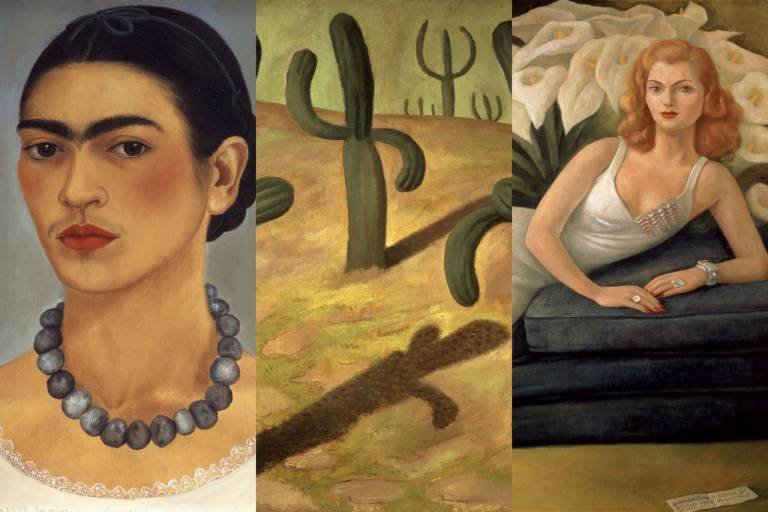
The Gelman couple created three major collections: one of European modern art, comprising 81 works by artists as significant as Renoir, Matisse, Kandinsky, Modigliani, Picasso, Braque, Dalí, Balthus and Miró, which was donated to the Metropolitan Museum of Art in New York in 1998; a second collection of pre-Columbian sculpture; and a third collection of modern Mexican art, made up of more than 90 works, which began with the commission of Natasha’s portrait from Diego Rivera in 1943.
Within the Gelman Collection of modern Mexican art, particular prominence is given to the significant group of 18 works by Frida Kahlo, alongside key works by Diego Rivera, José Clemente Orozco, David Alfaro Siqueiros, Rufino Tamayo, María Izquierdo, Francisco Toledo, Carlos Mérida and Gunther Gerzso, among others.
In addition to their patronage, the Gelman couple maintained a very close relationship with several artists, including Diego Rivera, Frida Kahlo, Rufino Tamayo and Gunther Gerzso, and played a decisive role in the international recognition of modern Mexican art.
Following the death of Jacques Gelman in 1986, Natasha Gelman continued to expand the collection, advised by the American curator Robert R. Littman, whom she appointed as executor of her estate in her will. After Natasha Gelman’s death in 1998, Robert R. Littman established the Vergel Foundation to manage the collection from 1999 onwards and continued to add new works of modern and contemporary Mexican art to the collection. In 2023, the Zambrano family reached an agreement with the Vergel Foundation to acquire the Gelman Collection.
In the last decades, the collection in its entirety, or selected works from it, has been featured in major international exhibitions organised by institutions such as Tate Modern, the Victoria and Albert Museum, the Museo Nacional Centro de Arte Reina Sofía, the National Gallery of Australia, the Nagoya Museum of Art, the Musée national des beaux-arts du Québec, the Art Gallery of Ontario, the Dallas Museum of Art and the Brooklyn Museum of Art.
[ad_2]
Source link