[ad_1]
Art displayed in public transit spaces, especially in subways, has long been a way to enrich riders’ travel, connecting them to a sense of place and community. Most famously, the Moscow Metro, called an “underground palace,” is a museum of Soviet-era 1930s’ design done in marble, exquisite sculptures, mosaics, columns and ornate ceilings hung with lavish chandeliers.
LA Metro’s D Line Art Humanizes Public Spaces

Susan Silton, detail of WE, OUR, US, 2026: Installation view at Wilshire/Fairfax Station, LA Metro.
Courtesy of Metro Art
In the United States, the newest transit art was unveiled on May 8 in Los Angeles with the opening of the 3.92-mile D Line extension. The line connects downtown with Beverly Hills, and soon, Westwood. Vast murals and other works cover concourse and platform areas in three stations: Wilshire/La Brea, Wilshire/Fairfax and Wilshire/La Cienega.
“Public art creates a sense of place,” said Clare Haggarty, LA Metro’s director of public arts and design, in an interview. “It humanizes our public spaces and makes them feel safer. Los Angeles Metro art also helps people find their way on a practical level. It becomes a way to orient yourself.”

Ken Gonzales-Day, detail of “Urban Excavation: Ancestors, Avatars, Bodhisattvas, Buddhas, Casts, Copies, Deities, Figures, Funerary Objects, Gods, Guardians, Mermaids, Metaphors, Mothers, Possessions, Sages, Spirits, Symbols, and Other Objects.” 2026: Installation view at Wilshire/Fairfax Station, LA Metro.
Courtesy of Metro Art
Haggarty notes that the LA Metro is “one of the oldest transit art programs in the United States—we’re 40 years old and we also have one of the largest collections of transit art in the U.S.”
The Wilshire/Fairfax Station Features The Human Touch

Striking art is found throughout the LA Metro system. Pictured: Karl Haendel, detail of “Hands and Things” found at the Wilshire/Fairfax station.
R. Daniel Foster
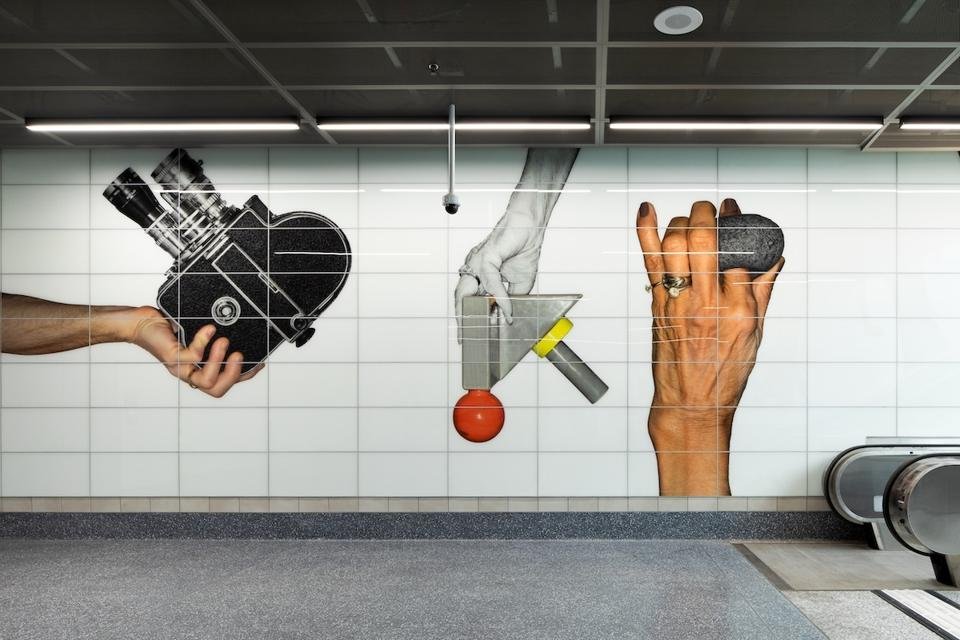
Over 1,400 artists applied to create work for the three stations; nine artists were chosen. Among them, Karl Haendel. His “Hands and Things” installation can be found at the Wilshire/Fairfax station located along the city’s Museum Row.

Karl Haendel, detail of “Hands and Things,” 2026: Installation view at Wilshire/Fairfax Station, LA Metro.
Courtesy of Metro Art
Haendel’s photos, paired with photorealist pencil drawings, are placed above escalators and along the station’s concourse. Hands are shown holding objects, sourced from nearby cultural institutions. Among the objects: a vessel for coffee, a film camera, a Ken doll, a steering wheel and others. There’s a visceral sense of touch about the artwork, especially given that Haendel modeled his hand drawings after those who work and live near the station.
The connection between hands and objects in his work is “spatial and temporal,” he said in a YouTube video about his work. Above the escalators, a hand holds up a copy of Franz Kafka’s novel Amerika, begun in 1911 but never finished. The novel is woven with stories of Kafka’s relatives who emigrated to the U.S.
“I want the art to be experienced quickly and slowly,” Haendel said. “So if you saw it for a couple of seconds, you might say, ‘That’s cool.’ And when you get close, you’d say, ‘Oh, these are hand-drawn because you’ll see all the marks.’”
Much of the artwork in the three stations is mounted using porcelain enameling, fusing a thin layer of glass to steel. Highly durable, the result prevents corrosion, scratching and fading. The gloss of the glass enhances the beauty of the work, and moreover, the material is extremely graffiti-resistant.
Art Deco References At Two Of The Stations

Mark Dean Veca, detail of “Miracle of La Brea,”2026: Installation view at Wilshire/La Brea Station, LA Metro.
Courtesy of Metro Art
The Wilshire/La Cienega Station is a study in blue, white and gray. There, artist Todd Gray has inverted original architectural blueprints of the Saban Theatre for his installation titled, “Mining the Archive: S. Charles Lee, Architect.” Lee designed the classic Art Deco theater, which opened as the Fox Wilshire Theatre in 1930.

Todd Gray, detail of “Mining the Archive: S. Charles Lee, Architect,” 2026: Installation view at Wilshire/La Cienega Station, LA Metro.
Courtesy of Metro Art
Vibrant blues and near-indigo treatments of the renderings are shot through with cultural textile patterns sourced from surrounding neighborhoods. The interweaving of architecture and cloth used in everyday life grounds the work with a felt experience.

Todd Gray, detail of “Mining the Archive: S. Charles Lee, Architect,” 2026: Installation view at Wilshire/La Cienega Station, LA Metro.
Courtesy of LA Metro
Gray said he was “mesmerized” by the Saban Theater, in a YouTube video, given that the historical structure is surrounded by Wilshire Boulevard high rises. Photos from the theater—curtains, fabric, carpet design, doors with ornate framing and etched glass—also cover the subway station walls. Viewing the fields of art, Gray said he hopes riders will feel how much “architecture shapes the culture.”
A Forward-Looking Design For The Wilshire/La Brea Station

Eamon Ore-Giron, detail of “Infinite Landscape: Los Ángeles Para Siempre,” 2026: Installation view at Wilshire/La Brea Station, LA Metro.
Courtesy of LA Metro
Riders at the Wilshire/La Brea station are greeted by a bright array of yellow, mint green and blue—colors found in “Infinite Landscape: Los Angeles Para Siempre” by Eamon Ore-Giron. The artist also references Art Deco buildings along the Wilshire corridor, especially the Deco building, just outside the station at 5207 Wilshire Boulevard. The 1920s structure, which originally housed the Security First National Bank, has a dazzling facade covered with black-and-gold zigzag moderne designs.

Eamon Ore-Girons designs seem to propel LA Metro riders forward on their journey.
R. Daniel Foster
Ore-Giron was taken with the zigzag designs, which “allude to the idea of moving forward and backward at the same time,” he said in a YouTube video about his installation. Horizontal lines and triangles reference the horizon––the converging, single-point orientation of a train track or subway tunnel. The graphic quality of his work, intersected with circles, conveys a feeling of constant movement, forever advancing.
“The work has an ethereal quality,” said Holly Hampton, senior manager, transportation and planning for the Los Angeles County Metropolitan Transportation Authority. “Encountering it during different times of the day, there’s a magical quality that shifts with the light.”
Other artists featured at the three new D Line stations: Mariana Castillo Deball, Ken Gonzales-Day, Soo Kim, Fran Siegel, Susan Silton and Mark Dean Veca.
LA Metro Riders Have Also Been Turned Into Art
While art at the three new stations celebrates Los Angeles’ diversity, LA Metro has furthered that idea with its Portraits of Metro Riders by Local Artists series. Featuring those who frequent the system, the art is found at stations, buses and on TAP cards used to access the system.

Portraits of LA Metro riders are featured throughout the system.
R. Daniel Foster
Among the portraits in the LA Metro Art series is “Traveler,” by Carolyn Castaño. In the work, the portrait of a man is overlaid with airline ephemera and Colombian and Californian flora. The portrait “honors the drifters, explorers, migrants, nomads and tourists” of Los Angeles, according to a statement about the art.
This article was originally published on Forbes.com
[ad_2]
Source link