
[ad_1]
Of This Earth is not a large exhibition but it carves a lively journey through contemporary First Nations ceramics held by the National Gallery of Australia in Canberra.
The first venue for this exhibition’s three-year itinerary throughout regional Australia is Cairns Art Gallery, which is fitting given that the earliest work in the exhibition is by Thancoupie (1937–2011), the first Indigenous woman to be acknowledged internationally as a solo artist working in clay.
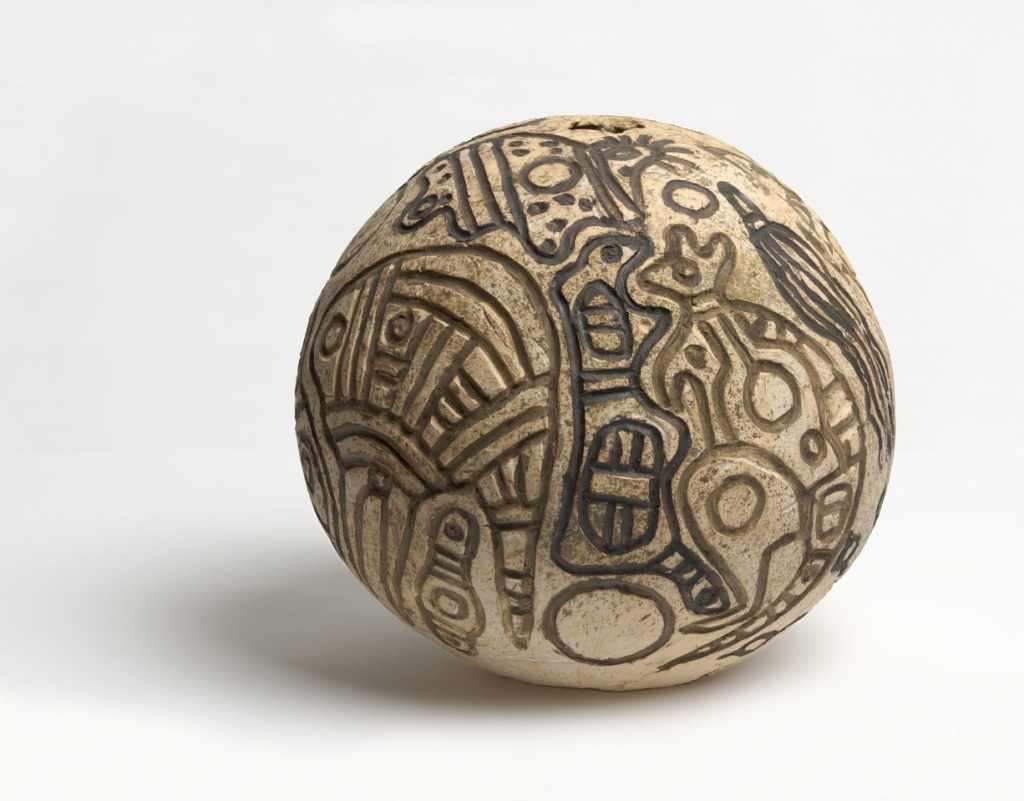
Thancoupie was born in far-north Queensland and practised close to Cairns for much of her life. Moocheth, the Ibis; Arough, the Emu; Golpondon, the Ibis’s Son (1988) is a fine example of her spherical forms. Built by hand this sculptural work is incised with motifs that relate the stories of these local birds.
National Gallery of Australia exhibition curator Tina Baum’s selection of Thancoupie acknowledges the artist’s importance. She said that the ability “to branch out and make a stamp on ceramics saw her creative
practice lead from the 1970s. To have her as the key work and artist in this exhibition was essential”.
From there the selection of works from the NGA collection opens Australia-wide and explores the humour and whimsy, tradition and innovation that ceramics has drawn from First Nations practitioners. For Baum,
(senior curator, First Nations Art) it was important to show “the depth and breadth and experimentation in works from artists in these communities. In some places, it is locally sourced material that’s used. It’s a beautiful
medium for artists to express cultural and historical stories and contemporary expression”.
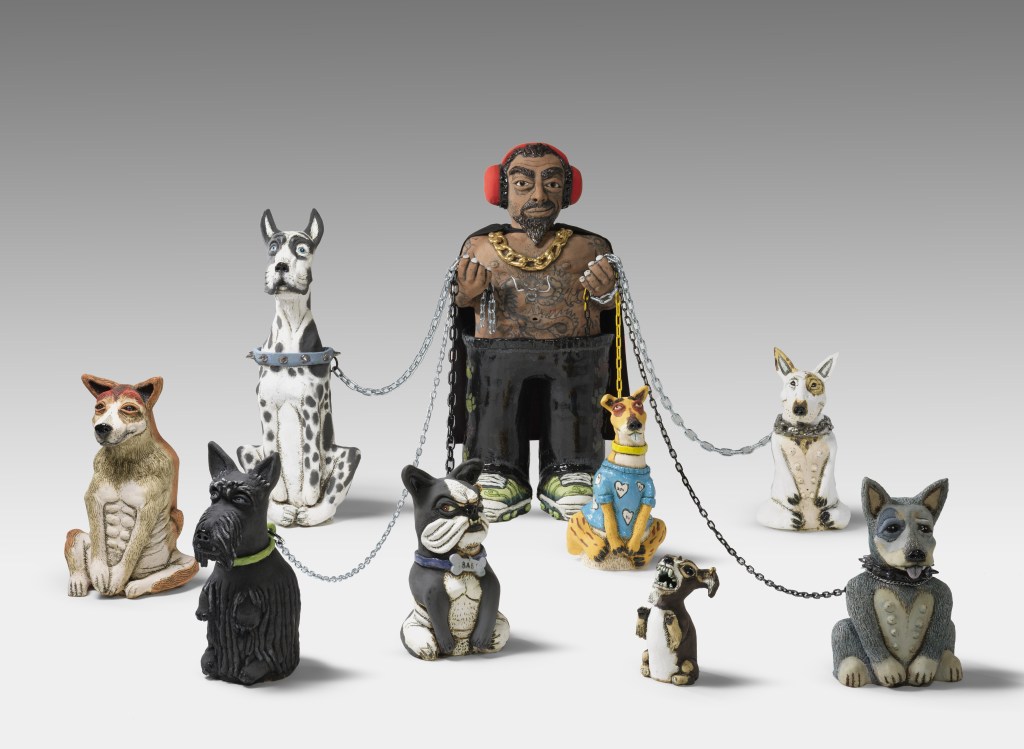
There is variety and surprise. The largest work is Billy Bain’s Dog Walker (Plan B), 2023. A man and a group of dogs look out at the audience. The man is in streetwear, headphones and trainers, with a large gold chain adorning his tattooed chest. Each of these dogs, attached with chains as leads, has personality expressed with markings, size and expression, with the breeds drawing on our knowledge and empathetic connection to
dogs. Yet they exude “tough”. This engaging work and its technical prowess also flags the precarity of art practice, with Bain (a Dharug man) imagining an alternative future (walking dogs) in the event that art-making
becomes unsustainable.
archaeological evidence suggesting that working with clay is a centuries-old cultural practice for First Nations peoples in Australia
Jock Puautjimi’s (born 1962) three pukumani tutini poles, titled Tiwi First Family (2022), are important inclusions that describe the longevity of the production of pottery on the Tiwi Islands, from 1972. These ceramics relate to the beginning of the Tiwi and the forming of ongoing burial traditions and echo an earlier carving tradition, with one of the poles in glazed earthenware featuring a bird at the top of its narrow height. Ochre colours reflected in simple blocked shapes evoke a quiet dignity.
Ceramics have significant longevity, with archaeological evidence suggesting that working with clay is a centuries-old cultural practice for First Nations peoples in Australia. However, more recently, ways of working have emerged differently in particular communities.
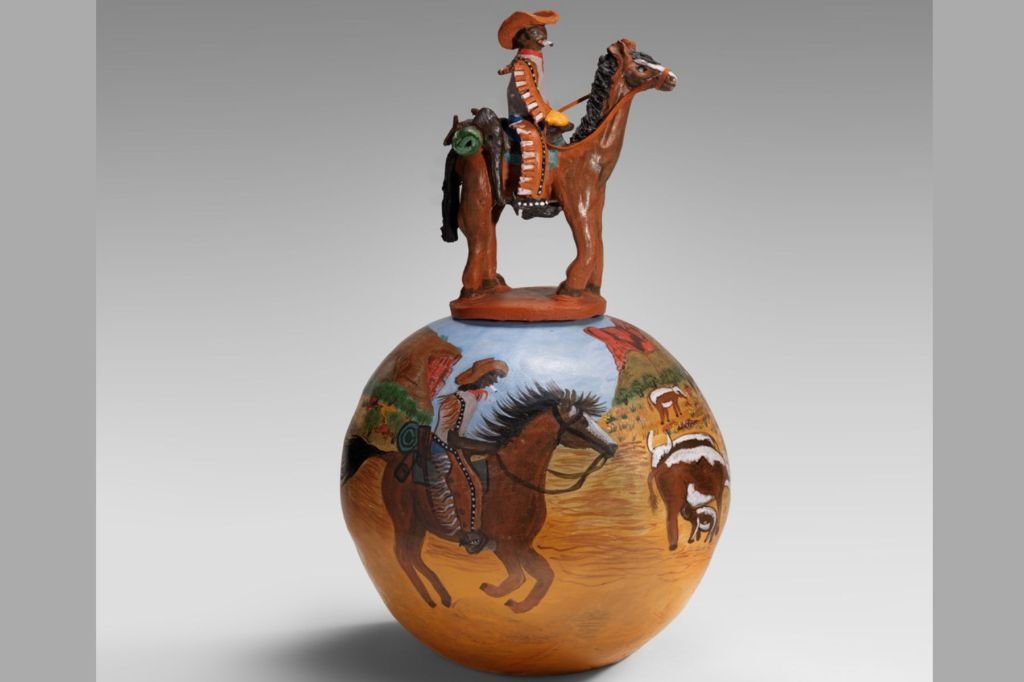
Hermannsburg Potters was established for economic reasons in 1992 by the Western Aranda community. These vessels have a consistent style, hand-coiled with sculptural lids, originally featuring animals or birds and reflecting figurative traditions inspired by Albert Namatjira (1902-1959).
The distinctly contemporary examples selected for Of This Earth contrast with earlier iterations from the same community. The most recent feature superheroes with Black Speed (2023) by Rona Panangka Rubuntja and Ray Mudjandi.
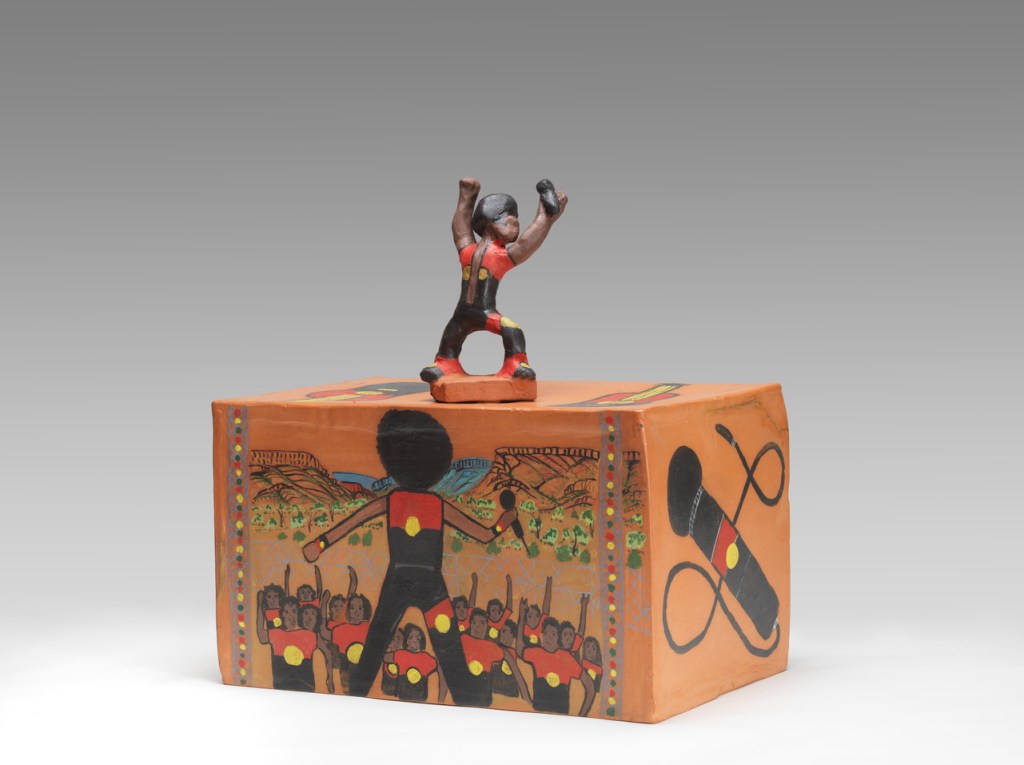
Then there is George Burarrwanga – Warumpi Band by Abel Pareroultja (2022), also evoking cultural shifts. Earlier examples describe previous styles and motifs, with Irene Mbitjana Entata’s Kaltjipuntjila (Baptism), 2007, and an earlier work by Panangka Rubuntja titled Drover, 2009, (a simple figure on a horse) an illustration of this artist’s adaptation to change.
New director of Cairns Art Gallery Angela Goddard notes that the sheer diversity of ceramic practice is one of the main takeaways of the exhibition. Among the many works that she nominates as outstanding is an arm band made by Janet Fieldhouse, who practises in Cairns.
Goddard said Fieldhouses’s Rhythm 2 from series Dance, 2008, in flexible porcelain “is small, almost humble in scale. But I am thinking about the ways that it might relate to a whole world view and understanding built with the body and performance. It carries this huge weight, but in itself, it’s delicate, beautiful and light”.
This exhibition traces a ceramic journey that showcases innovation, humour, colour and story. With 28 First Nations artists included and a tour through four states, it offers wide audiences an opportunity to understand the contemporary influences and innovation so vibrantly illustrated in these explorations of the handmade and the sculptural.
Of This Earth continues at Cairns Art Gallery until June 14.
[ad_2]
Source link

