
[ad_1]
Get the best of Vancouver in your inbox, every Tuesday and Thursday. Sign up for our free newsletter.
Climate catastrophe is everywhere in modern life. Take B.C.: milder winters mean smaller snowpacks, and water restrictions in the summer. Hotter summers can result in tragedies like the 2021 heat dome, which saw at least 619 deaths in the province as well as the extensive wildfires that incinerated Lytton. Forest blazes cover the sky in smoke during the warmer months, while winter sees extreme rainfall that results in floods, mudslides, and entire roads being washed away.
Other parts of the world have it even worse, as a range of tragedies both natural and man-made—habitat destruction, rising sea levels, droughts, storms—threaten lives and livelihood. The world burns, while politicians seem to do nothing but look on and issue fossil fuel subsidies.
But artists have noticed. Future Geographies: Art in the Century of Climate Change, an expansive exhibition opening on May 14 at the Vancouver Art Gallery, considers how artists have responded to the ever-changing state of Planet Earth.
“In my career, I’ve done what I kind of call ‘big question shows’: large group shows that ask the big questions of the day,” says Eva Respini, the Vancouver Art Gallery’s interim co-CEO and curator at large, on a video call. “I did a big show around migration back in 2017-18, which was at a time, especially in Europe, when there was a really heightened sense of thinking about that topic. In the U.S., it was during the first Trump presidency, when there was a lot of activity around the Mexican border. My question was, how did artists help us think through these big topics?”
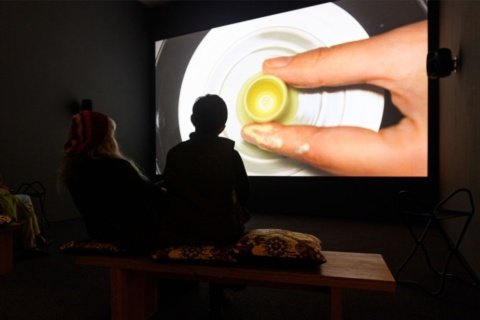
To that end, more than 30 artists are featured in the mammoth exhibition, which sprawls across multiple floors in an uncontainable tangle, including an immersive installation on the fourth floor (SANCTUARY: The Ancient Forest Experience, by Skwxwu7mesh artist and ethnobotanist T’uy’t’tanat Cease Wyss and filmmaker collaborators Damien Gillis and Olivier Leroux), and spreads outside the gallery’s walls with a billboard on East Hastings Street.
While Respini has been kicking around the idea of a climate-themed show for a while, the concept crystallized after she moved to Vancouver in 2023. For one, Greenpeace was founded here; for another, B.C. was largely built off the back of massive resource extraction.
“All of that kind of came together, and I thought, ‘Okay, let’s do this exhibition that really addresses both the local and the global, that helps us ask these questions,’” Respini says. “I wouldn’t say there are really any answers, but it’s how artists help us imagine our future, how they help us think differently, both from the local and the global lens.”

Included in the show are everything from B.C. works (like Hul’q’umi’num and Sylix artist Lawrence Paul Yuxweluptun Lets’lo:tseltun’s painting The Impending Firestorms, and Cree and Metis sculptor Gabrielle L’Hirondelle Hill’s flag made from dried tobacco leaves) to artists who have never shown in Vancouver before.
The exhibition opens with Teresita Fernández’s Island Universe 2, a huge charcoal installation evoking Pangaea, while the show takes its name from Brazilian artist Clarissa Tossin’s Future Geography: Cosmic Cliffs, which weaves together NASA photos of the cosmos with strips of discarded Amazon delivery boxes and marks Tossin’s first exhibition in Canada.
Future Geographies is also presented alongside two partners, the climate journalism publication Canada’s National Observer—which is presenting an online version of the exhibition, including original essays and videos—and UBC’s Climate Action Lab, which asked students to create videos reflecting on four themes that appear within the exhibition space itself. The result is the largest contemporary art show to date in Canada about climate change.

“It’s the biggest on this scale,” Respini says. “It’s a topic so big that I think we should have 15 shows about this, and we wouldn’t even begin to scratch the surface.”
To help visitors navigate the exhibition, it is split into four distinct chapters. First up is Living Knowledge, which considers mediums or knowledge that are sustainable. Firelei Baez’s Unbound (one way ashore, a thousand channels) deconstructs colonial-era maps she has responded to, while Carolina Caycedo (who has Colombian ancestry) reconfigures fishing nets gathered from Central American communities into ethereal hanging sculptures.

Next is Consumed Earth, which considers the parallel perils of extraction and extinction. Ghanian-British artist John Akomfrah’s video installation Vertigo Sea montages footage from across time to create a meditation on how the fishing industry has polluted the ocean, and LaToya Ruby Frazier’s Flint Is Family In Three Acts considers the crisis of Flint, Michigan’s toxic drinking water.

“This is the section that deals most with ideas around extinction, around our footprint on the planet,” Respini explains. It’s also where Yuxweluptun’s mammoth renditions of Okanagan forest fires sit. “I call them history paintings of our time… They’re about our moment, rendered in the realm of painting.”
Next on the journey is Speculative Worlds: a section for artists that are considering different views of the future, be it Indigenous futurism or solar-punk optimism. Abbas Akhavan, the artist representing Canada at this year’s Venice Biennale, has a touchstone piece in a large sculpture that pairs natural elements with a green screen—suggesting that nature might one day only be accessible in mediated, structured experiences.
Finally, the show ends with Material Memory. The final chapter is all about repurposing elements—reducing, reusing, and recycling through the lens of artistic medium. Take Brian Jungen’s Cetology, a whale skeleton made entirely from plastic patio chairs; or Jean Shin’s futuristic Huddled Masses, forging a digital philosopher’s garden out of obsolete cell phones and computer cables.

“It ends on perhaps a more hopeful note,” Respini suggests, “or a note around recuperation, and even a sense of healing.”
To that end, the show acts as a catalyst for the gallery itself to consider how to be more sustainable—both as an institution and also art as a field more broadly.
Future Geographies eschews air shipments of works for the show, and uses a lot of works from the gallery’s own collection as well as from local artists to help reduce transit emissions. The exhibition space itself also came under scrutiny, with labels going on cardboard mounts, walls being reused from previous shows, and plans to donate all extra materials after teardown to a local lumber reuse centre. Even the paints for signage were chosen to be as environmentally friendly as possible.
“This is, in a way, a testing ground,” Respini adds. “These are the kind of conversations we’re having that I think could be really fruitful as we go forwards.”
The overall tone of the show is not didactic but imaginative: not a vessel to teach or scold, but to ponder, speculate, or invent.
“Artists are not scientists, they’re not journalists,” Respini reflects, “but they do have a role to play in how we might imagine our shared future on this planet.”
When wondering what the world could be like, who better to ask than artists?
Future Geographies: Art in the Century of Climate Change runs from May 14 to January 10 at Vancouver Art Gallery.
[ad_2]
Source link