
[ad_1]
Chicago-born and raised muralist Robert Valadez remembers the song “Cult of Personality,” a 1988 single from the band Living Colour. “In the song, they say ‘Only you can set you free,’” Valadez said while taking a break, slightly stained from painting the side of CocoBar restaurant on the Chicago Riverwalk at Wabash and Wacker in late April.
The song is an examination of so-called leaders in society who shape the minds of the masses, with lyrics like “I exploit you, still you love me.” It critiques how individuals can use their power to manipulate the masses.
Valadez offered the song as an analogy about news of the Latino civil rights leader Cesar Chavez. The cofounder of the United Farm Workers (UFW) union allegedly abused women and girls for years as a leader in the labor movement, according to first-person accounts in a New York Times investigation published in March.
In 2017, Valadez was commissioned to restore a mural at the Self-Help Federal Credit Union building in Little Village, originally painted by another artist in the 80s. The bank recently called him to paint over the depiction of Chavez in the mural, in light of the allegations, and he will soon revitalize it with a portrait of Dolores Huerta.

Credit: Kirk Williamson
Huerta, who also cofounded the UFW union, was among several women who recently shed light on the years of abuse they experienced at the hands of Chavez during the movement to better conditions and wages for farm workers in the 1960s and ’70s.
“I admire her greatly,” Valadez said of Huerta. “But again, she’s just a human being.”
Valadez’s words reflect broader conversations being held within Latine arts and organizing spaces, where Chavez was highly celebrated, as the community works to heal and move forward. The intersection of labor and immigrant rights is a large part of Chicago’s identity, which makes the news about Chavez especially tragic to the city’s arts and organizing spaces.
Arise Chicago, a faith-based organization, was founded in 1991 to advance workers’ rights and dignity through unionizing. The group’s work is informed by the labor movement, including the UFW movement, according to executive director Laura Garza.
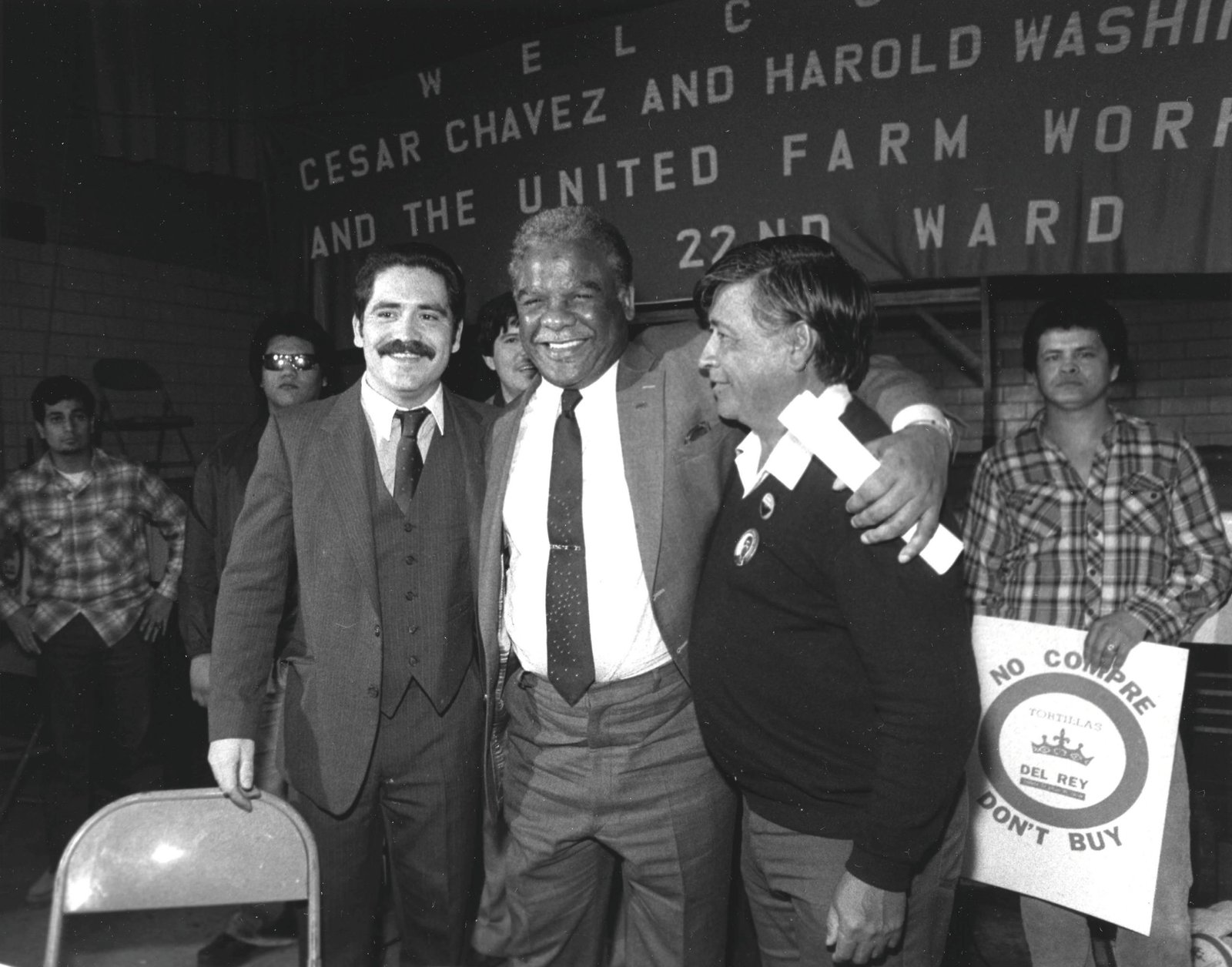
Garza grew up during the UFW movement, having volunteered with the group in 1993 at 19 years old. She recalled a picture she took with Chavez during his visit to the National Museum of Mexican Art (NMMA) in Pilsen that year; she had long had the picture posted in her office and her home.
“I came home and basically took it down. I couldn’t even bear to see it,” Garza said. “And it’s still gonna remain down.”
Garza said Arise held space for its members, who are largely low-wage immigrant workers, to express their thoughts and concerns on National Farm Workers Day on March 31, both in person and on a Facebook livestream.
“People are afraid, especially when you’re an immigrant worker, you’re not going to come forward, especially in these times, right?” said Garza, sharing details from that conversation. “It’s so much that we have to swallow and keep our mouths shut. And we just can’t afford to do that anymore. We can’t afford to do it in our labor movement. We can’t afford to do it in our not-for-profits—we can’t. We have got to do better, and we got to hold people accountable.”

Courtesy Ross Barney Architects
In the nearly two months since the earth-shattering news about Chavez’s sexual abuse of women and girls, several entities honoring Chavez are undergoing name changes. Neighbors were given a chance to rename Cesar E. Chavez Multicultural Academic Center, an elementary school in Back of the Yards. Chavez’s image was removed from a mural in Pilsen, and the Chicago post office, named for him at 1859 S. Ashland, will also be renamed by local high school students through an effort by Congressman Jesús “Chuy” García.
The unveiling of the allegations of sexual abuse at the hands of the revered leader struck a nerve in Dulce María Díaz. The visual artist and founder of S.H.E Gallery, an education nonprofit, says this moment has been one of reckoning and reflection.
“I feel so many emotions, and I thought so many thoughts. I still think about mostly compassion, of what it’s been like holding something like that in,” said Díaz, referring to Huerta. “Maybe she thought she was going to take [that] to her grave—and letting it out of her chest, that must have been extremely hard and liberating.”
Late last year, Díaz was commissioned to paint murals as part of a project for Little Village Lawndale High School, “which upholds activism,” she said. She originally was going to include Chavez’s image in the work, but ultimately decided not to; instead, she featured the emblem for the slogan “Sí, se puede,” adopted by Huerta and Chavez as a rallying cry during the farm workers’ struggle.
“I felt like that was enough recognition to their [United Farm Workers] work. And instead of adding his face, I added a big black panther,” Daz said. Though Díaz worked on the piece before Chavez’s sexual abuse allegations were brought to light, her decision is a reflection of how some in Chicago’s arts community are feeling when it comes to how artists should capture political and historical moments.
Along with the wide cultural impact, the allegations are personal for Garza and Díaz, who know firsthand what it’s like to be survivors of domestic and sexual abuse.
“It actually took me back to my own story, and telling my own story when I was a teenager, and having the courage to tell my mom what had happened to me,” Garza said. After learning of the news about Chavez’s sexual abuse, Garza created a support group that included friends she made during her volunteering experience in Texas. She said she and members of the group joined a Zoom call to discuss the allegations.
“There’s still a lot of conversations that need to happen with our community, and those conversations are happening in different spaces,” Garza said.

Courtesy Self-Help Federal Credit Union
As these allegations are coming to light decades after they occurred, Elizabeth Mumford, a senior fellow at NORC at the University of Chicago, whose work involves research on interpersonal abuse and violence, explained the various barriers that can keep victims from coming forward based on published research.
“The fact that some of these allegations are coming forward now is not so surprising, because there are a lot of barriers,” Mumford said. “They might be afraid of being believed. They might be afraid that they will be blamed. They might feel like they hold some responsibility for some of this.”
Mumford said the Chavez case, specifically, includes multiple factors that could be heightened, making it even more difficult to discuss, given his position in a movement to improve people’s lives.
“There can be a lot of social pressure in this case in particular,” Mumford explained. “It’s not a stretch for some people to feel like the social pressure isn’t just about their immediate social setting, but they may feel like it’s a broader social cause, a group, a social tribe of people, what Cesar Chavez represented—that could feel like pressure too.”
“I have a feeling that our artistic community will find a way to express the new views towards Cesar Chavez in a way that is honest.”
NMMA curator Cesáreo Moreno
Cesáreo Moreno, director of visual arts and chief curator for NMMA, said that, though it’s too early to tell what will come of this revelation, he has faith in the arts community to keep history alive while also reevaluating it with a new lens.
A vest Chavez wore during a 1993 speech in Chicago, which hung in the NMMA, has been removed. Moreno said he made the call to remove the memorabilia from the museum’s floor after learning of Huerta’s experience and informing other directors at the institution. Moreno said the exhibition was closed for two weeks, and signage was posted explaining that the closure was due to the allegations about Chavez’s abuse.
Moreno added that the more than 20,000 works of art in the museum’s collection should be preserved, rather than destroyed, to inform future generations and prevent the same mistakes.

Credit: Les Lee/Express/Hulton Archive/Getty Images
“Someone said, almost jokingly, that for this year’s Day of the Dead, that we should maybe do an altar to the second death of Cesar Chavez,” Moreno said. “It touches on this idea of the death of a hero. I have a feeling that our artistic community will find a way to express the new views towards Cesar Chavez in a way that is honest.”
Paintings from artist Pamela Enriquez-Courts have since replaced the Chavez memorabilia at the NMMA. Moreno searched the institution’s storage for a replacement that would flow into the museum’s political section. He said the two paintings have to do more broadly with immigration and the border.
The decision to use artworks that more broadly depict immigration work is a shift that Moreno said he expects to see more of.
“We love heroes, right? We love to put a face on a movement, and maybe we love doing that because it makes it easier to teach,” Moreno speculated. “It makes it easier for them to envision and imagine and learn from and remember. And so oftentimes an individual becomes an icon, or becomes a symbol of something that’s great.”
“You don’t want to put your heroes on a pedestal. You know, we’re all made of clay.”
artist Robert Valadez
Reflecting on an exhibit he worked on with Maria Varela, who was an organizer with the youth-led Student Nonviolent Coordinating Committee of the 1960s, Moreno remembers learning the importance of centering the “faceless” who fight in the struggle.
“I was picking out a few photographs that included Martin Luther King and included some of the other heroes of that movement. And she’s the one that told me, she’s like, ‘I don’t want you to use those photos,’” Moreno remembered. “We all know that movements are made by many faceless individuals, nameless people, who take up the cause. Those people are rarely remembered. Those people are rarely memorialized.”
For Nicholas Zepeda, a Chicago artist and arts administrator, spending time at the Second Floor Gallery, a queer Latine arts space in Back of the Yards, has been cathartic. Zepeda said the gallery has been holding space for the community to come together during this time.
Zepeda sees the allegations coming to light as a part of a cycle when it comes to powerful men using their roles to abuse and manipulate. They hope the bravery of the women who spoke out against Chavez can prevent further harm today.
“I feel like fixating on Cesar Chavez as the one person that has this new kind of insurmountable evil that has to be addressed—I feel like staying there too long is where we kind of forget that it’s still happening right now,” Zepeda said. “People call out a man in the Chicago art scene like once a week on Instagram, and I feel like nothing really happens, and nothing really happens to those men involved.”
Such concerns focus on the real-world impact of calling out perpetrators, which often results in little or no accountability, according to Mumford.
“There’s a lot of attention, and there’s some strength in numbers, if more than one person comes out of the woodwork and accuses an alleged perpetrator. Then people may start to say, ‘Yeah, me too,’” Mumford said. “But there’s legal research that shows that [people speaking up] is not necessarily translating into accountability for these perpetrators.”
“Cesar Chavez is just a man,” were the powerful words spoken by Esmeralda Lopez, recounting her experience with Chavez, who tried to use his status to bribe her into sleeping with him. Grappling with these allegations while still honoring the movement is a battle the community is navigating at this moment.
“I like to think that the movement, for people of color and the Latino community, is bigger than any one individual, certainly bigger than Chavez,” Valadez said. “So the struggle continues, the movement continues without him, but that’s the way things go. You don’t want to put your heroes on a pedestal. You know, we’re all made of clay.”
Reader Recommends: ARTS & CULTURE
What’s now and what’s next in visual arts, architecture, literature, and more.

In their joint exhibition, artists Mike Cloud and Nyeema Morgan prompt us to reflect on how narratives are constructed and circulated.

Works by Nordic artist Sofia Hagström Møller light up the Swedish American Museum for its 50th anniversary.

This season, exhibitions in Chicago provide canopy cover from the chaos of infinite wars.

Will Quam’s new book shows that the story of brick and the story of Chicago are forever intertwined.

John A. Knudsen fashioned a visual symphony of simultaneous urban motion.

Critic Pia Singh surveys the scene at EXPO Chicago and beyond.
[ad_2]
Source link