[ad_1]
Unlock the Editor’s Digest for free
Roula Khalaf, Editor of the FT, selects her favourite stories in this weekly newsletter.
Around the middle of the 7th century, during the Tang dynasty, a new form of Chinese landscape painting began to emerge. Known as ink-wash painting, this idiosyncratic style placed great emphasis on feeling and emotion. Colour and detail were replaced by broad, monochromatic and virtuosic brushstrokes, and it marked a move away from a representation rooted in realism towards something more impressionistic. Usually based on the imaginary, as opposed to seeking to replicate the real world, ink-wash painting sought to capture the essence, or spirit, of a landscape. The physical world was deconstructed, only to be reconstructed through the eyes and hands of the artist. It is through this lens that Taiwanese artist Wu Chia Yun seems to look upon the world and, specifically, her homeland. Through the use of video, installation, printmaking, drawing and photography, Wu creates a vocabulary in which she seeks to peel back the layers of her identity.
“My practice began with filmmaking,” Wu tells me. “I have always been fascinated by the ‘empty shots’ in cinema, as they appear neutral yet are capable of shaping perception through their sequencing and editing. In a similar way, I layer still, empty shots with photos of my family, created through scanning and rephotographing, in order to construct fragmented and abstract emotions into a coherent structure.”
Wu will have two bodies of work on show at the UP Gallery stand at Photo London: mother-land (2024) and A Song for Loss (2020). Both projects explore family and statehood. “Issues of Taiwan and national identity were not topics I initially intended to explore,” Wu says. “However, once that chaotic yet yearning door is opened, family and nation naturally become inescapable questions in my life.”


Family and nation. For Wu there is a precariousness to both. Taiwan’s existence as a sovereign country is disputed — only 12 other countries recognise it as an independent state — and China considers it no more than a breakaway province. As an island, it is by its very nature isolated, battered by typhoons from the east. Most inhabitants live on the west side, within touching distance of mainland China.
How our personal and national sense of self is formed can be a complicated, nuanced and changeable thing. The layering of images in Wu’s work hints at this. Peel back one photograph and there is another, under the skin of one image lies something else. Water is a recurring theme, something fluid and changeable, calm yet destructive. In the portraits of Wu’s parents, the sun sends blinding reflections off the surface of the ocean, dancing around the face of her father as he stands alone in a field. In the backlit portrait of Wu’s mother, water droplets sit like fallen tears on top of her face, obscured by shadow.


“I am very close to my parents,” says Wu. “Yet something has long separated them [from each other], and my life has always unfolded within this contradiction. My mother often stays at home. Whenever I am about to develop a roll of film but have not finished shooting it, I photograph her, and this image is the last frame of that roll. My father is almost always away, yet he always travels great distances to visit me abroad, and I often take him to see landscapes.”
Within Wu’s work, we can sense the reaching hand of China. “Questions of independence, identity and territory never have clear answers,” Wu says of mother-land. “This lonely island is surrounded by the ocean, waves and tears, where the image of water has become a symbol of fluidity, unsettlement and confusion.”
The colour red, so synonymous with China, bleeds into a number of images. Exploding over a firework, spreading out in a circle like a gunshot wound or simply encroaching from the edges, the symbolism is clear. In one image, nearly the whole frame is taken up by this redness, the people in the photograph squished into the bottom quarter of the picture.

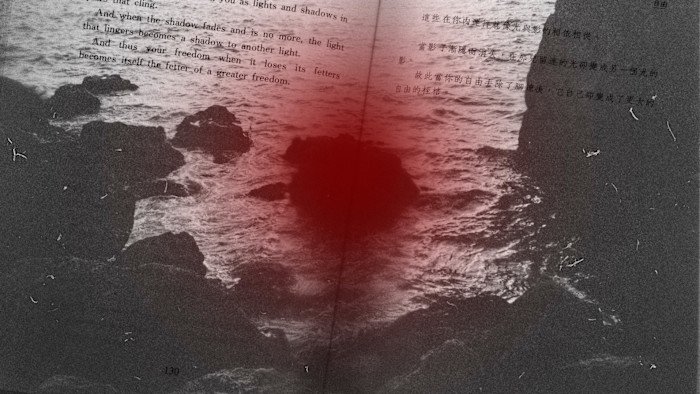
These things move within you as lights and shadows
in pairs that cling.
And when the shadow fades and is no more, the light
that lingers becomes a shadow to another light.
And thus your freedom when it loses its fetters
becomes itself the fetter of a greater freedom.
This verse from Kahlil Gibran’s The Prophet, which appears overlaid on an image of Taiwan’s rocky coastline, asks what it means to be free. Is there always a force hanging over us, gripping us and restricting us, whether real or imagined? How does a people, a nation, an island, step out of the shadow cast by an all-powerful neighbour? Is such a thing possible? Is it desirable even? Might not one restrictive power simply be replaced by another? These kinds of questions and contradictions seem to permeate Wu’s work. Light and dark, water and rocks, freedom and captivity all sit side-by-side.
“I want to dream, but not sleep / I want to walk, but without feet” the Taiwanese poet Ling Yu wrote in her book Daughters (2022, English 2025). Whether through writing, ink-wash paintings or film and photography, depictions of the landscape have, for thousands of years in Chinese art, been viewed as mirrors to the soul.
Wu Chia Yun’s work will be on display at the UP Gallery stand at Photo London, May 14-17
Find out about our latest stories first — follow FT Weekend Magazine on X and FT Weekend on Instagram
[ad_2]
Source link