[ad_1]
On the birth anniversary of Rabindranath Tagore, Shreya Chaudhuri revisits the bard’s artistic legacy through an immersive portrait of his life and work.
The multi-hyphenate Rabindranath Tagore (1861-1941) occupies a deified status by virtue of his prolific output that could run into infinite pages, if quantified. A renowned poet, author, playwright, composer, philosopher and cultural reformer, Tagore has worn multiple hats in the course of his lifetime. A lot of us know that the Nobel Laureate began dabbling in painting at the ripe age of 63, but most who celebrate his life and legacy, are oblivious about his genius as an artist.

Tagore’s epiphanic burst into the realm of visual art, in his ripe sixties, has been a subject of immense scrutiny and speculation, especially for art connoisseurs.
His initiation into art
Rabindranath Tagore’s career as a practising artist spanned about 17 years. His initiation into the world of art began with doodling on his working manuscripts and rough copies of his written works.
It was in 1924, when he was writing Purabi, a collection of 52 poems and songs; that Tagore started doodling on the pages of his book. Doodling is a free-form drawing that lacks deliberate intention but transforms scribbles, lines or shapes into intricate and complex artworks. While scribbling, Tagore crossed out and covered the discarded margins of the pages and written lines with a varied rhythmic poise that often took a dramatic veering, at times into a bird, a flower, an animal or some imaginary creature.
Over time, Tagore’s doodles, with an inter-play of both beauty and the grotesque, came to acquire greater eloquence and articulation as they traversed beyond just a decorative element in the erasures of his manuscripts. Art historian and critic, R. Siva Kumar, who has heavily researched Rabindranath Tagore’s artistic trajectory, noted that among his later manuscripts, doodles are seen in drafts of Raktakarabi (1923-24), Tapati (1929) and Banashree (1933) among his plays, and Jogajog (1928), Shesher Kobita (1928), Dui Bon (1932-33) and Malancha (1933) among his novels but the most complex doodles were seen in the working manuscripts of his poems. In most of Tagore’s later manuscripts, however, the text is completely swamped beneath his scribbles, much like gushing water let out of his mental floodgates, harbingering the arrival of the painter and his painterly renditions. His visual vocabulary
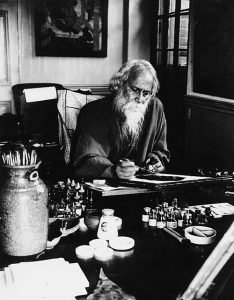
Without any formal training in art, Tagore charted his own course in the world of art, carving his own individual artistic style. Tagore has to his credit, a robust body of work comprising over 2500 paintings, many of which are preserved at Vishwa-Bharati University, Santiniketan and the National Gallery of Modern Art, New Delhi, many of which have been widely exhibited across India, Europe and Asia.
Tagore’s portraits, a recurrent subject in his oeuvre, dwell on the exploration of the human face, most often female head and figures, delving into the depths of emotion, suffering, and psychological complexities. His portraits are deeply intertwined with the lives of people who were closest to him. Paintings of these innumerable faces unveil a gamut of emotions ranging from mysterious, ominous, dramatic, sombre and at times, romantic. His portraits, more often than not, gaze at the viewer bearing profuse psychological conflict. Tagore used a restricted palette of colours, often watercolours and pastels in a mix of dark and light shades. This, coupled with the technique of simplistic use of lines sets the stage for a labyrinthine imagination in the eyes of the beholder. Many of his drawings and ink paintings were made using brushes, rags, cotton wool and also his fingertips. Personal tragedies and his lived experiences infused powerful pathos in his work. Tagore suffered many early bereavements in his lifetime, many of which were in quick succession. His mother, Sharada Devi passed away when he was only 14 years of age, his childhood confidante, muse and sister-in-law Kadambari Devi died by suicide when he was 22 years old. This episode broke him into smithereens. This was followed by the death of his wife, Mrinalini Devi in 1902, his daughter’s premature passing in 1903, his father’s demise in 1905 and eventually his youngest son who died of cholera in 1907 at the age of 13.
 Tagore’s visual language stemmed from his mental anguish and agonised realities, allowing his inner world to guide his paintbrush. Through his landscape paintings, his mystical search for the invincible quality of nature found expression. His landscapes are usually hinged on a threshold between day and night bearing a brooding sense of melancholy. Twilight and dusk seemed to have enraptured this modernist artist’s senses. Dark, edgy foregrounding of most of the artworks with billowing yet brooding trees, and panoramic horizons set the tone for most of his landscape renditions.
Catalyst and stimuli
Tagore was immensely influenced by Expressionism in European art, Japanese art, and primitive art of ancient cultures allured him as well. His cross-cultural encounters and visits abroad played a role in his elevated pictorial language. By incorporating these motifs, leitmotifs and styles, he created works that were ‘universal’, free from the shackles and barriers of language used in his writings, poems and songs. He never titled nor dated any of his paintings or artworks. He left them open-ended for the spectator to derive meanings and make boundless interpretations of his work. Surprisingly, for a man who surrendered himself to the written word and the textual world, he never chose to give a name to his artworks.
Tagore once said, “People often ask me about the meaning of my pictures. I remain silent even as my pictures are. It is for them to express and not to explain. They have nothing ulterior behind their own appearance for the thoughts to explore and words to describe, and that appearance carries its ultimate worth.”
Rabindranath Tagore’s search for a new language of expression was channeled through his art, perhaps to articulate something that remained unsaid in his verses.
All images sourced from: Wiki Commons
[ad_2]
Source link