[ad_1]
Within an hour of meeting her now-husband, photographer Tamara Reynolds learned something that would shape five years of her work — he told her he was Melungeon.
She knew the term from the stigma associated with the community, but had never personally met a descendant of the lineage.
The term “Melungeon” defies easy definition. Often described as a mix of African, Native American and European ancestry, it’s an identity shaped as much by discrimination and folklore as genealogy. For Reynolds, this ambiguity became less a question to answer than a reality to photograph.
“The United States is known as a melting pot,” Reynolds tells the Scene. “Coming off the first term of Trump, a lot of nationalism and white supremacy was being discussed. I thought it would be a worthy project to reevaluate what this country is really made of.”
What began as a quest to document any remaining Melungeon people in Sneedville, Tenn. — a small town in northeast Tennessee that’s often considered the epicenter of the group — gradually shifted to a personal focus. Living intermittently in Sneedville with a camera and a camper purchased with Guggenheim Fellowship funds, Reynolds shifted her perspective to an exploration of loss, belonging and the humanity of a group of people who resist labels of Black, white or anything in between.
In late April, a group of women gathered around a fire in an East Nashville backyard. They passed around chocolate cupcakes, wine and Topo Chi…
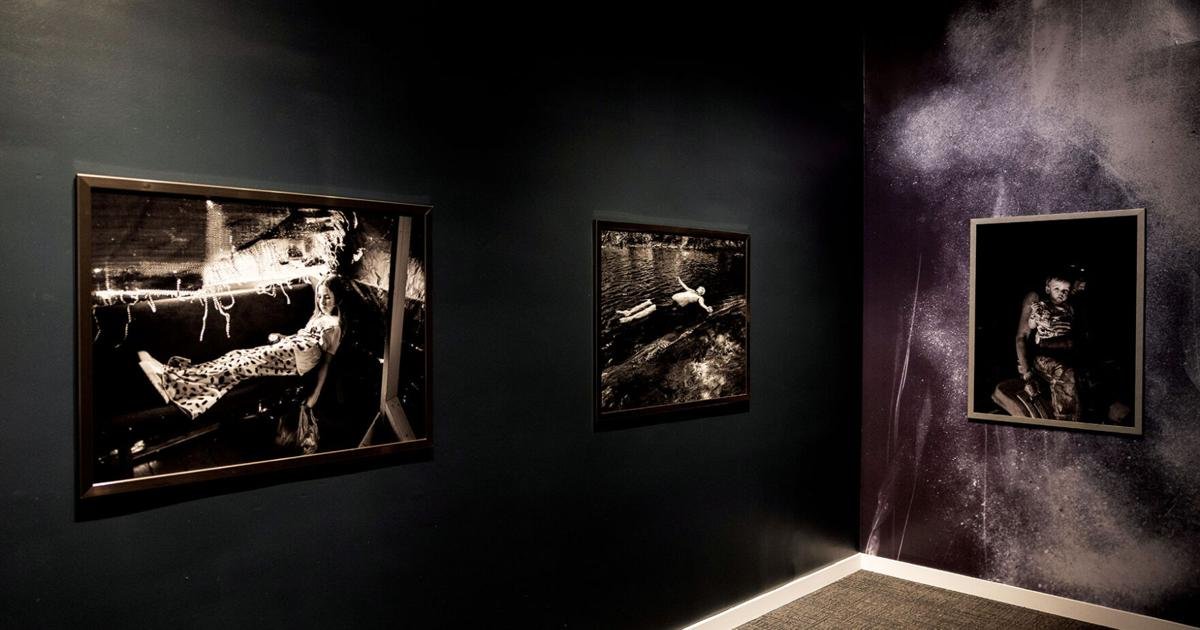
Her five-year project, Melungeon, is on view through June 26 at Vanderbilt University’s Begonia Labs.
Nestled in the valley below the slopes of Newman’s Ridge, Sneedville sits at the end of winding roads through hilltops and hollows along the isolated Appalachian Mountains, an environment shaped by rugged terrain and a complex history.
Today, the exact number of Melungeons living in Sneedville remains uncertain. Because Melungeon isn’t a recognized race or ethnic category in the U.S. Census, determining the group’s ancestry often relies on surnames and generations of inconsistent racial classification.
When white settlers arrived in the late 1700s, people believed to be of mixed ancestry fell under the broad label “free persons of color,” a designation contributing to their marginalization and geographic isolation along Newman’s Ridge. Over time, isolation gave rise to speculation and myth surrounding the community.
History’s scars are present in Reynolds’ photographs. Her subjects linger in doorways, their eyes not quite meeting the camera. From conversations with her husband, Reynolds knew long before arriving in Sneedville that her identity as an outsider with a camera would complicate her documentation.
“I was glad she wanted to do it, but I had a little apprehension,” says Mike Goins, Reynolds’ husband, who grew up near Sneedville. “I didn’t want her to piss them people off down there,” he adds wryly.

As she built trust with the locals over the years, Reynolds gained access to private moments. That intimacy appears most clearly in photographs of Aibrianna, a young girl who “became the protagonist of the body of work,” Reynolds says.
Aibrianna was the first Sneedville resident Reynolds met — it was shortly after the girl and her sisters lost their mother. Reynolds found her during her own period of grieving for her sister, who had also recently died.
“In a sense, she’s a stand-in for me,” Reynolds says. “There was this sense of loss of witnesses to my life. Maybe I was finding a kind of surrogate family, and she was my surrogate.”
Aibrianna’s family does not identify as Melungeon, though surnames in her family history suggest possible ties to Melungeon lineage.
In one photo, Aibrianna slips underwater. She stretches out her arms, one eye winking as she struggles to keep the other open. Her mouth parts in a half-smile, and her pale skin glistens against the deep blackness of the water.
Next, she’s on dry land, covered in water droplets. She clutches her stomach for warmth and looks into the camera sideways with an uncertain expression.
Reynolds’ photographs look closely at subjects who are often overlooked
These images hold Aibrianna in a space between states of childhood innocence and loss, belonging and isolation, reflecting uncertainty surrounding identity in a place where it cannot be named in easy terms.
“My work may be considered documentary, but there is so much of the personal that is tucked in there,” says Reynolds. “I am just moving through the world like this. I happen to be taking people along with me.”
The exhibition gives voice to a place whose loss, exploitation and resilience often go untold to outsiders. For Reynolds, this lack of testimony brought urgency to her photos, both on and off view.
“There is one photo I would love to use,” she says. “I don’t know if it’ll ever be used, but it’s a letter Aibrianna’s mother wrote to them … and they had it pasted to the wall, and I had to photograph it.
“I think sometimes I photograph things so they won’t go away,” she continues. “I’ve photographed a lot of things people will never see, but it’s been photographed,” she says, her voice catching slightly.
She steadies herself and adds: “Anyway, that’s why I’m a photographer. I photograph because I feel.”
[ad_2]
Source link