
[ad_1]
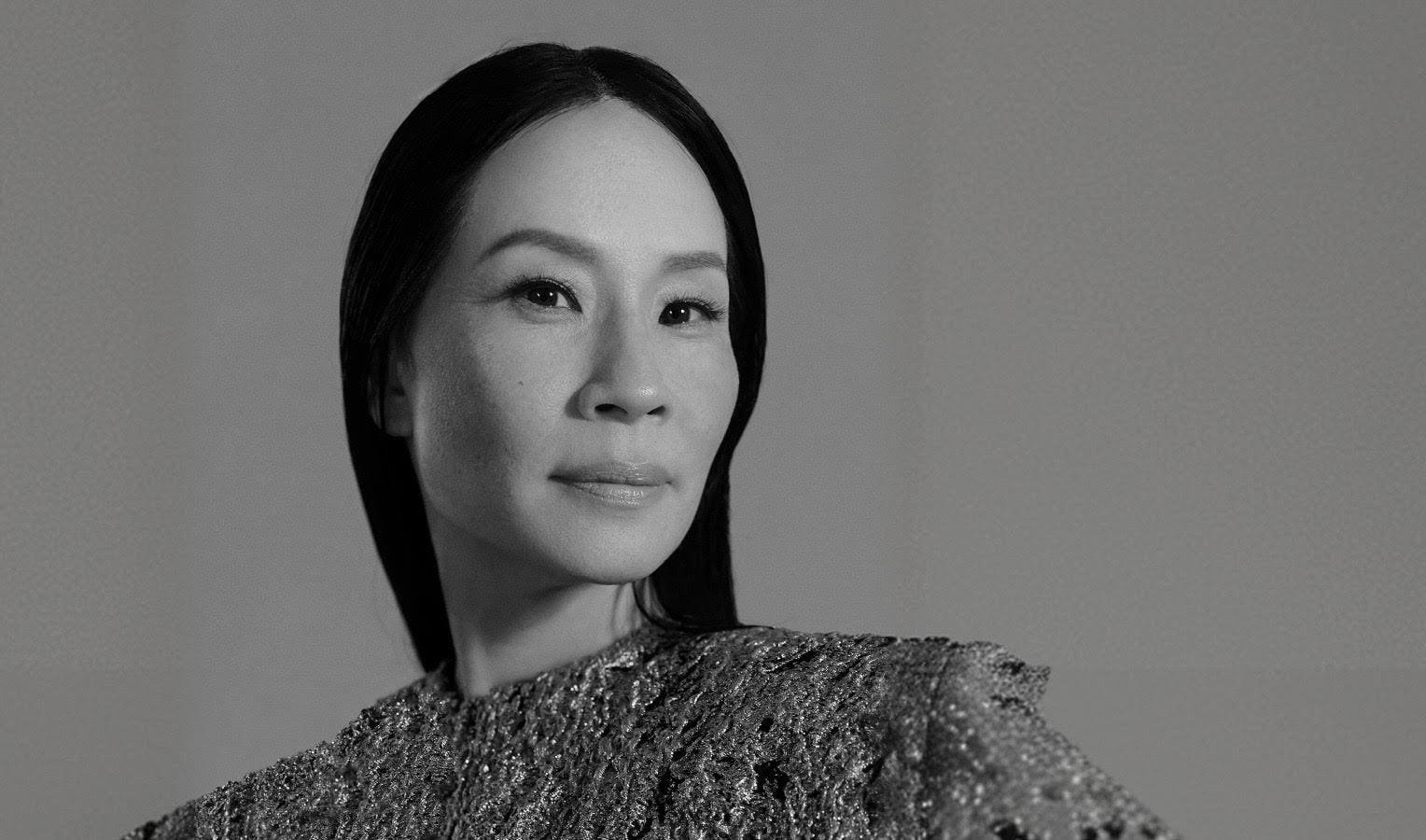
Memory is a living thing. If you’ve sat with an old photograph long enough, you know this. What you remember about the moment it captured changes depending on who you’ve become since. Lucy Liu has spent the better part of a decade making paintings within this gap: between what a photograph shows and what a memory holds, between the family that posed and the one she actually grew up in. It’s a tension that anchors Hard Feelings, her current exhibition at Alisan Fine Arts in New York through June 6th.
At the center of the exhibition is her ongoing what was series, which began in 2017 following the death of her father, Tom Liu. Returning to an archive of family photographs with grief and questions, Liu began making paintings that do not reproduce those images so much as move through them. They layer, obscure, and reimagine what was there until what remains is feeling, not documentation.
Liu is, depending on when you encountered her, an actress, a painter, a sculptor, a collagist—a woman who has made her name across disciplines. Hard Feelings, is, by her own account, the most honest thing she has made. The paintings evolve across distinct phases. Earlier works obscure the original image through loose, expressive brushstrokes, allowing it to dissolve into layered gestures. In more recent pieces, a sharper, more defined visual language emerges, with figures—particularly her parents—outlined and held within the composition.
We spoke with Liu about the work, the process, and what it means to bring something so personal into public view.
Natalie Stoclet: You’ve built a career across multiple disciplines. How does being a multi-hyphenate shape the way you approach your artwork today?
Lucy Liu: I think moving between disciplines has always given me a kind of freedom. Acting is very collaborative—there’s a script, a director, a structure you’re stepping into. Visual art is where I can be completely autonomous.
Lucy Liu at Alisan Fine Arts New York
Because of that contrast, I don’t feel the need to explain the work in the same way. I can let it be more intuitive, more internal. Being a multi-hyphenate isn’t about doing many things—it’s about understanding where each form allows you to say something different, or maybe something you can’t say anywhere else.
NS: You’re working from photographs, and from the emotions tied to them. You’ve described the process as healing. What else needs to be present before a painting can begin?
LL: Time. There has to be enough distance from the moment so that I’m not just reacting to it. If it’s too immediate, it’s still raw—it hasn’t transformed yet. I need to be able to look at the image and feel something layered, not just one emotion. Also, a kind of quiet. Not just physically, but mentally. When I start a painting, I need to feel like I’m listening more than deciding.
Lucy Liu at Alisan Fine Arts New York
NS: This work draws from deeply personal material. How do you prepare yourself to make that public?
LL: When something is very personal, it can feel almost too private to share—but at the same time, that’s often where the most connection happens. So I try to shift my thinking from this is my story, to this might resonate with someone else in their own way. That shift makes it feel less exposing and more like an offering.
NS: These paintings hold attachment, distance, forgiveness, and compassion at once. Does making the work change how you remember those experiences?
Lucy Liu at Alisan Fine Arts New York
LL: Yes, absolutely. Memory isn’t fixed—it evolves. When you revisit something through art, you’re not just documenting it, you’re reinterpreting it. You start to see and remember things differently because of the experiences we all have—it shapes us and sometimes it can soften certain edges which are too sharp to even hold. I think the act of making allows for more compassion—not just towards others, but toward yourself. It doesn’t erase what happened, but it changes how it lives in you.
NS: The series is called what was. Do you have a sense yet of what’s next?
LL: I’m working on new works for a solo institutional show now.
[ad_2]
Source link