[ad_1]
Exploring The Phillips, The Underground, The Kreeger, and Calder Gardens
By Ruth Allan, L’Enfant Gallery
In the early 20th century, the U.S. offered open-minded audiences and creative freedom to artists—an environment that stood in stark contrast to the political repression permeating Europe, from fascist Spain to occupied France.
We sat with Barbara Hepworth’s work in the outdoor garden of The Philips Collection, as April turned into May, with a backdrop of green leaves and the aged copper roof across the street.
The Philips Collection’s current exhibition Miro and the United States, which ends July 5, highlights the work of Joan Miró (1893-1983) and tells the subtle story of his creative journey through his exchanges with American artists. Next to Miro hangs contemporaries like Mark Rothko (1903-1970), Alexander Calder (1898-1976), Louise Bourgeois (1911-2010), Jackson Pollock (1912-1956) and many other great modernists who supported and inspired one another.
On display is the Constellations series, themed around wonder, joy, nature, love and escape. Miro produced the artworks only months after the violence and chaos of the Spanish Civil War, during which he was exiled in France. Since an exhibition in Spain or occupied France was not a viable option at that time, Constellations was discreetly exported to the U.S. in 1944 and first exhibited in New York City immediately following the Second World War.
We read, with admiration, the exceptional beautiful and detailed book, produced for the show and will the same title, Miro and the United States. Gratitude is directed at the conviction of curation with which Phillips showed From Many, One and now Miro. On the collection, Jonathan P. Binstock, Vradenburg director and CEO of The Phillips Collection said, “Presenting this exhibition in Washington, D.C., underscores art’s role in fostering cross-cultural exchange and affirms the Phillips as a space where global conversations in modern art unfold.”
We like to think of Metro stations as underground urban gardens and Miro’s art in the Dupont Underground is on display until May 17 with Miró and Sert. The exhibit shows how the work of the Catalan artist and the Catalan architect, Josep Sert (1902-1983), made spaces for freedom and democracy in the shadow of exile and dictatorship.
Another art-filled garden we frequent is not far up the road at the Kreeger Museum, who is bringing Miro’s Mallorca Series (1973) out of storage on May 21. These works were acquired when David and Carmen Kreeger attended Miró’s 80th birthday on the Spanish island. Miro has said “the light of Majorca is saturated with the purest poetry,” a belief that clearly guides his artworks.
Our final garden visit takes us out of D.C. and just up the coast to the Calder Gardens, where the legacy of Miro’s close friend breathes new life into 20th century artistic expressions.
In Paris 1928, Alexander Calder and Miro forged a friendship that would span nearly 50 years. Despite the Atlantic Ocean separating the two—Calder in his native Philadelphia and Miro in Catalonia—they both felt the disruptions of World War II and expressed their frustrations through their creative endeavors.
Along a busy Philadelphian road, in sight of the Barnes Collection, is a new and unconventional museum dedicated solely to the work of Miro’s associate. Calder Gardens sits in a planted landscape, sloping up to a small reflective building by Herzog and de Meuron, architects of Tate Modern in London. The former describes the project as “a new type of place for being with art, a place that provides an interplay between art, architecture, nature, people and the city.”
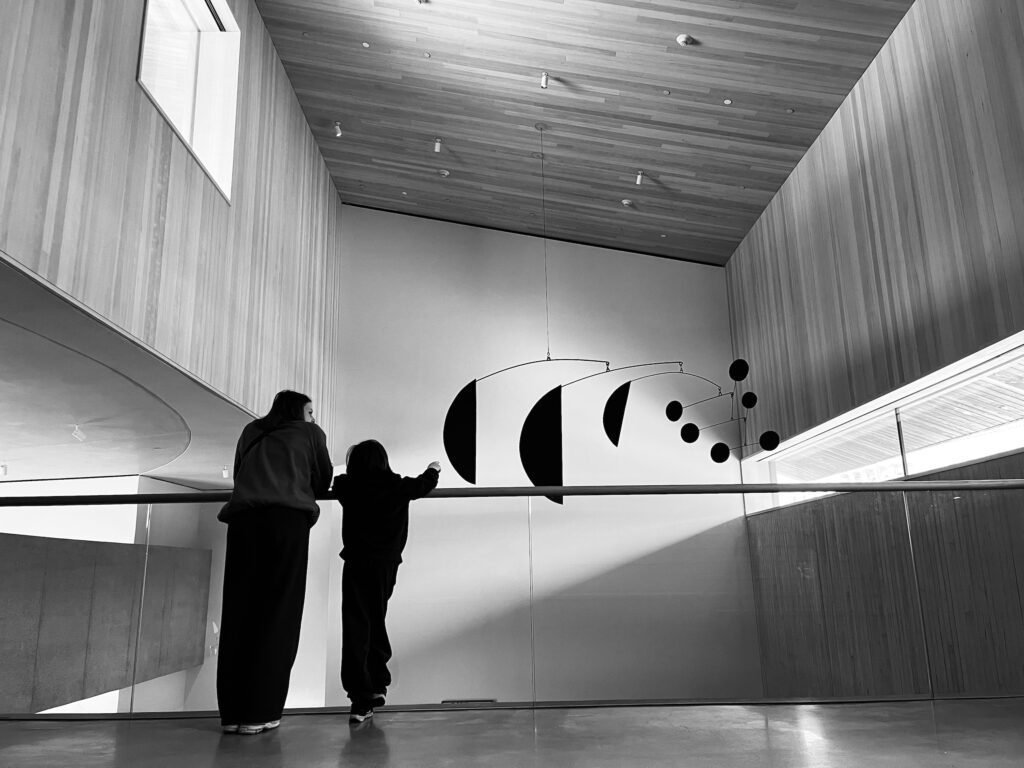
There, elements of surprise and texture are set within intimately designed sculptural spaces that allow visitors to experience the full breadth of Calder’s evocative colors and forms. The metallic facade mirrors the colors of the trees and buildings around it, appearing invisible among the natural towers. The famed mobiles and stabiles, with their ever changing shadows, can be viewed from many levels both indoors and out.
These places and spaces allow art and nature to converge and celebrate a shared history of creative freedom. So next time you want to step out of D.C., and if you have already visited Glenstone, we suggest you take an uplifting trip to Calder Gardens, because as Calder says, “above all, art should be fun.”
Additional photos of Calder Gardens below are by Ruth Allan.
tagsbarnes collectioncalder gardensdc artsDupont UndergroundL’Enfant GalleryPhillips Collectionvisual arts
[ad_2]
Source link