
[ad_1]
A new book from the Beaverbrook Art Gallery and Anchorage Press celebrates the prestigious fine arts program at Mount Allison University — from its origin as the first art school for women in Canada to its continuing tradition of training successful professional artists.
Leaders in the Field documents the program’s history and legacy and features hundreds of colour reproductions of works by its students over the past 170 years.
“It’s tangible evidence of the magic that was created there,” said John Leroux, a curator at the Beaverbrook and one of the book’s editors.
Leroux calls Mount Allison a “tiny, special spark of a university.”
“Some of the most important artists in Canada have come out of there,” he said in an interview with Information Morning Fredericton.
They’ve achieved success in visual arts, music, film, architecture, cartooning, theatre, industrial design and other fields, and shaped how we see ourselves in the world, Leroux and co-editor Thaddeus Holownia write in their foreword.

“Its story is also the story of women’s empowerment and professionalism in Canadian art,” said Leroux.
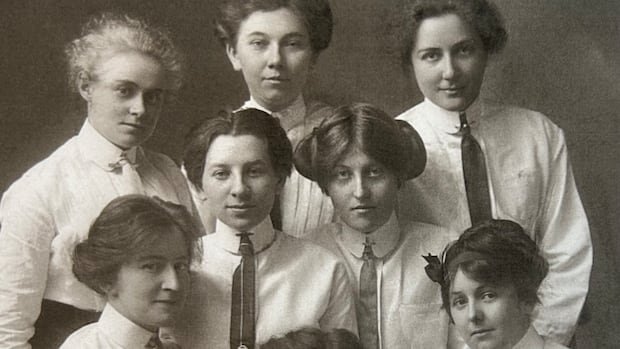
Mount Allison’s fine arts school began as the “Female Branch of the Wesleyan Academy,” in the southeast New Brunswick community of Sackville.
The school was later called the Ladies College, Jane Tisdale says in the section of the book she wrote, about the program’s first era, from 1854 to 1935.
Tisdale is herself a graduate of the Mount A fine arts program and works as an art conservator at the Owens Art Gallery in Sackville.
Art was seen as a strictly feminine pursuit in the early days, she writes.
The first curriculum included painting with oils and watercolours, making wax flowers and doing needlework — things considered important to the “development of a respectable lady.”
But the instructor also cared about “intellectual vigour” and made a point of reading to the students as they did their needlework, Tisdale writes.
They were schooled not just in refinement, but in being citizens of the world, said Leroux, and many went on to become instructors themselves.
The university started to focus on producing “serious artists” and gained a reputation as an innovative art school in the mid-1900s, said Ray Cronin, director of curatorial programs at the Beaverbrook and author of the book’s second chapter.
“If you went to the fine arts program at Mount Allison, it was not dabbling,” said Cronin, who was interviewed with Leroux.
Students learned to draw, understand colour, become proficient in different techniques and gained a sense of art history, he said.
After learning those rules they could begin to break them, Cronin said.
Some notable students from the 1940s and 1950s returned home to become renaissance figures in places like Uganda and Jamaica, noted Leroux.
This era for the art program was defined by instructors Stanley Royle, Lawren P. Harris and Alex Colville, said Cronin, as well as three “student prodigies” — Mary (West) Pratt, Christopher Pratt and Tom Forrestall.
Royle was a post-impressionist landscape painter who mentored Colville.
Harris, son of Lawren S. of the Group of Seven, was an official war artist for Canada during the Second World War.
Colville was also a war artist and one of the founders of a regional school of magic realist style called Maritime Realism.

He was also the artist behind a set of coins released for Canada’s Centennial year, featuring a bobcat, wolf, dove, mackerel, rabbit and goose, that became “the most widely circulated art pieces in the history of Canada,” Leroux said.
“Those were designed in Sackville … to represent the country of things that he saw that mattered, how we represented ourselves in the spirit of these animals.”
After the “Colville magical realist period,” came many conceptual artists, photographers and fine craftspeople doing “really exciting things,” Leroux said.
Herménégilde Chiasson, multidisciplinary artist and writer and former lieutenant governor of New Brunswick, and Evergon, a Governor General Award winner known for large-scale photographs and murals, are among those who attended in the late 1960s and early 1970s.
The 1970s, though marred by controversy over the departure of popular professor and pioneer video artist Colin Campbell, saw the addition of photography and the adoption of a more multidisciplinary approach, Mireille Eagan writes in the book’s third chapter.
Holownia, the book’s co-editor, joined the staff during this time and retired as head of the program in 2018. He’s an award-winning photographer whose typical subject matter is nature with human intrusion.
Some students from this era have included political cartoonist Michael de Adder, textile and installation artist Janice Wright Cheney, multimedia artist and educator Ann Manuel and world-renowned contemporary artist Danica Lundy, known for her figurative paintings and represented by the exclusive White Cube gallery.
“They only have about 15 artists and some of the most important contemporary artists on the planet,” Leroux said. “She’s one of them.”
“We punch so far above our weight,” Cronin said.
“We quietly have made an impact on the country that far outweighs our population, our wealth — everything except our history.”
As with Maritime musicians and writers, it hasn’t happened by accident, Cronin said.
“Artists aren’t being left out under the cabbage patch. It’s work. … They work hard and they’re mentored,” he said.
“This book is a record of commitment and of people who’ve really worked hard and succeeded.”
The sum of their efforts shows Canadians to be much more than “hewers of wood,” “drawers of water” or “working drudges” in resource industries, he said.
“People are poets and they’re fishers. People are musicians and they work in the woods. People are artists and they teach high school.”
A launch party is planned for Sunday at 5 p.m. at the Purdy Crawford Fine Arts building at the university.
A Fredericton launch is planned for May 14 at 6 p.m. at the Beaverbrook Art Gallery.
[ad_2]
Source link
