
[ad_1]
This article is part of a series of pieces celebrating Glasstire’s 25th anniversary. To see other stories from this series, go here. To see pieces from the month of May, around the theme Training Grounds: Studios, Students & Schools, go here.

Tudor Mitroi and I shared a single semester together in graduate school decades ago while both pursuing an MFA in studio art at the University of North Texas in Denton. We studied with Vernon Fisher, among other great professors in that program. Those critiques were an absolute highpoint of my art making journey. We were all in the same boat rowing with vigor in hopes of making breakthroughs we could all sense as being just around the corner.
Mitroi has continued to be a source of inspiration in my life. His remarkable depth of knowledge and his ceaseless devotion to his art is stronger today than ever before.
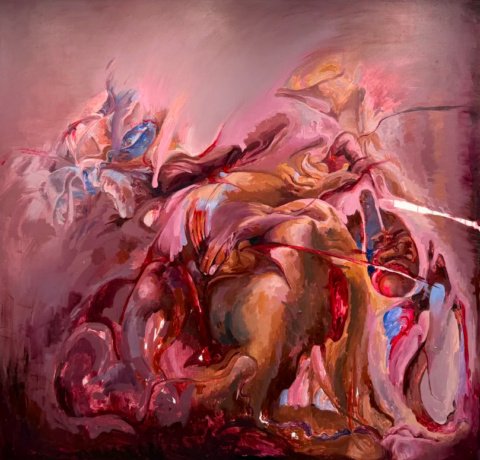
Garland Fielder (GF): Your paintings are very layered and present the viewer with information fragments, the meaning of which is somewhat up for speculation, yet they are personal in a way that is relatable.
Do you ever relate the content of your paintings to a sort of pedagogy?
Tudor Mitroi (TM): The layering is part of the process, as new elements are added to the painting, and some are pushed back. For lack of a better word, I call all of my paintings “journals,” although they’re obviously very different from actual journals. The fragmented information fits my way of thinking and experiencing the world.
Also, maybe because I come from a culture of relics, I find fragments perhaps even more interesting than complete things. The items are personal, and their place in time and space goes back and forth between immediate and very distant. Then there are elements that are usually seen as fixed and impersonal: measuring rulers, current dates and days of the week, times, etc. Viewers sometimes see the paintings as abstract although everything is representational, while often not immediately recognizable.
As for any kind of pedagogy, nothing could be further away from my intentions. My work is never meant to teach anything.
GF: By employing a strategy of ambiguity, the viewer is allowed to discover content at will, as it were, rather than being told what to experience in any given composition. I find this to be a bolder starting point in art, and it allows for a more honest approach that imitates life more accurately. It takes a certain amount of trust in the process from the perspective of the creator, to pull it off. It can serve as a sort of admission — I don’t entirely know what my work is about, but I know there is enough investigation coupled with intention that something sincere will be present in the reading of the final image.
In my own practice, this allows me to discover things I could never have achieved had I actually set out to manifest them, so its rejuvenation for the viewer as well as the creator. In this respect, would you consider yourself a perpetual student of your own work?
TM: The ambiguity is never intentional. It’s probably a by-product of the way I see the world. I always try to be accurate (that of course means something completely different in art versus science). But in the end, I have noticed that what I make seems to have just happened, as if the artwork made itself. In that respect, although I’m very curious, and look at and read a lot of things, I’m not sure if I actually study my own work. Thinking about it all the time, yes. But maybe understanding too much isn’t productive.
GF: Could you speak to the influence your own education has on your current practice — from growing up in Romania through your later years in Texas?
TM: I was born and raised in a very different world, in many ways almost like another planet. I have a lot of memories from my early years. It happened that one fundamental influence was very close to home. My uncle, Florin Mitroi, was one of the greatest artists. Admired by all who knew him, he was also a professor at the art school I later attended. He was known to be reclusive, and I was one of the few people who was very close to him. Over the years he shared with me countless ideas, thoughts, and images. Without ever teaching me formally, his insights were the most profound and made a lasting impact on me. My dad was also a talented draughtsman and an art lover, and he took us kids to some great art shows I remember to this day. He also had many art books in his library.
The art school I later attended was more like a traditional art academy. Brancusi had graduated there around the turn of the 20th century, and his diploma work, an ecorché based on an antique sculpture, was one of our props in the anatomy studio. It was one of the most competitive institutions of higher learning. Admission was based on anonymous auditions, in my case a sketchbook, a drawing, and a painting, all done on different days on the school premises. This was both good and not so good. But the school provided a solid training while avoiding the soulless and mindless “realism” (or rather naturalism) that is sometimes associated with the art academies. I sometimes think of the school at the time as if Da Vinci and Cezanne got together to set up an art program, which was very loosely structured. There was also much less awareness and emphasis on the international developments in postwar art.
Another fundamental experience was my contact with traditional Romanian art, and Byzantine and post−Byzantine art. I was 7 when I first saw the frescoes that covered the interior of a 14th century church. I was fascinated, and that feeling has always stayed with me. Then there was the old Romanian art department in the National Museum of Art, the Village Museum, and many places around the country where the archaic traditions were still alive. Also, I remember I was about 6 when I discovered an old atlas in my grandfather’s library. The maps were amazing. They were very accurate with their sharp, fine lines and text, yet they felt like an open ended story with strange characters.
So this was the educational baggage I brought with me to the U.S. I was fortunate to attend a very good program for my MFA at the University of North Texas. It wasn’t easy to figure out how to develop as an artist in a totally different environment, far away from my early formative experiences, and it took me a while. My studio professors were great artists, and some also became good friends. Vincent Falsetta, Vernon Fisher, Annette Lawrence, Ed Blackburn, Robert Jessup — they were very different in their approaches, and their insights were invaluable. I learned a lot about contemporary art, and how to see my own work and the work of other artists in that context.
In critiques I learned how to analyze and discuss works of art. I think my ability to talk about art in English, which is my third language, is now greater than in my native Romanian. And, inevitably, I learned about myself as an artist. I guess it sometimes takes distancing ourselves from our origins in order to gain a deeper understanding of who we are. Of course, the great museums and galleries were an essential part of my education. And after all these years I can say that I was never “taught” in the sense of someone showing me “how to,” or looking over my shoulder to check my work. But again the insights from the artists I worked with made a lasting impact and I’ll always be grateful for that.
GF: It is hard for us to do at times, but do you recognize yourself as a part of that pedagogical influence you received from so many varied sources? Sometimes when I’m feeling lost in my studio, I have to realize that as artists/educators, we touch many lives that we never consciously know about. There is comfort in realizing we are part of an ongoing experiment that is art writ large, the creative impulse, as it were.
TM: I think our essence stays the same. We absorb all kinds of influences, which are both inevitable and needed for our development. In fact, the more diverse the influences, the better their balance. But in the end, just like we can recognize the same tree after decades or even centuries, we can only become who we already are. In the studio I tend to forget about most everything and let my mind wander anywhere from distant memories to the things I have right in front of me. I think it’s always been like this: images and ideas that resonate with us become more or less consciously ours, but in the process they must change, hopefully in very interesting and unique ways.
[ad_2]
Source link