[ad_1]
As Dallas readies itself for the global stage of the 2026 FIFA World Cup this summer, a new campaign asks a pointed question beneath all the pageantry: Who gets to feel safe when the world comes to town?
“No ICE in the Cup,” a national coalition effort led by the Horizons Project and backed by nonprofits, faith leaders, worker organizations, small businesses, artists and soccer fans, wants the answer to be simple: everyone.
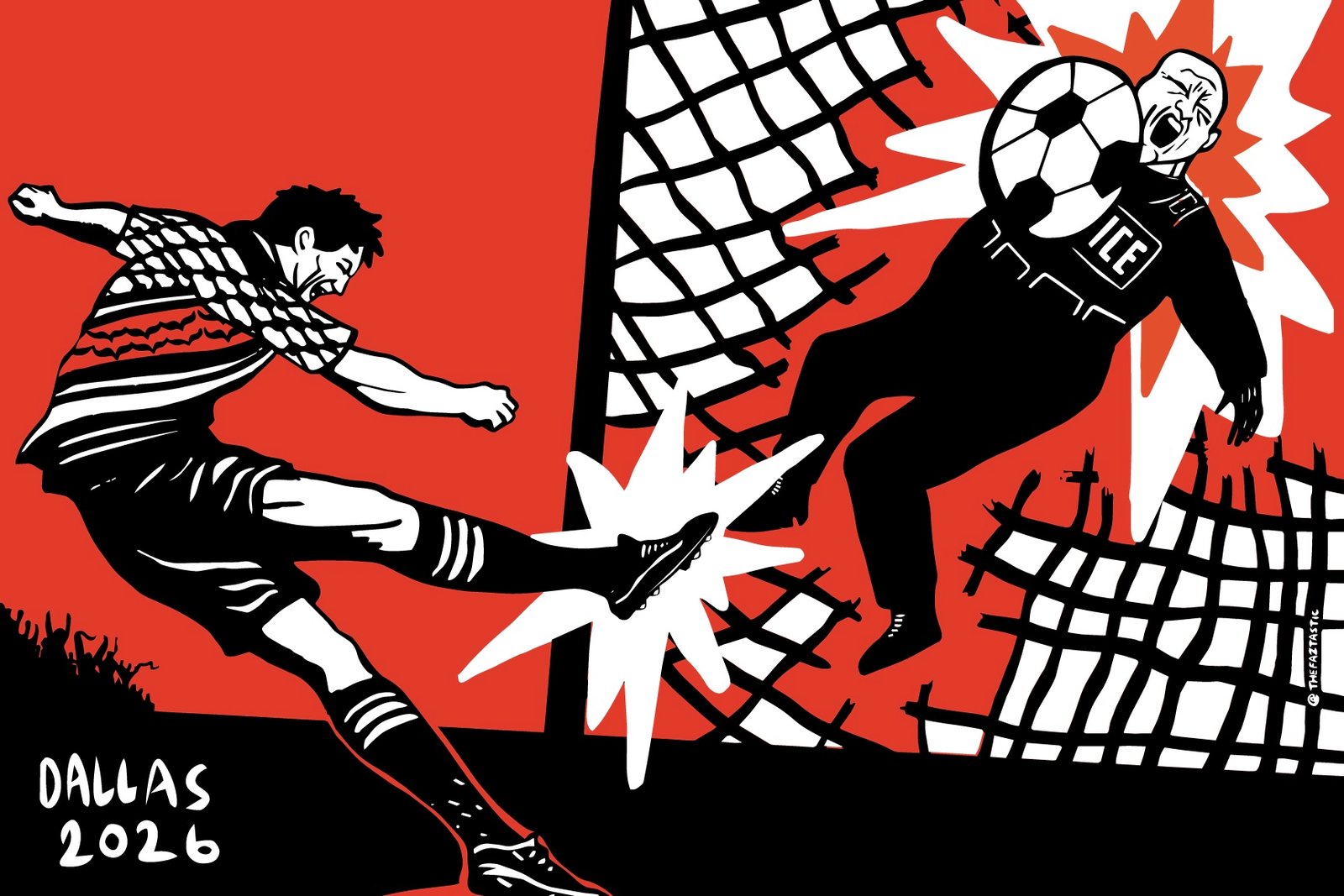
In World Cup host cities, including Dallas, the campaign is calling for fan experiences free from the threat of immigration enforcement, while building something more expansive than a protest slogan. It is organizing youth soccer events, community watch parties, local activations and a national art initiative that treats culture not as decoration, but as a form of public defense. That last part matters in Dallas, where local artist and designer Angel Faz has contributed one of the campaign’s first featured works — a fierce, kinetic image that looks less like a polite invitation than a warning shot. It’s protest art with cleats on.
The poster is blunt in the best way. A soccer player drives the ball hard into a looming goalkeeper marked “ICE,” blasting both man and net backward. Red floods the background as black anchors the weight and white letters shout the campaign’s name across the top with “NO ICE IN THE CUP!!!”
For Faz, who was born and raised in West Dallas, the piece comes from lived ground.
“I’m a Dallas-based artist and designer and I work a lot with land, land-based movement, migration, communities, how we protect one another,” Faz, who uses they/them pronouns, tells the Observer. “We protect us.”
That phrase — “we protect us” — feels like a key to both the campaign and Faz’s larger practice. Their work often moves through questions of land, belonging, Indigenous identity, migration and civic memory. Faz describes their family as Indigenous and Mexican-Indigenous, rooted in Texas long before modern borders made belonging feel conditional.
“We’ve been here since before Texas was Texas,” the artist says.
Pulling the Penalty Card on ICE
That history gives extra force to the campaign’s central argument. The World Cup is supposed to be a festival of movement, sound and shared obsession, a place where flags wave and strangers yell in unison. But for immigrant communities, that joy can curdle quickly under the presence — or even the possibility — of surveillance.
“For me, the World Cup should be about joy, play, gathering, people coming together across borders,” Faz says. “But the threat of ICE changes that feeling of public space. It turns celebration into fear.”
That tension sits at the center of “No ICE in the Cup.” The coalition’s stated goal is to make the tournament feel like a public celebration rather than a checkpoint. The campaign is pushing not only a message, but a model: communities, businesses and organizers creating spaces where people can gather without intimidation. The effort spans multiple host cities, but in Dallas, where immigration politics, policing and public space have long collided, the message lands with a particular charge.
Faz’s artwork does not soften that charge. It sharpens it.
“Art is visceral,” they tell us. “It can move through differently than a policy statement. It can make people feel something.”
That’s exactly what the poster does. It draws from a protest vocabulary that feels both historic and immediate — the stripped-down urgency of red, black and white underlined by the hard angles and sense of motion compressed into a single blow. Faz says they intentionally used a limited palette to make the image feel urgent, citing a love for protest posters from the 1960s and ’70s. Trained as a graphic designer, they brought those principles into the work while resisting the polished emptiness that often flattens political art into branding.
“In this day and age of saturated imagery and AI art, it was important for me to hand-draw it,” Faz says.
The image also carries layered references. Faz noted the comic-book force of the central figure and subtle nods in the player’s design that point to broader political solidarities. But the core idea is plain enough to hit in a second: fear is in the goal, and somebody has to kick it out.
“I wanted people to feel the joy of the game and the seriousness of protecting that joy,” Faz says.
That line may be the cleanest summary of the campaign’s artistic ambition. “No ICE in the Cup” is not asking art to simply illustrate a message after the fact. It is asking artists to help build on public sentiments of courage, visibility, defiance and welcomeness. The campaign launched with works by Faz and New York artist Cristy Road, while also inviting artists around the country to submit their own responses.
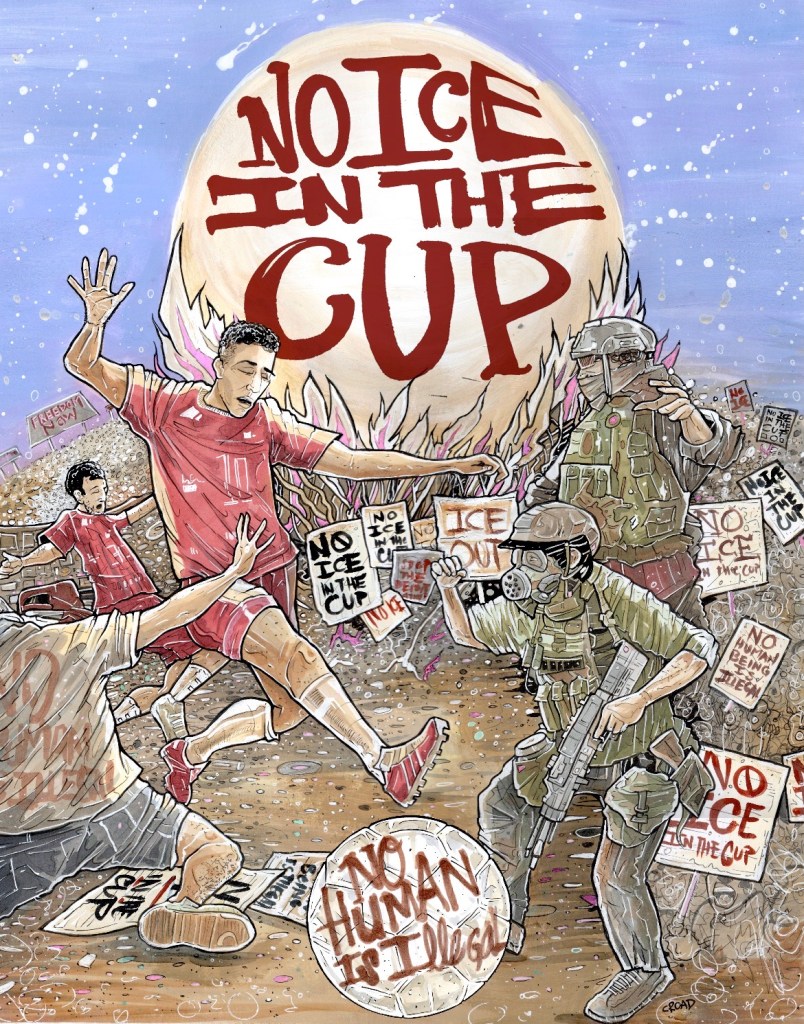
Faz says they appreciated that the organizers gave artists room to interpret the prompt on their own terms. They also valued the fact that the campaign links artists with various community groups rather than treating culture as an isolated lane.
“It creates much more of a movement with artists, small businesses, faith leaders, workers and community groups all rallying,” the artist says.
That coalition-minded approach also mirrors what Faz sees in Dallas itself. Asked about the city’s art scene, they pointed less to major institutions than to artists creating their own spaces and public spaces. That, in their view, is where some of the city’s most vital work is happening.
“When I see the evolution, it’s people making their own spaces, not looking to institutions or these larger art groups to include them,” Faz says. “They’re creating their own spaces, and I think that’s freaking rad.”
That DIY civic energy matters here. Dallas has always had more creative power than it gets credit for, but some of its most meaningful cultural work happens where art and organizing overlap in neighborhood actions, mutual aid networks, grassroots exhibitions and collaborations that do not wait for permission. Faz looks to the city’s tight-knit activism as one of its strengths, especially when art connects to actual work on the ground. For them, this campaign is one chapter in a broader practice. They are also involved in Indigenous-led land and water work in Dallas, including efforts tied to the renaming of lakes near the Trinity.
So, what would success look like for “No ICE in the Cup” and the artists involved?
“I hope people feel more energized and empowered to create art and show up for their community, create their soccer events, create safe spaces,” Faz says. “This is still their game, and that public joy is worth protecting.”
That may be the deepest challenge the campaign poses to Dallas as the World Cup draws near. Not whether the city can host the spectacle. It can. Not whether it can sell an image of itself to the world. It will. The harder question is whether Dallas can make room for joy without fear — whether it can let the world in without turning some of its own people into targets.
On Faz’s poster, the answer comes in one clean strike. The ball flies. The net tears. The crowd, if you can imagine it, rises.
To submit your own artwork, learn how to get involved or download the featured posters for free, visit the official campaign website.
[ad_2]
Source link