
[ad_1]
The Venice Biennale has never been a purely aesthetic event, and anyone who imagined that the 61st edition might somehow sidestep the world’s most pressing political realities was not paying attention to the programme, the location or the moment. Art and politics have always been entangled here, in the Giardini’s national pavilion structure, which mirrors the logic of international diplomacy as much as it mirrors the logic of exhibition-making, and in the Arsenale’s vast spaces, which have historically absorbed the work of artists for whom politics is not a subject but a condition of practice. This year, after four days of press previews and VIP vernissage events, the Biennale opened to the public, carrying more explicit political freight than perhaps any edition in recent memory.
The backdrop was already charged before a single visitor arrived. The international jury had resigned en masse in the days before the opening. The late curator Koyo Kouoh, whose title In Minor Keys suggested a particular attentiveness to suppressed and marginalised voices, was mourned throughout the Giardini by artists and curators who had worked with her vision and who now carried it forward in her absence.
Russia’s pavilion remained closed to the general public following a compromise. The European Commission had threatened to withdraw funding. Italy’s Culture Minister had boycotted the opening ceremony. The Biennale Foundation had maintained its position of institutional neutrality with a firmness that its critics read as something closer to evasion.
Against that backdrop, the works themselves took on an additional weight. Some pavilions, like Ukraine’s, engaged directly with the political crisis and with considerable force. Others retreated into a studied absence of statement that was, in its own way, as revealing as anything more explicit.
The United States pavilion arrived scrubbed of political content, a blankness that under any other administration might have read as formal restraint but under the current one reads as something harder to name. South Africa withdrew entirely but held a pop-up event in Castello that was more of a poetry reading.
Here is a selection of ten moments, gestures, rooms, and works in which the relationship between art and power was most legible, most uncomfortable, or most impossible to ignore.
Alfredo Jaar’s Red Room Confronts the End of the World at Venice
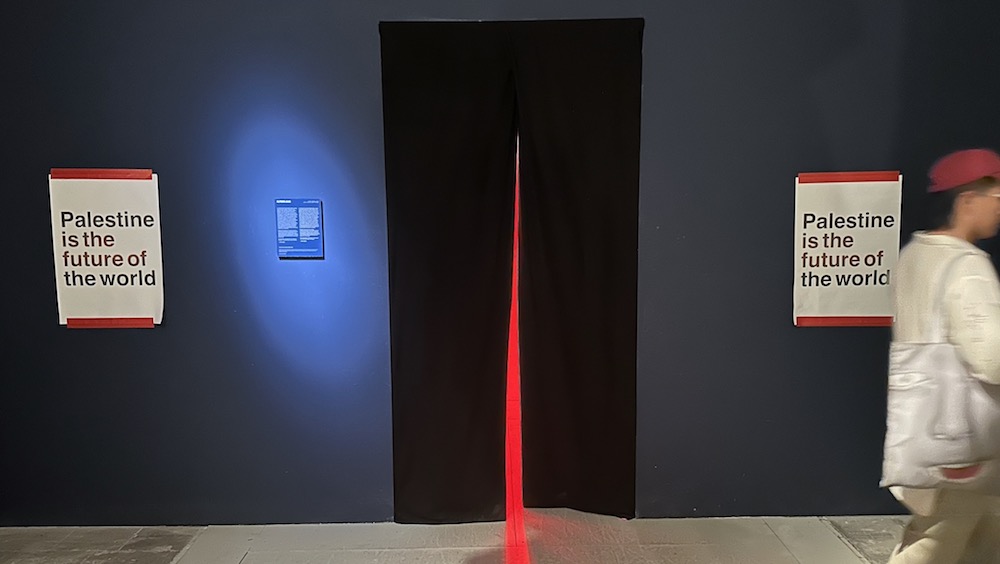
Chile’s contribution to the 61st Venice Biennale arrives with the quiet, devastating authority that has defined Alfredo Jaar’s practice across four decades. The End of the World, installed in the Chilean pavilion, is a Red Room work that does what Jaar has always done best: it refuses to let the viewer remain comfortable, or distant, or uninvolved.The installation draws on the visual and conceptual language Jaar developed across a body of work that has consistently placed the humanitarian crisis at its centre, from Rwanda to Chile’s own history of political violence. The red suffuses the space with an urgency that is physical before it is intellectual, and the effect is immediate. You feel the work before you understand it.
In a Biennale full of gestures and qualifications, Jaar’s directness registers as something close to moral clarity. At a moment when clarity is in short supply, that counts for a great deal.
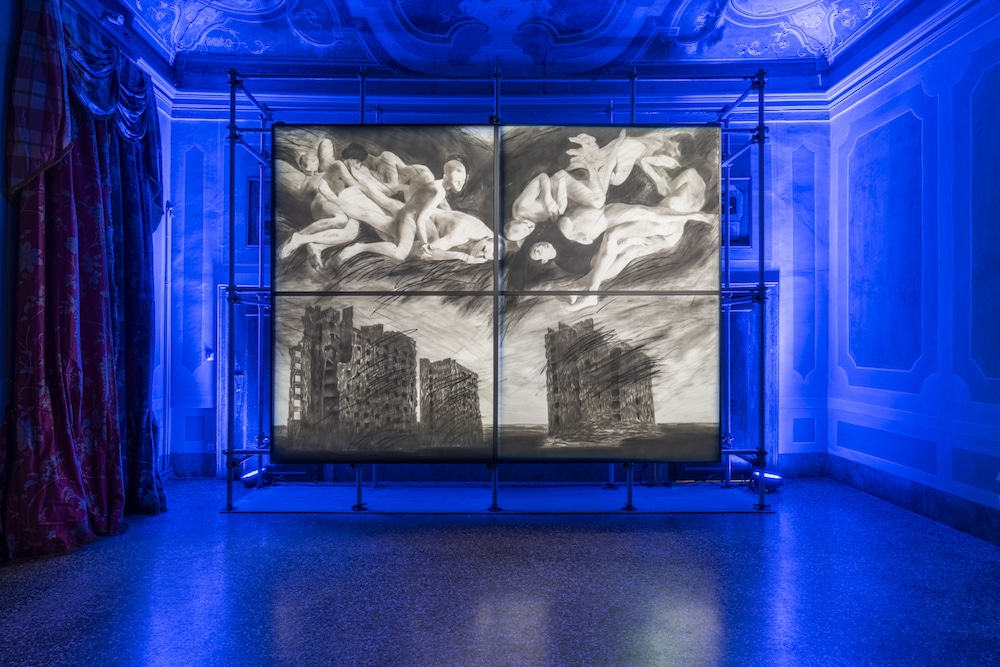
Nikita Kadan: Photo Credit: Nikita Kadan, After All, 2026. Still Joy — From Ukraine Into The World / Biennale Arte 2026. PinchukArtCentre. © Photo OKNO Studio
Still Joy: Ukraine’s Radical Act of Resistance Comes to Venice. Presented by the Victor Pinchuk Foundation and the PinchukArtCentre
This official Collateral Event of the 61st Venice Biennale, Still Joy: From Ukraine into the World, opened at the Palazzo Contarini Polignac on 9 May and runs until 1 August 2026. The exhibition takes joy not as a comfort but as a form of defiance, grounding that proposition in testimony collected by two Ukrainians with direct experience of the war’s human cost. Hlib Stryzhko, a marine, veteran and former prisoner of war, and Nataliya Gumenyuk, a conflict journalist and co-founder of The Reckoning Project, gathered the stories that anchor the exhibition in lived reality. Around those testimonies, an international group of artists, including Tacita Dean, Janet Cardiff and George Bures Miller, Nikita Kadan, Zhanna Kadyrova, and Gabrielle Goliath, has assembled works that refuse to treat survival and beauty as contradictions.
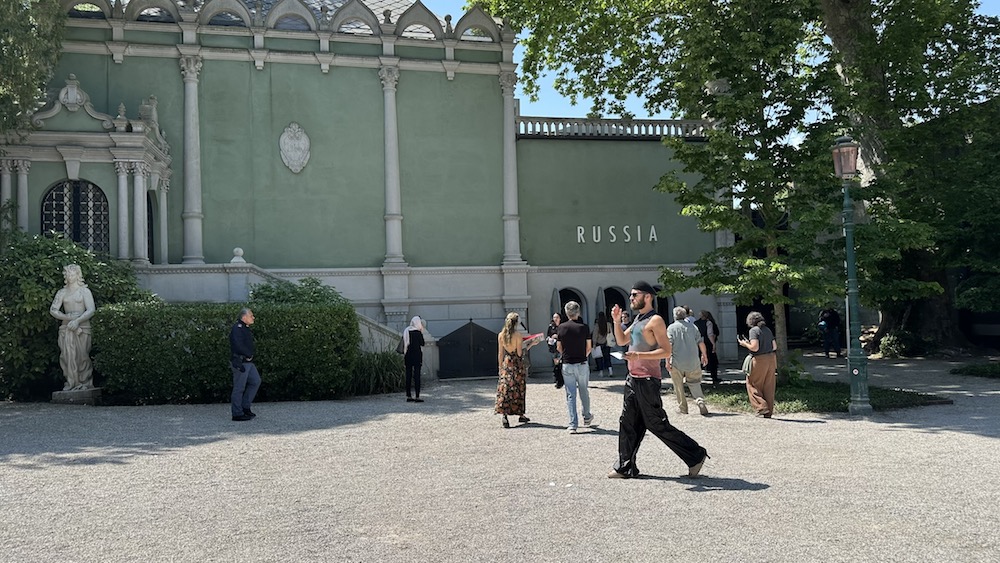
Russia Pavilion 2026 Venice Biennale
Russia’s Return to Venice: A Pavilion That Says Everything by Saying Nothing:
Whatever one expected from Russia’s controversial return to the Venice Biennale after a two-year absence, the reality of the pavilion is perhaps the most disorienting response of all. The exhibition, titled The Tree is Rooted in the Sky, is essentially void of content in any meaningful artistic sense, a space that seems to have been conceived less as an exhibition than as an exercise in occupying the building. Downstairs, bunches of flowers sit in pots with the casual arrangement of a market stall rather than a considered installation, their presence decorative at best and, at worst, a provocation dressed as innocence. Upstairs, a looping video work featuring horses moves through its paces with the unhurried certainty of something that knows it will not be challenged. The work of participating artists, Kirill Savchenkov’s former collaborators and figures connected to the Moscow contemporary scene, provides little critical scaffolding for what surrounds it. Outside, a blaring Russian hip-hop DJ sets the soundtrack, drawing in headbanging youngsters who treat the pavilion less as a site of artistic encounter than as the liveliest party in the Giardini. Whether that atmosphere is the point, a deliberate subversion of Biennale solemnity, or simply what happens when content is absent, and volume fills the vacuum, is left entirely to the viewer to decide. It is, in its way, a perfectly illegible statement from a country that currently has every reason to prefer illegibility.
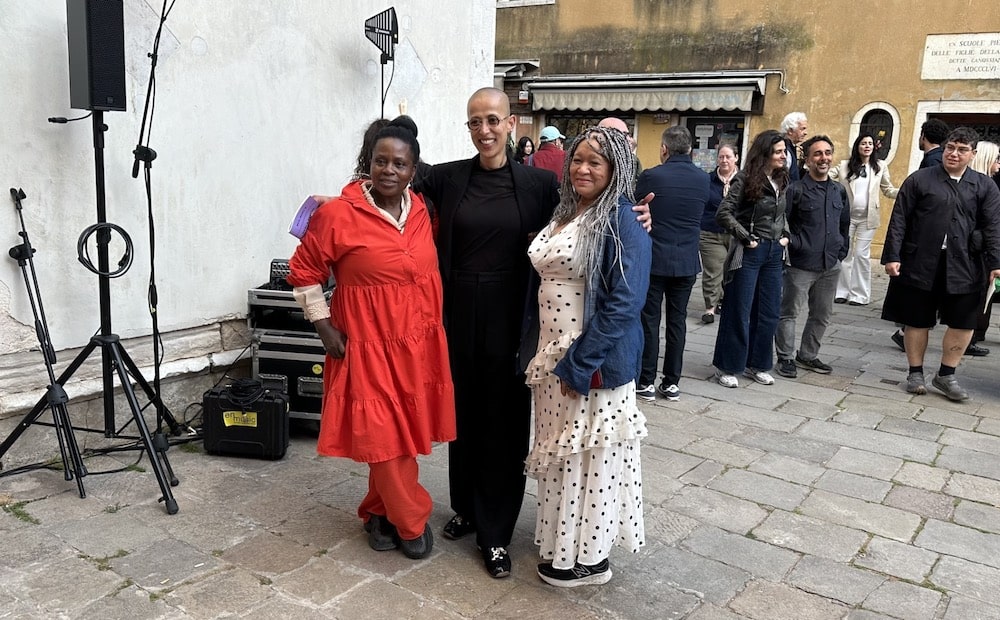
South African Pavilion Remains Empty, Gabrielle Goliath Finds Off-Sight Continuum
Gabrielle Goliath Brings Her Life-Work of Mourning to Venice After South Africa Pavilion Withdrawal
While the South African pavilion stands empty at this year’s Venice Biennale, Gabrielle Goliath has brought her work to the city anyway. The artist, whose performance Elegy was withdrawn from the official pavilion by South Africa’s Department of Sport, Arts and Culture in January after it was deemed related to an ongoing international conflict that is widely polarising, inaugurated her off-site exhibition today with a public poetry reading on a crowded Venice street. Speaking outside the fourth-century church hosting her show, Goliath described the gathering as “an assembly of broken words”, a mourning ritual that moves between femicide in South Africa, genocide in Namibia and the ongoing devastation in Gaza, Lebanon, Sudan and beyond. Elegy, begun in 2015, involves seven singers sustaining a single tone for an hour in collective lamentation. That the South African government found this too polarising to show tells you rather more about the government than about the work.
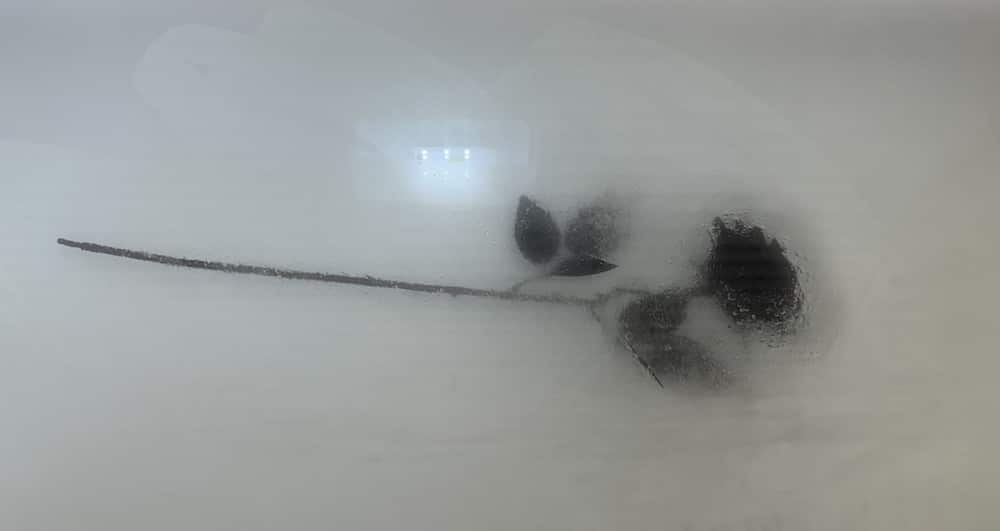
Israel’s Rose of Nothingness: Meditation Amid the Storm
Belu-Simion Fainaru’s installation Rose of Nothingness, presented in the Arsenale as Israel’s contribution to the 61st Venice Biennale and curated by Avital Bar-Shay and Sorin Heller, arrives carrying a weight of controversy that no single artwork could easily bear. The work itself is quietly conceived, using desert-farming equipment to construct a meditative space that draws on themes of spirituality and memory, with a formal language closer to contemplative withdrawal than to political statement. A frozen rose and a rain room complete an atmosphere of suspended time, of something held still against the pressure of the world outside.
That world outside has been loudly present. The pavilion has attracted sustained protests and renewed calls for a boycott throughout the preview days, its location in the Arsenale making it impossible to avoid for anyone moving through the main exhibition. Whether Rose of Nothingness succeeds in holding open the space for reflection that its makers intended, in circumstances that make reflection extraordinarily difficult, is a question the Biennale’s remaining six months will continue to pose without resolution.
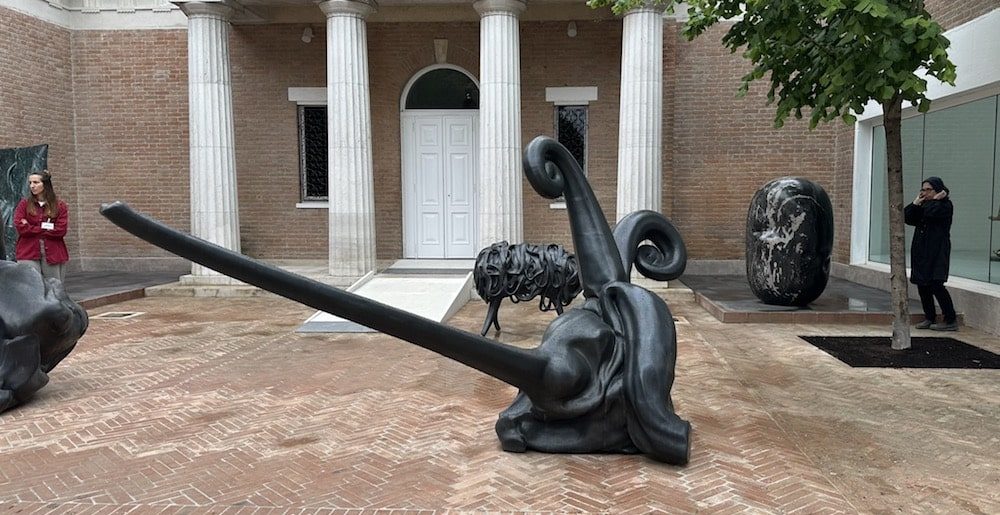
The US Pavilion at Venice 2026: Architectural Sculpture for the Mar-a-Lago Set
The 2026 United States Pavilion at Venice produces a particular kind of discomfort, one that combines outrage and exhaustion in roughly equal measure. What was once a significant platform for American art has been diminished by a selection process that appears to have prioritised inoffensiveness above all other qualities, and the results are visible in every room.
Alma Allen’s twenty or so sculptures, ranging from Mexican onyx gourds to stylised bronzes, are competent objects that would sit comfortably in a South Beach hotel lobby. A fourteen-foot polished bronze totem occupies the central gallery. Jagged reliefs suggesting tree bark line the walls nearby. The vocabulary is biomorphic and vaguely talismanic, Brancusi for beginners and a century late for that particular conversation.
On preview days, the crowds were notably thinner here than elsewhere in the Giardini. That absence felt like a verdict. The work requires no interpretation beyond the language children use to describe clouds. It does not offend. It simply offers nothing whatsoever. Making this a pure political statement.
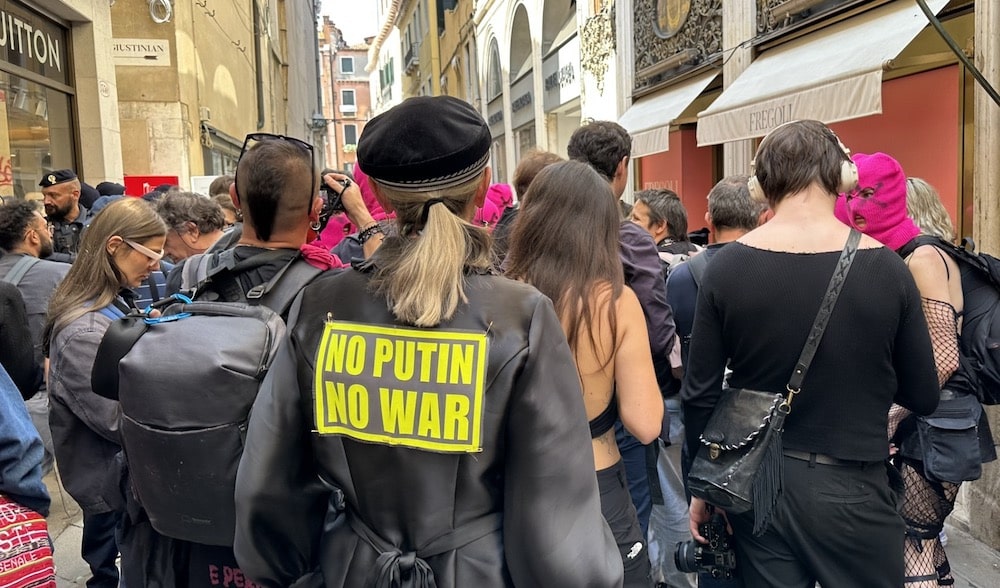
Pussy Riot Storms the Venice Biennale in Protest at Russia’s Return
Pussy Riot staged a protest at the Venice Biennale this week as Russia made its controversial return to the Giardini for the first time since the full-scale invasion of Ukraine. Dressed entirely in black apart from their fluorescent pink balaclavas, the activists moved through the Biennale gardens before converging on the Russian national pavilion in a demonstration that was brief, loud and impossible to ignore.
As security guards rushed to close the glass doors, smoke flares went off, and the protesters punched the air, chanting “Russia kills, Biennale exhibits.” One poster read: “Curated by Putin, dead bodies included.” The action lasted minutes. Its image will last considerably longer. In a Biennale already defined by political crisis, institutional compromise and the quiet absence of a jury, Pussy Riot provided the kind of unambiguous statement that the official programme has largely declined to make.
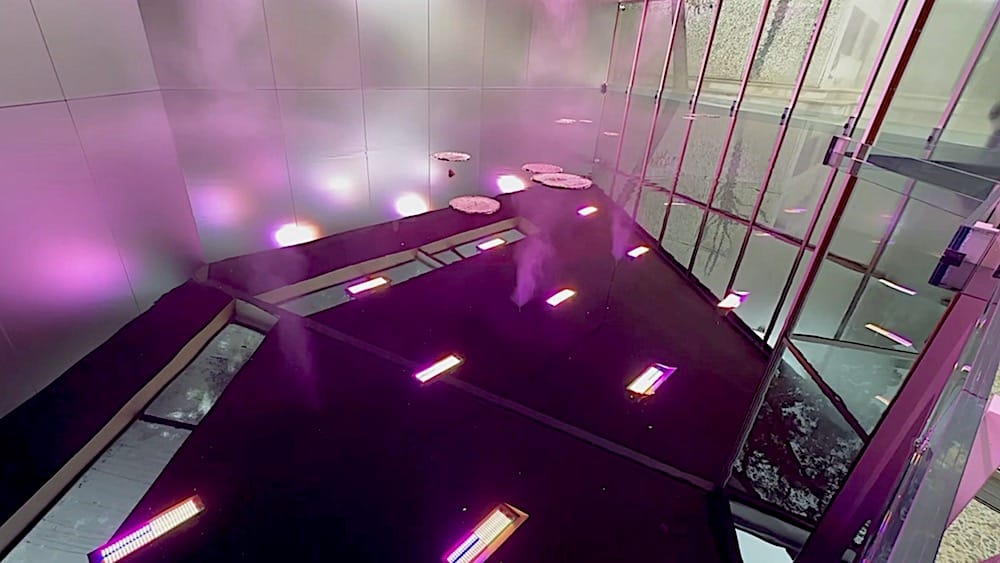
Canada’s Venice Pavilion Becomes a Living Climate System
The Canadian pavilion at this year’s Venice Biennale has been transformed by Abbas Akhavan into something closer to a living ecosystem than an exhibition space. Humidity and temperature inside have been calibrated to replicate the steaming heat of the Amazon, with fine mist released through small tubes into air that feels dense and organic the moment you enter. Roughly a third of the floor has been converted into an above-ground pond, lily pads drifting across dark water that absorbs what little light reaches it. At the heart of Picoplanktonics is a series of large-scale robotically printed structures embedded with Synechococcus PCC 7002, a picoplankton species that gradually reinforces the surrounding material by absorbing and storing atmospheric carbon dioxide. Fabricated initially in a laboratory, the structures have been relocated here to continue growing. The pavilion makes its argument through atmosphere rather than rhetoric. In the context of the ongoing climate crisis, that restraint feels entirely appropriate.
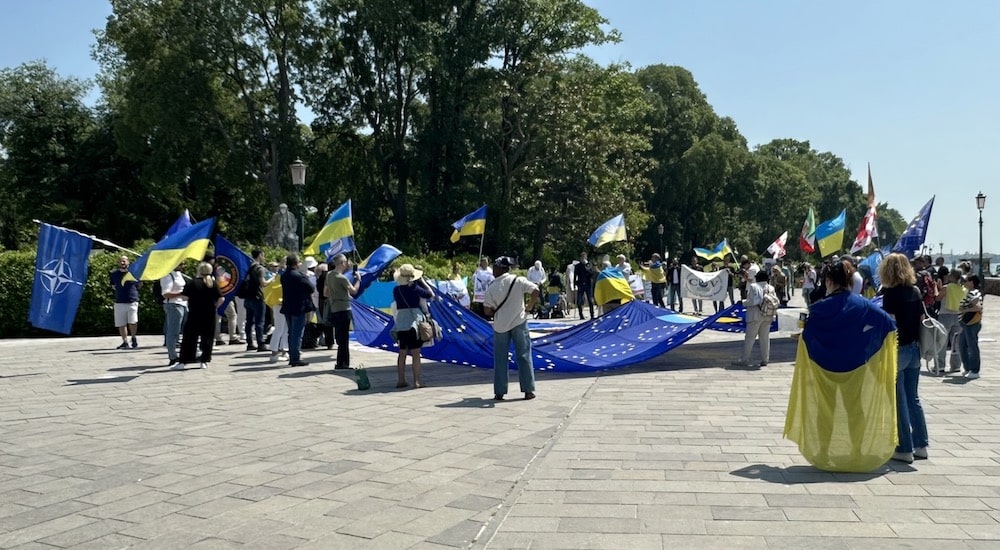
Ukraine’s Presence at Venice: Protest as the Pavilion Itself
Ukraine did not confine its presence at the 61st Venice Biennale to the walls of its national pavilion. Throughout the preview days and into the opening weekend, Ukrainian activists, artists and supporters made themselves visible across the Giardini in ways that no official programme could have choreographed. Protesters gathered outside the Russian pavilion, carrying images of those killed since the full-scale invasion began in February 2022, their presence a direct counter to the flowers in pots and the hip hop soundtrack emanating from within. Ukrainian flags appeared at pavilion entrances and along the paths between them, quiet but insistent markers of a war that the Biennale’s institutional apparatus has struggled to address with anything approaching moral clarity.
The protests were peaceful and sustained. They did not disrupt so much as insist, refusing to let Russia’s return to the Giardini go unnoticed. In a Biennale defined by political evasion at the institutional level, that insistence carried a weight that no jury statement or foundation communiqué could match.
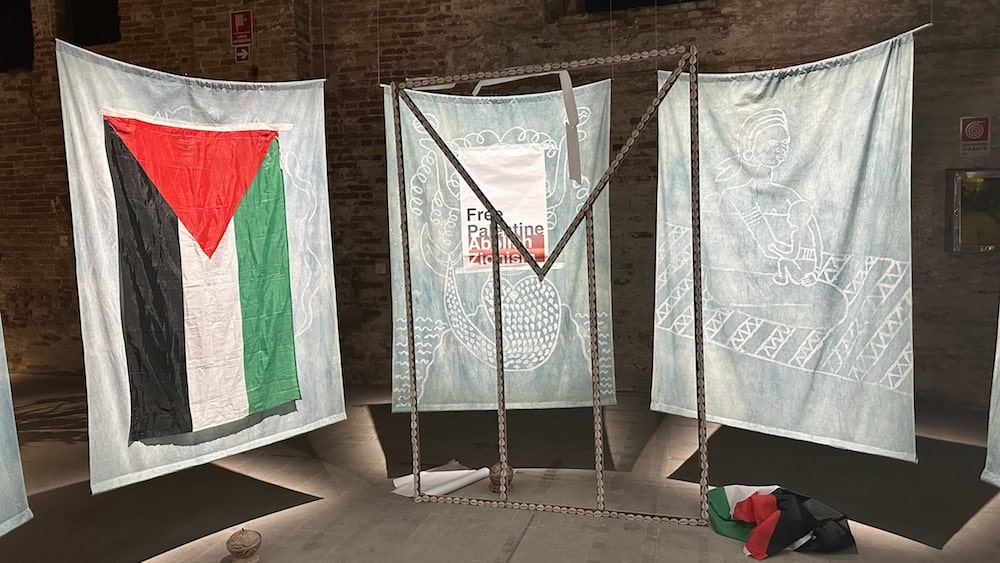
Pavilion Strike Over Israel’s Participation Closes Venues Across the Giardini
On the final day of the Venice Biennale preview, a strike organised by the Art Not Genocide Alliance brought significant disruption to the Giardini, with pavilions across the site closing in protest at Israel’s participation in the 61st edition. The Belgian, Dutch, Austrian, Japanese, Macedonian and Korean pavilions remained closed for the entire day. The British, Spanish, French, Egyptian, Finnish and Luxembourg entries either closed and reopened or shut early, causing considerable confusion among press and VIP visitors with less than twenty-four hours remaining before the public opening.
Austria’s pavilion, widely considered one of the standout works of this edition, stayed shut throughout. A sign on the British pavilion cited the Italian cultural workers’ strike as the reason for its closure, though it reopened later once additional staff were found.
Inside the main exhibition, In Minor Keys, the protest extended beyond closed doors. Tabita Rezaire and others hung Palestinian flags alongside their work, while posters appeared at several pavilion entrances reading “Palestine is the future of the world.” The strike demonstrated, with considerable clarity, that the political crisis surrounding this Biennale could not be contained by institutional statements alone.
Words/Photos © P C Robinson Artlyst 2026
[ad_2]
Source link