A monument with a fault line
At first glance, Mr Phantom’s portrait appears to have the mass of a public monument. The male profile is built from rectangular blocks that suggest stone, steel, concrete or digital pixels enlarged into architecture. The head is less an image than a structure.
Then the structure begins to fail. The right side breaks into fragments, and the fragments carry words: stress, pressure, exposure, expectations, silence. The portrait does not simply show a troubled expression. It imagines psychological pressure as material leaving the body.
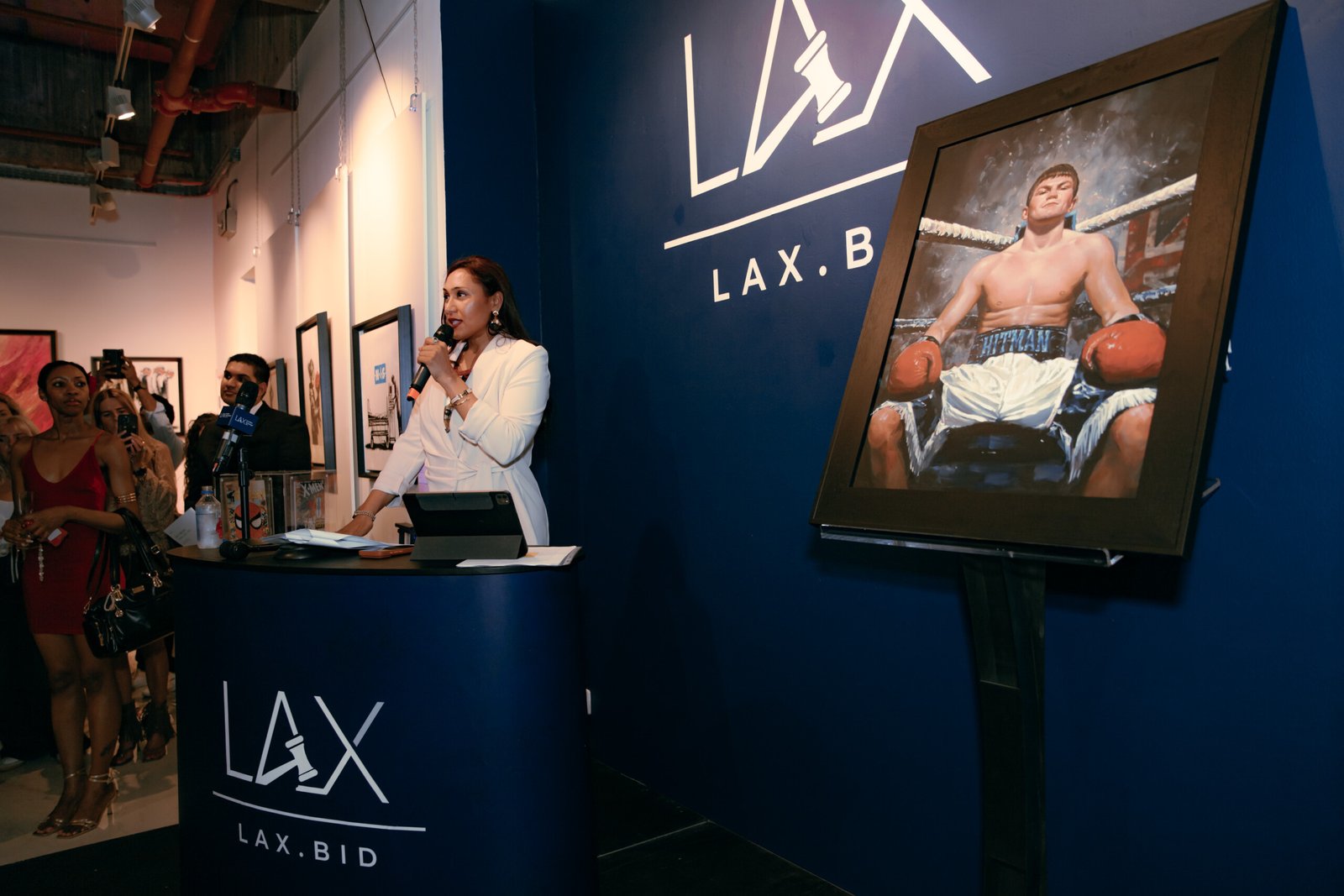
The work, titled The Hitman: Nobody Needs to Fight Alone, was created in tribute to Ricky Hatton for the LAX.BID men’s mental-health exhibition and auction. It avoids the most obvious visual language of boxing. There are no gloves, ropes, belts or crowd. The fighter is present through the profile and title, but the real subject is the architecture of endurance.
Why the blocks matter
Blocks imply construction. A public identity is assembled over time from achievements, roles, expectations, photographs and other people’s memories. The grid gives the face strength, but also suggests that it has been built rather than discovered.
This is particularly relevant to a sports figure. The public sees a career through results and highlights; the person lives through training, injury, fear, routine, pressure and the demand to remain recognisable. Mr Phantom’s blocks allow the viewer to see the difference between the image and the load-bearing structure beneath it.
The fragmentation begins at the side associated with thought and hearing. Words move out of the head as if silence has finally become visible. They are not arranged neatly. They collide, repeat and dissolve.
Silence is both material and absence
The word “silence” appears several times. In a conventional poster, repetition would emphasise a slogan. Here it behaves like debris. Silence is shown as something with weight.
That reversal gives the work its emotional intelligence. Silence is usually defined by what is not said. The portrait suggests that what is not said still occupies space, presses against the structure and may eventually break through.
The work does not claim that speaking solves everything. The fragments continue to fall. Disclosure can be necessary without being simple, and public conversation can expose a person as well as support them.
The child and the ladder
At the bottom of the composition, a child climbs a ladder toward the larger figure. The scale is impossible. The head appears monumental, and the child is small enough to be overlooked.
This detail changes the work from a portrait of individual pressure into a picture of relationship. The child may be read as a son reaching a father, a younger generation climbing toward an inherited model of masculinity, or the vulnerable part of the self attempting to reach the public structure above.
The ladder is an important choice. It is neither a dramatic rescue nor a passive witness. It is a practical tool. Someone has placed it there. Someone must climb. The image therefore contains a modest theory of support: the distance may be large, but a route can be built.
The absence of boxing imagery
A tribute to a boxer might be expected to celebrate the punch, the ring walk or the belt. Mr Phantom’s refusal of those symbols prevents the work from becoming memorabilia alone.
The profile remains recognisable enough to carry the Hatton reference, but the visual argument applies beyond one person. Anyone whose identity depends on appearing strong can enter the image.
That broader relevance explains why The Times could include the artwork in a national news-in-pictures feature. Removed from the event speeches and auction context, the image still communicated a clear conflict between monumentality and fracture.
Street art techniques in a gallery context
Mr Phantom’s wider practice is associated with socially charged, conversation-led imagery. The fragmented surface and typographic debris draw from the visual speed of street art and digital culture, while the central profile has the formal clarity of a poster or public mural.
Presented inside a gallery and auction launch, the work moves between public-message art and collectible object. That transition creates productive questions. Does the work retain its social force when attached to a price? Can an auction expand the message without converting it into lifestyle branding?
The answer depends on context and transparency. A cause-led work can raise money and reach new viewers. It can also become decorative if the charity outcome and message are not carried beyond the event.
Market visibility and market caution
London Art Exchange represents and promotes Mr Phantom, and its public materials cite a £147,000 result for The Matrix as a significant historical auction marker. HENI and Artsy provide additional visibility around the artist.
Such evidence can support a market discussion, but it should be described carefully. One result does not establish a guaranteed value for every work. Size, subject, date, medium, provenance, condition, edition status, buyer competition and sale context all matter. Art is illiquid and may fall in value.
A credible article can recognise the artist’s growing public profile without turning a mental-health tribute into an investment promise.
Why it worked at the launch
The LAX.BID event contained several competing attractions: a new platform, luxury lots, celebrities, music, press and a charity purpose. Mr Phantom’s portrait prevented the cause from becoming a line in the invitation.
Guests could encounter the image before hearing an explanation. The face, words and ladder carried the argument visually. The artwork connected the boxing legacy to the mental-health theme without requiring a literal narrative.
It also offered the auction platform a model for editorial presentation. An object should not be surrounded by generic claims of rarity and luxury. It should be interpreted through its formal qualities, context, evidence and limits.
The portrait remains unresolved
The face is still standing, but it is not repaired. The child has begun to climb, but has not reached the top. The words have become visible, but they have not disappeared.
That incompleteness is the work’s strength. Mental-health campaigns often seek a reassuring final message. Mr Phantom leaves the structure open. Support is possible, conversation has begun, and the viewer is asked to remain with the uncertainty.
The portrait refuses to stay whole because wholeness would be dishonest. It offers something more useful: a visible fracture and a ladder placed against it.