[ad_1]
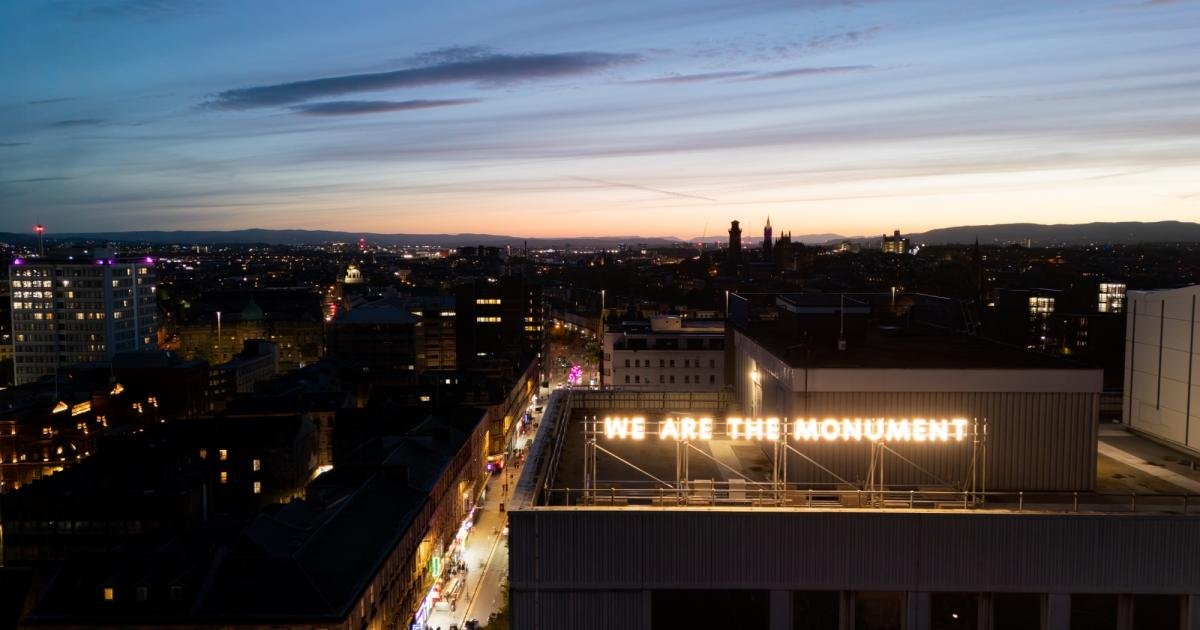
The new work, described as a “text-based sculpture”, overlooks the fire-ravaged remains of Charles Rennie Mackintosh’s Glasgow School of Art masterpiece and the O2 ABC concert hall, and the Centre for Contemporary Arts building, which closed this year due to mounting financial problems behind the scenes.
Read more:
Coley has taken the phrase from a text of the same name by the American writer and activist Rebecca Solnit, which explores how cities often “memorialise” tragic events, such as the 9/11 terror attacks or the devastation caused by Hurricane Katrina.

The artist, a former graduate of Glasgow School of Art, said the newly-unveiled work is intended to explore “why and how we memorialise events, how public statues represent us (or not), who and what they are for, and what role they have for our public life”.
The Herald was given a sneak preview of the work – which features LED “fairground bulbs” – as the finishing touches were being made to its installation on the NHS building.

WE ARE THE MONUMENT has been acquired from the artist by Glasgow Life, the charity responsible for the city’s publicly-owned art collection, and attractions including Kelvingrove Art Gallery and Museum and The Burrell Collection.
It is expected to go on display at selected sites around the city after being bought by Glasgow Life with the use of grants from Art Fund, the UK-wide charity for museums and galleries, and the National Fund for Acquisitions, which helps Scottish attractions add to their collections.

However its initial location is hoped to raise awareness of ambitions to transform the fortunes of Sauchiehall Street by creating a new “Culture and Heritage District” between the Mitchell Library and the Glasgow Royal Concert Hall.
Coley said he hoped that WE ARE THE MONUMENT would be “inclusive but challenging”.

He added: “It changes depending on the context and the audience who see it. Here in its first display site – on top of the Dental Hospital, beaming its light and message down Sauchiehall Street – it can take on many forms. It’s speaking to the diverse and ever-evolving community that lives on the street and surrounding areas.
“It overlooks the burned-out shell of the Mackintosh Building and ABC, and now-closed CCA – important cultural venues whose legacy may now only be in the memories of those who loved and used them. What, who and how will the city decide to memorialise in the future?

“With George Square being renovated and the city changing in exciting ways, this work aims to make us stop and think about what this means and what we want – because in the end, it’s the people of Glasgow that are the monument.”
One of Coley’s text sculptures – THERE WILL BE NO MIRACLES HERE – is currently on display in the grounds of the National Gallery of Modern Art in Edinburgh.
Similar works have gone on display in Berlin, Abu Dhabi, Tasmania and Aarhus in Denmark as part of its tenure as European Capital of Culture.
Coley’s work is held in collections around the world, including the National Galleries of Scotland, the UK Government Art Collection, the Tate in London, the Whitworth Art Gallery in Manchester, the Israel Museum in Tel Aviv, the Van Abbemuseum in Eindhoven and Auckland Art Gallery in New Zealand.
WE ARE THE MONUMENT, which is made up of 46 centimetre tall capital letters, spans around 10 metres.
Coley told The Herald: “Like all of the other text works I have made, the important thing is that the phrase is not mine. I am not a poet or a writer. I seek and look and listen for ready-made phrases.
“They can be song titles, the last line of a piece of literature, a conversation with a taxi driver or a piece of graffiti. I’m at my worst when I’m looking for one. They predominantly find me.
“This one came from an essay by Rebecca Solnit. She was saying that in terms of how we memorialise either natural disasters or man-made events, instead of using public space, and building and making statues of mainly men and mainly in uniform, was there not another way to use public space to create a location where we could gather as a community and remember to mark the moment and remember people that have passed.
“It was a bit of a criticism of that rather standard, outdated model of someone being commemorated in a figurative form.”
Coley was personally involved in the negotiations with NHS officials for the use of the roof of the hospital building.
He said: “I’m more interested in working in non-cultural buildings and locations.
“I’m quite into the idea that it doesn’t look like art, I’m comfortable with that.
“I’m clearly an artist and that’s the world I am in. But I think the audience will come across it and ask: ‘Is it advertising, is it a slogan, is it poetry?’.
“If it is at Kelvingrove or somewhere else where culture lives then it is something different.
“Being on the roof, above the cityscape, is quite interesting. The building is like the clinch for it. It’s above the eyeline.
“Down on Sauchiehall Street, there is a lot of language, there is a lot a lot of text and there is a lot of instruction.
“It is going to be here for a year. I am really okay for it to be not completely in your face. Maybe it will be up for weeks or months until you notice it when you are coming back from the pub and you are a bit p****d.
“It is exciting for me that it will be there long enough to test it throughout the seasons and the cultural life of the city.”
Jane Rowlands, head of museums and collections at Glasgow Life, said: “We’re delighted to have acquired works by internationally acclaimed Glasgow artist Nathan Coley for the City Collections.
“His innovative creations challenge us to engage in conversations about how we interact with our built heritage, and the meaning of the public places we share and occupy.
“Being able to reveal WE ARE THE MONUMENT on the roof of the Glasgow Dental Hospital for its first year of public display extends our each in the city beyond our museums’ walls.
“Its location also highlights the ambitions of the current Sauchiehall Street Culture and Heritage District regeneration project to celebrate the history of this part of the city and take forward its development as a thriving contemporary cultural centre.”
[ad_2]
Source link