
[ad_1]

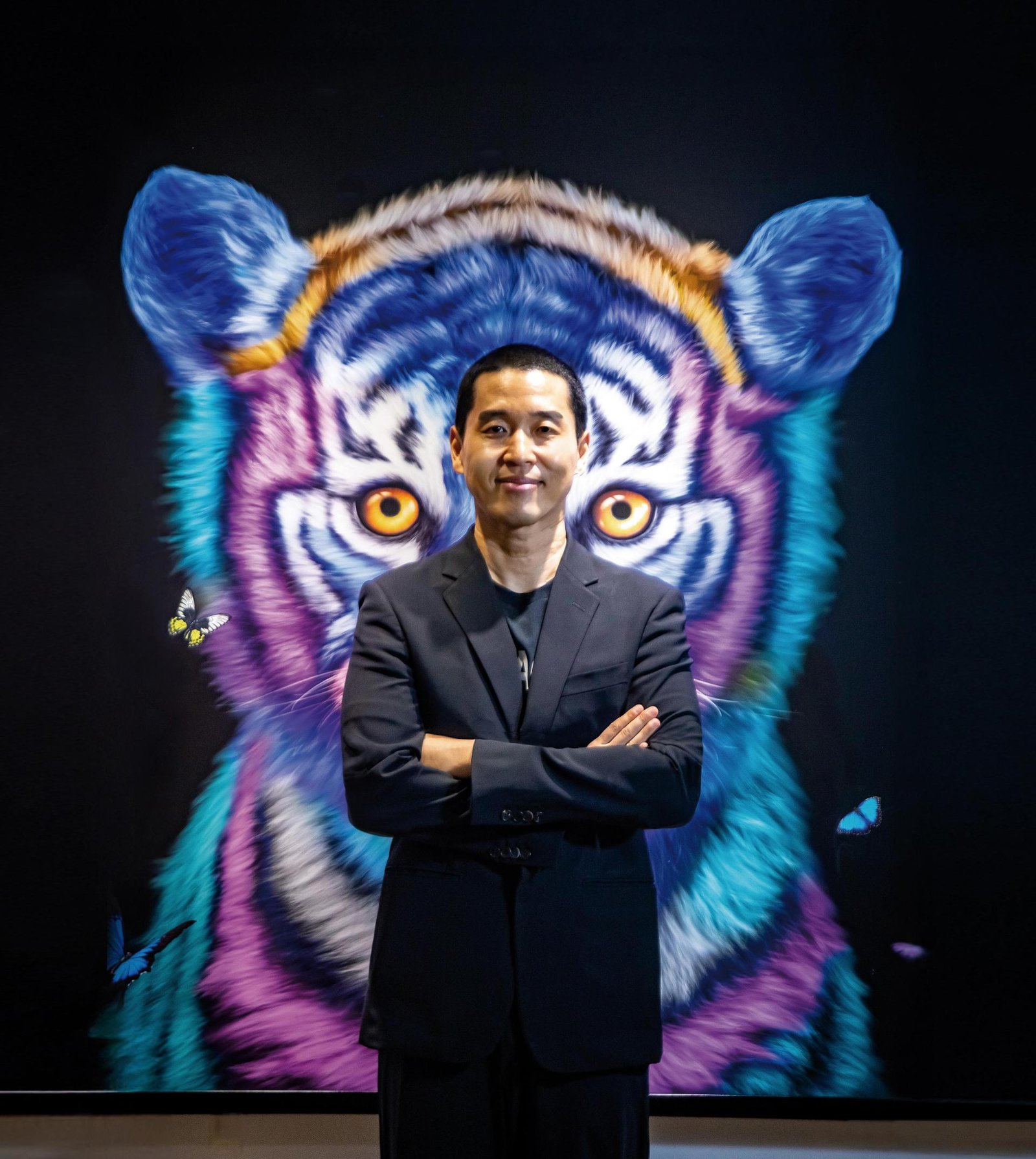
Artist Koh Sang-woo / Courtesy of Savina Museum of Contemporary Art
A young wolf named Neukgu became an overnight sensation last month when his escape from a theme park in Daejeon set off a nine-day search that kept the entire country on edge. When he was finally captured alive, his story became something more than just a miraculous rescue.
Just eight years earlier, a puma that broke free from the same facility was swiftly shot and killed, its death largely accepted as a necessary public safety measure. Neukgu’s live capture, by contrast, signaled a change in public ethos — one shaped by a deeper recognition of animal rights and preservation. And this week, it prompted the government to take a harder look at the country’s zoo management and animal welfare standards.
It is within this shifting social landscape that artist Koh Sang-woo’s haunting animal portraits resonate with particular force.
Through luminous blue-toned paintings of creatures scarred by human exploitation, Koh explores the shared vulnerability of beings forcibly pushed to society’s margins.
In his latest exhibition, “Still Breathing,” at the Savina Museum of Contemporary Art in northern Seoul, he expands that vision through his first collaboration with Cheongju Zoo, Korea’s first conservation-centered zoo.
Koh Sang-woo’s “Hana” (2026) / Courtesy of Savina Museum of Contemporary Art
Unlike traditional zoos built for display, Cheongju Zoo in North Chungcheong Province prioritizes wildlife rescue, rehabilitation, species preservation and animal welfare. Inspired by the real-life stories of animals under its protection, the artist turns their experiences into delicate digital brushstrokes.
One piece, “Hana,” portrays a rescued eagle born with a severe beak deformity that made life in the wild impossible. Within Koh’s dreamlike blue universe, the bird appears almost otherworldly — suspended in cosmic space, its gaze conveying both resilience and quiet dignity.
“I’ve long been skeptical of zoos, but Cheongju Zoo made me reconsider. Wild animals belong in nature, of course, but some simply cannot survive if returned. For them, places like this can serve an essential purpose,” the artist said.
Koh Sang-woo’s “Borderless Faces” (2026) / Courtesy of Savina Museum of Contemporary Art
In addition to the zoo collaboration, the exhibition also unveils new works born from his partnership with the World Wide Fund for Nature (WWF), documenting spotted seals around Baengnyeong Island in the Yellow Sea.
In paintings like “Borderless Faces” and “Borderline,” Koh turns his focus to seals inhabiting waters near the Northern Limit Line (NLL), part of the heavily militarized and politically fraught maritime border between North and South Korea.
For humans, the region represents division and unresolved conflict. For these marine creatures, however, the same dangerous frontier paradoxically becomes a haven, protected from hunters and abundant in food.
By portraying animals that move freely across human-imposed borders, Koh said he offers a poignant meditation on peace, coexistence and the enduring continuity of life beyond manmade divisions.
“Still Breathing” runs through May 31.
[ad_2]
Source link