
[ad_1]

Think you know Switzerland?
The recovery of the Bosschaert paintings was one of the foundation’s most dramatic recent successes—and a reminder that the work of the Monuments Men and Women Foundation is far from over.
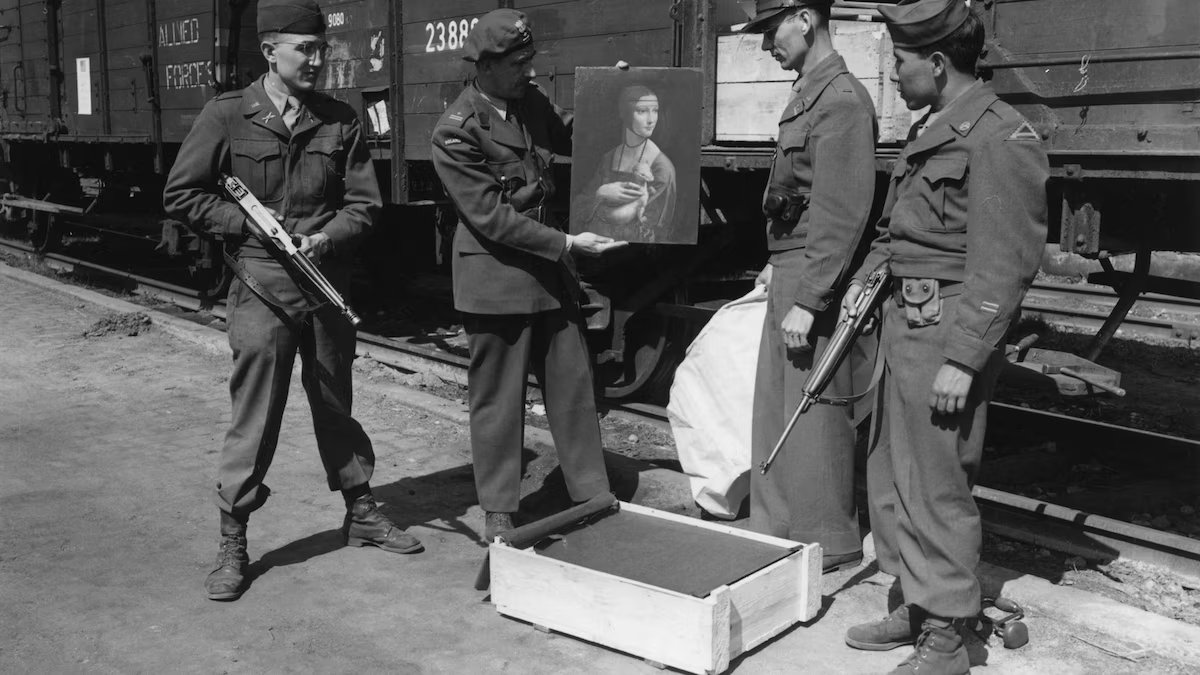
During World War II, the original Monuments, Fine Arts, and Archives (MFAA) program—popularly known as the Monuments Men—was composed of roughly 350 men and women from 14 nations. They were museum directors, curators, art historians, and conservators, many of whom traded their tweeds for fatigues. As Allied forces advanced through Europe, the MFAA officers followed close behind, identifying bomb-damaged churches, cataloging rescued works, and uncovering caches of looted treasures hidden in salt mines and castles. They recovered somewhere in the range of five million pieces of art, including Michelangelo’s “Bruges Madonna” (1503-05) and Édouard Manet’s “In the Conservatory” (1879).
For every painting tracked down and returned, countless others remained missing. Some were destroyed; others were hidden away in private collections, passed down quietly through families who never knew, or never asked, where the art had come from. Historians estimate that nearly 20 percent of artwork in Europe was stolen by the Nazi regime, in many instances through outright plunder and in others through forced sales as Jewish collectors were compelled to sell their pieces for significantly less than they were worth. Today, more than 100,000 pieces are still missing, spread out across the globe.
Among those 100,000 pieces are hundreds of paintings that were part of the Schloss collection. After the deaths of Adolphe and Lucie Schloss in the late 1930s, the collection passed to their four children, who moved hundreds of pieces of art to a château in the Loire Valley, hoping to keep them safe from plunder. In 1943, the Vichy government paved the way for seizure of the entire collection. More than 200 paintings were earmarked for Germany—destined for Adolf Hitler’s planned Führermuseum in Linz, Austria (Hans Posse, appointed by Hitler to source art for the museum, wrote specifically about the Schloss collection in his diaries in 1940, noting names and location), or for the personal collections of senior Nazi officials—while another 49 were diverted to the Louvre in Paris, where curators quietly inventoried and stored them even as the museum outwardly resisted overt collaboration.
By the time the Monuments Men reached Germany in 1945, the core of the Schloss collection had already vanished, and more than 150 pieces have yet to be found. How two of them ended up in Ohio is a mystery.
[ad_2]
Source link