[ad_1]
Holly Davey, the artist and PhD student behind Amongst Visions, on her research into Slade alumna Frances Jennings and why she found Jennings’ art so impactful.

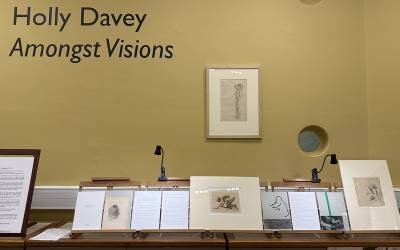
UCL Art Museum’s latest display showcases work by artist and PhD student Holly Davey, celebrating the life and work of Slade alumna Frances Jennings (1885-1915).
Davey, whose work shines a light on forgotten women artists at the margins of archives and collections, spent 18 months painstakingly piecing together fragments of information about Jennings’ life. In the end, she revealed a remarkable story about one woman’s struggle to live with disability and produce art at a time when women’s rights and freedoms were greatly curtailed, and there was little to no support for those with disabilities.
We caught up with Holly to find out more about her investigation into the Jennings archive…
Your display at UCL Art Museum was inspired by the work of Slade alumna Frances Jennings – how did you come across Jennings’ work?
Holly: I’ve been working within the UCL Art Museum collections as part of my PhD, and [specifically] the Slade Collection, which is a collection of prize-winning drawings from Slade students collected from about 1891.
45% of that collection is by women artists and my PhD is researching women artists, thinking more broadly about how women artists occupy collections, archives and our institutions.
[In the collection] there’s a series of archival boxes that have got the drawings in, and they’re all in chronological order, so I was going through each individual box looking for work by women artists, making notes, photographing them, going off and doing research, coming back, looking at the next box. And in one of the cupboards there’s one box labelled “Jennings”, and I took that out and I said to Andrea, who’s the acting Head of Art Collections and Lucy, who’s the acting curator, “Who’s Jennings?”
And they say oh, it’s a woman called Frances Jennings, but actually we don’t know that much about her. What we do know is we have 92 drawings of hers in the collection and this is them. So, then I looked at [these drawings] and was just completely and utterly blown away, transfixed.
What was it about Frances’ work when you first saw it that really grabbed you?
Holly: I think the emotional intensity of the drawings. They feel very light touch on the page – there’s an outline, often in pencil or ink, and then sometimes there’s a grey watercolour wash that’s being used to denote texture and tone or shadow of the body, the muscle structure. It’s the simplicity in a way, of the drawing, but what she’s doing with that is capturing the intensity of emotion in the sitter.
The style at the Slade and other art schools at the time was very much about understanding the skeletal structure, the muscle structure, muscle tone, light reflecting off the body, but what she was doing was something very different. It felt much more progressive and individual at that time.
And can you tell us a bit about Jennings’ life?
Holly: So, Frances Jennings was born in 1885, and she was one of three children. Her mother, Chrissy Cresswell, was also an artist. Unfortunately, when Frances was five, her father died, and then when she was about eight or nine, her mother then died as well. The children ended up in St Anne’s Charity School in London.
[After that] there’s a bit of a gap where I can’t find any information at all, and then I find her on a census in Teignmouth (in Exeter) with her grandmother.
The next time I find her, she’s moved to Dumfries in Scotland to live with her aunt Charlotte, and second cousin, Henrietta Cresswell, who was a very successful writer at the time. When she’s come to the Slade in 1905, it’s Henrietta Cresswell who supported her financially to study.
So, then she’s at the Slade and then in 1908, she gets an illness. I think it’s essentially some form of polio, and she recovers from the illness, but she’s left paralysed in one leg.
And this obviously has a huge impact on her wellbeing, her mental health, her physicality, and she carries on making work or trying to make work, but she’s really struggling. There’s no disability benefits at that time. There’s no support at all.
A group of women friends pull together a bit of money, so they give her a little bit of support financially. Then in 1910 she sees her doctor for a checkup and the doctor says you need to get out of London, you need fresh air.
And so, she decides to go on a tour, she gets a donkey cart and journeys from Glastonbury to St Winefride’s Well, in Flintshire in North Wales. She’s living on the road for almost a year, she’s sleeping out in fields, camping, sleeping in barns, meeting local people, writing letters, and she’s doing a series of drawings, which are in [a] book that I found, “A Tour in a Donkey Cart”.
Frances came back to London in about 1911/1912 and there’s very little trace then until a newspaper cutting of the inquest into her death, which was in 1915. From that I was able to look up different records to understand what had happened.
Her mental health had deteriorated, and she had moved a couple of times and then she was living on Cheyne Walk along the Thames, in a top floor room, and unfortunately, she decided to take her own life.
To piece together a picture of Jennings’ life, you used a mixture of archival material from UCL Art Museum and other external sources. How did you work with the UCL Art Museum team throughout this process?
I’ve worked with Lucy and Andrea incredibly closely, they’ve supported my research, enabling me to have access to material, to spend time with the drawings and paintings.
It’s been an absolute partnership with the exchange of knowledge at its core. My research helps to bring more knowledge [to] the Slade Collection. They have been wonderful to work with over the last five years and have been crucial in my supporting my PhD.
What was your first lead outside of the UCL Art Museum collection?
Holly: In 1921, Frances’ friend Isabel Derby pulled [Frances’] letters and drawings together from the tour, and she published them in a book called “A Tour in a Donkey Cart” with the help of publisher John Lane at The Bodley Head. I went and looked at the book [at the British Library] and it was just unbelievable.
Through her letters, I could really hear [Frances’] voice and understand the way she experienced the world. What interested her. What captured her imagination. You really got a sense of her through those letters, which was amazing because up until that point, I’d just got dates. I knew when she was born. I knew when she died, I knew when her parents got married, [the] kind of things that you can look up on the census or on electoral registers, but to actually have her letters suddenly it was like, oh, wow, I can hear this person, even though she died over 100 years ago.
To be continued…
We’ll be publishing part two of our interview with Holly next week. In the meantime, you can visit “Amongst Visions” at UCL Art Museum on Wednesday afternoons.
Plan your visit
Visit “Amongst Visions” at UCL Art Museum’s Prints & Drawings Room during public opening hours, Wednesdays 1pm–5pm between 24 September and 26 November 2025.
[ad_2]
Source link