
[ad_1]
The Brandywine Conservancy & Museum of Art is moving ahead with an approximately $100 million expansion that leaders say will reshape its Chadds Ford campus with a major new museum building, renovations to its historic mill, and a dramatic enlargement of public trails and conserved land.
According to Nicole Kindbeiter, the conservancy’s director of marketing & communications, work is anticipated to start in the spring of 2027 and finish, with an opening, in the fall of 2029.
Kindbeiter added that 31 from the United States and the rest of the world submitted qualifications, and that group was whittled down to six firms, which then submitted proposals.
“From there, three finalists were invited for interviews, including Kengo Kuma & Associates. Ultimately, the decision was based on the team who most clearly understood the unique nature of the Brandywine Conservancy & Museum of Art and offered a vision of a building reflective of our mission. We are delighted that our globally renowned design architect, Kengo Kuma & Associates, chose to partner with Philadelphia-based landscape architect Field Operations and Boston-based Schwartz/Silver Architects, giving us the best possible total design team reflecting our values and representing shining talent from both the USA and Japan.
“Out of all the candidates, this team best understood who we are and what we were looking to accomplish with this project. The resulting building designed by Kengo Kuma & Associates will be one that is both beautiful and in complete harmony with its surroundings, and one that is also reflective of our organizational identity.”
The plan calls for a 40,000-square-foot building designed by Kengo Kuma & Associates — the firm’s first museum project in the United States — plus significant upgrades to the Brandywine Museum of Art’s mill building along Brandywine Creek. The landscape portion, led by Field Operations, would expand the institution’s current 15-acre campus into a 325-acre public preserve and garden with about 10 miles (16 kilometers) of trails. Construction is expected to begin in spring 2027, with the new building slated to open in fall 2029. The conservancy said it has raised nearly half of the projected cost.
Virginia Logan, executive director and CEO of the Brandywine Conservancy & Museum of Art, said the effort is intended to advance the organization’s founding mission as it nears its 60th anniversary.
“Since our founding in 1967, our vision has been to ‘preserve the land that inspired so many artists,’” Logan said in a statement. “As we approach our 60th anniversary, this campaign fulfills that founding vision at a transformative scale.”
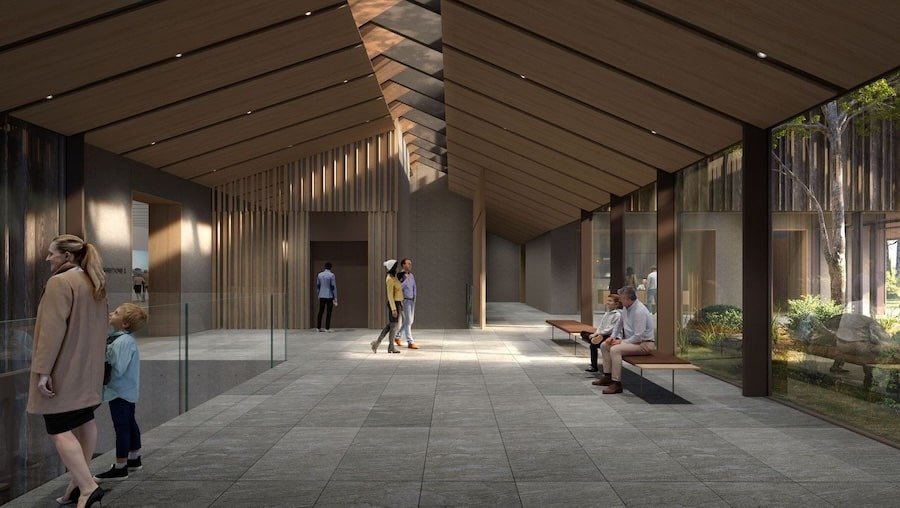
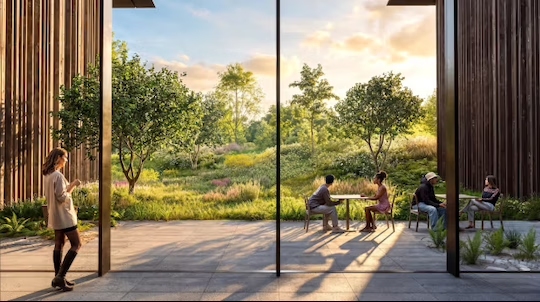
Design drawings show the new museum as four wood-clad pavilions aligned along a central corridor, with low, vernacular-style roofs that rise to uneven peaks. Visitors would enter from the southeast at the upper level into a hall framed by views of the surrounding preserve, with galleries on either side. Plans also include additional gallery space on the lower level, along with a coffee bar and a terrace.
The new building would add about 14,000 square feet of gallery space, bringing total exhibition space across both buildings to nearly 20,000 square feet — an increase of about 80%, the organization said. Plans include a 4,000-square-foot gallery for landscape paintings, a second 4,000-square-foot gallery for special exhibitions, and a 1,000-square-foot space dedicated to Andrew Wyeth on the upper level. The lower level would include another 1,000-square-foot special exhibition gallery and a 4,000-square-foot gallery aimed at presenting 130 years of work by five Wyeth family artists across three generations.
Kuma said the design is meant to connect visitors to the landscape rather than dominate it. “Our design seeks to honor the dynamic and evolving relationship between art and nature by creating a building that emerges from the landscape rather than imposing upon it,” he said. Balázs Bognár, a partner and executive vice president at Kengo Kuma & Associates, said the building and trails are intended to encourage visitors to move “from the surroundings to artwork and back again.”
“Our design seeks to honor the dynamic and evolving relationship between art and nature by creating a building that emerges from the landscape rather than imposing upon it,” said Kengo Kuma, Founding Partner, Kengo Kuma & Associates.
Added Balázs Bognár, Partner and Executive Vice President at Kengo Kuma, “The design puts landscape at the heart of the experience, with the new building playing part of a much larger story of Brandywine’s fused mission as a land conservancy and art museum. The landscape connects both museum buildings, encouraging all to find deeply personal paths from the surroundings to the artwork and back again. We hope that visitors feel a meaningful sense of locale, following the footsteps of artists inspired by the place, immersed in histories, and surrounded by local materials, techniques, and suffused forest light. The landscape and the art frame each other, and the new work offers considered spaces for that relationship.”
The existing museum building — a converted mid-19th-century grist mill — would remain a central part of the visitor experience. After being significantly damaged by flooding from Hurricane Ida in 2021, the conservancy said the mill recently underwent flood-hardening work that uses “submarine-grade” technology to make the lower level watertight. The museum also renovated parts of the building and courtyard to replace lower-level public programming space and to create a barrier-free entrance.
Additional renovations are planned, including an interactive exhibit on the conservancy’s land and water protection work, a new studio art classroom and expanded space for educational programming and events. Once the new building opens, the mill would keep three galleries totaling about 5,500 square feet for works from the museum’s permanent collection, along with the Millstone Café and two research destinations: the Walter & Leonore Annenberg Research Center and the Andrew & Betsy Wyeth Study Center.
Thomas Padon, director of the Brandywine Museum of Art, said the added space would allow the museum to show more of its collections — including its Wyeth holdings, landscape paintings, and American illustration — and to mount larger special exhibitions. He said the mill building would continue to offer an intimate setting for collection displays while supporting more programs and events.
Outside the galleries, planners are also banking on the landscape as a major draw.
Field Operations’ design would turn the current campus into a 325-acre preserve and garden described as a “learning landscape,” with about 10 miles of trails — more than double the existing network — including boardwalk segments through wetlands. Plans call for expanded native plantings and interpretive signs about local ecology, along with stormwater features near the new building intended to improve weather resilience. The proposal also includes changes near the mill building, such as improved drop-off and parking, and expanded native gardens along the creek.
The conservancy said visitors would see new educational installations in the mill building as well as an outdoor classroom and nature play area within the preserve. The trail loop is expected to connect both museum buildings with the original studios of N.C. Wyeth and Andrew Wyeth, National Historic Landmarks, that the organization said will have expanded public hours during the season.
“Every element of our landscape design, from the plantings to the interpretive moments along the trails, is intended to deepen visitors’ understanding of stewardship and their connection to the natural world,” said Sarah Weidner Astheimer, a partner at Field Operations.

About Rich Schwartzman
Rich Schwartzman has been reporting on events in the greater Chadds Ford area since September 2001 when he became the founding editor of The Chadds Ford Post. In April 2009 he became managing editor of ChaddsFordLive. He is also an award-winning photographer.
[ad_2]
Source link