
[ad_1]
Navigating information is a convoluted process—how do we enter the story? This is the question that lingers throughout Nyeema Morgan and Mike Cloud’s exhibition “Story Structure, Pt. 2” at the Neubauer Collegium. The artworks are grounded in varying narratives shown in an unstable state, one wrapped in the present with burdens it carries from both the past and the future.
“Story Structure, Pt. 2”
Through 6/28: Mon–Fri 9 AM–4 PM, Neubauer Collegium, 5701 S. Woodlawn
Morgan’s artwork, scattered across the walls in differing installations, includes seemingly unfinished, framed works and videos embedded into the wooden panel walls—both obstructed by letterpressed Post-it notes.
The framed pieces are presented as if an artist were inspecting them before completion, or a registrar was creating a report on the artwork; in either instance, it is an intimate inquiry into understanding the condition of the work. It is also an instance where the power to complete a story (or an event) and its perspective is left to one individual. The videos embedded in the walls amplify this encounter by directly concealing a work of art.

Credit: Robert Chase Heishman for Bob.
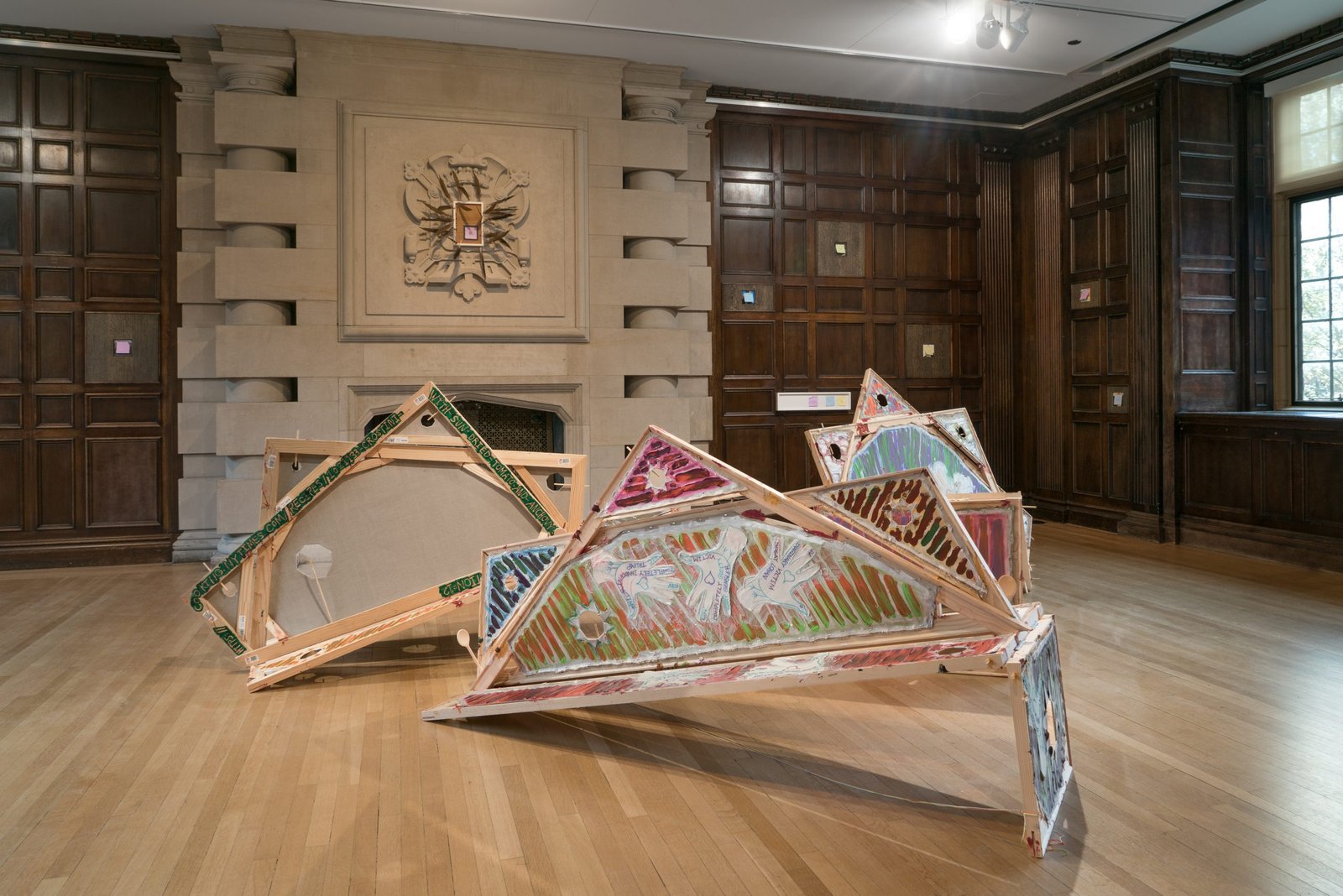
In the center of the room are three paintings by Cloud that point back to news articles (or, in one instance, a recipe), with the article links written on their stretchers. The paintings appear like benches made out of stretchers and canvas; they register more as sculptures, maintaining a position as a contemplative object. Instead of those news articles transmitting concrete bodies of information, they mystify their narrative through form. Information is no longer of the immediate image, but its delay, asking: What are the expansive ways of holding onto a story?
The connectivity between objects, ideas, events, and people forms the primary material and interplay in these artworks. One way to approach them is to consider the medium’s internal history, alongside the social and cognitive networks that surround artmaking. In this exhibition, viewers are invited to navigate the intimate relationships between artists, between Cloud and Morgan specifically, as well as the social, cognitive, or sympathetic connections, and the broader unpredictable convergence of events unfolding across the world and in visual arts history. An audio installation of Cloud and Morgan titled “Everything I Know about Warhol I Learned from Kusama. Everything I Know about Kusama, I Learned from . . . ” plays as a recursive relay that folds inheritance into citation, and citation into a kind of performed knowing. This interplay stretches the meaning of each work beyond the immediate, prompting a reflection on how narratives are constructed and circulated.
In a media landscape increasingly dominated by alarmist or reactionary information, the imagery of the world can feel overstimulating yet depleted of resonance. Cloud and Morgan respond to this condition through artistic processes that negotiate the value of images and information, offering a reconsideration of attention and care.
The artworks emphasize narrative as a symbolic, rather than fixed, form. While materially distinct, both artists converge conceptually in exploring the provisional and relational dimensions of perception. The viewer encounters partially realized stories, fragments that resist closure and the commodification of information. Morgan and Cloud treat social relations, images, and beliefs as unfixed, contingent, and open to reconsideration. They cultivate attentiveness to nuance, to the rich interaction of context, history, and perspective that often gets lost when stories are simplified.

Credit: Robert Chase Heishman for Bob.
Within this space of notation and inquiry, the apparent gaps or absences in the works—such as the missing connections between Cloud’s abstract forms in his painting and the articles to which they refer, or the blank spaces in Morgan’s frames and the concealed images—create a relational field between the viewer and the artistic process. The exhibition resists the logic of the fixed or consumable image, offering instead a reflective mode in which the act of looking becomes an active, thoughtful engagement.
This approach encourages a reconsideration of how we might approach not only art but the narratives circulating in the wider world. By attending to questions and encouraging multiple forms of viewership and inquiry, the works suggest alternate ways to engage with contemporary events and their multiple perspectives. They model an approach to storytelling that is provisional and relational, asking us to consider how we might “finish” narratives together without imposing a singular resolution.
The exhibition emphasizes the ethical and imaginative possibilities inherent in narrative incompleteness. Morgan and Cloud’s work reminds us that the act of interpretation is always ongoing and that understanding emerges not from closure but from engagement and reflection. Their art offers a space in which stories remain open, and where the viewer’s attention becomes part of the evolving structure of meaning.
Reader Recommends: ARTS & CULTURE
What’s now and what’s next in visual arts, architecture, literature, and more.

Works by Nordic artist Sofia Hagström Møller light up the Swedish American Museum for its 50th anniversary.

This season, exhibitions in Chicago provide canopy cover from the chaos of infinite wars.

Will Quam’s new book shows that the story of brick and the story of Chicago are forever intertwined.

John A. Knudsen fashioned a visual symphony of simultaneous urban motion.

Critic Pia Singh surveys the scene at EXPO Chicago and beyond.

“Castle” asks visitors to think about what a painting is and who, truly, is its painter.
[ad_2]
Source link
