
[ad_1]

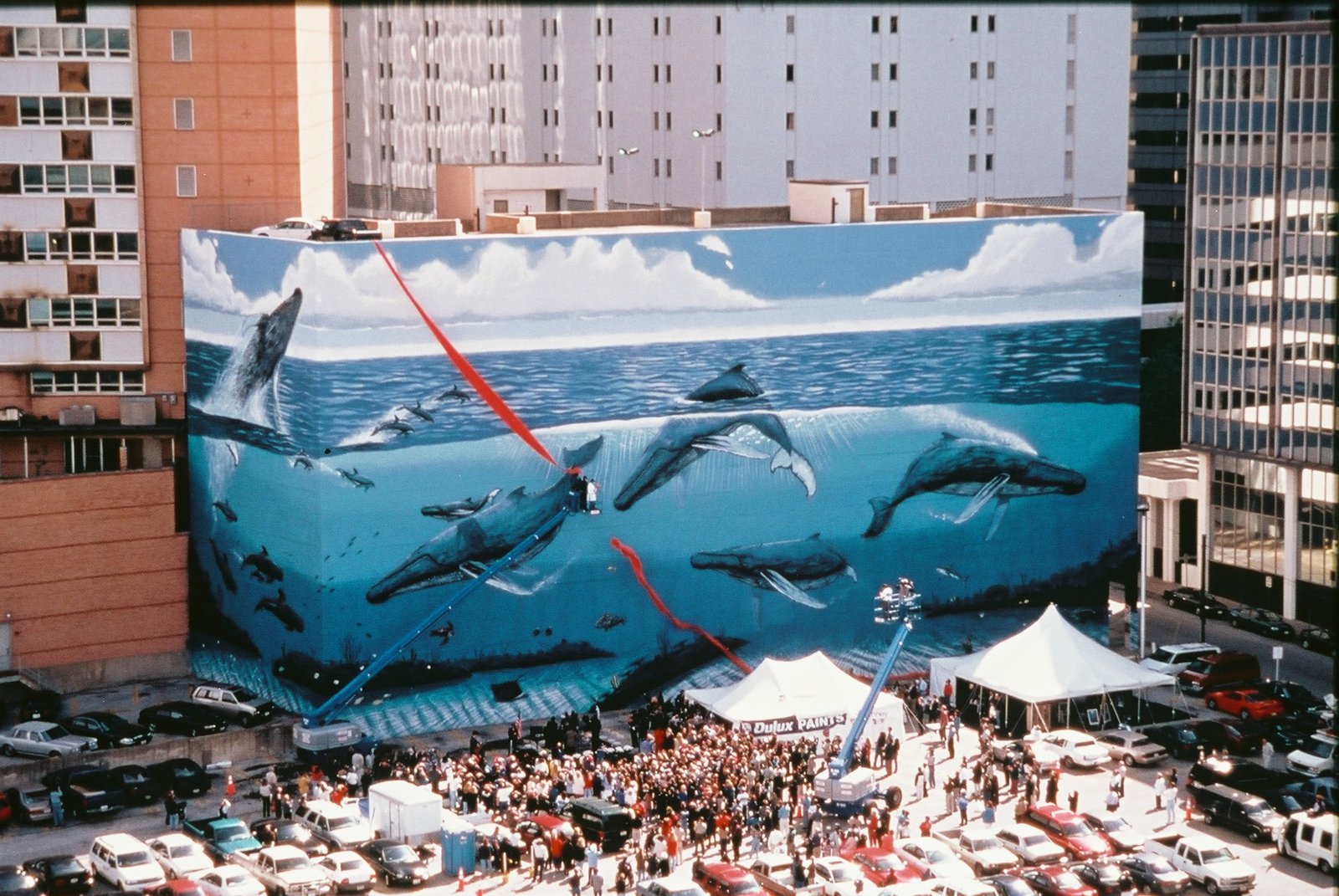
The official dedication of Wyland’s giant mural of humpback whales in downtown Dallas in April 1999.
Is it worth mourning the now-lost whale mural by Wyland, recently painted over by surprise? On this point, I had some initial doubts.

The mural wouldn’t qualify as a work of artistic genius. It was covered up for many years. There are many dozens of other “Whaling Walls” in different cities that take the same basic approach. They have finite lifespans, and every so often one of them in Vancouver, or Milwaukee or Redondo Beach is threatened or destroyed. Time marches on. What’s the big deal?
Article continues below this ad
Such a callous dismissal, though, is a mistake. Dallas’ mural struck a chord with the public, and with good reason. While it lasted, Wyland’s wall inspired a themed restaurant in Fairview. Artist Byron Pritchett, who originally worked with Wyland in 1999, has continued in the same tradition with many works in his own right. Understanding why the mural resonated might help guide future plans.
In that spirit, I offer three propositions against which to test Wyland’s whales.
First: Big is good, blue is good and a bigger blue is even better and bluer. Perhaps surprisingly, this was a maxim of the great modern painter Henri Matisse, as brilliantly explained by the art historian Yve-Alain Bois: “One square centimeter of any blue is not as blue as a square meter of the same blue,” or alternatively, “The quantity of color was its quality.”
Other artists, for example Teresita Fernández in her tranquil installation at Austin’s Blanton Museum, have had similar intuitions. Just by being big, Wyland’s mural evoked the ocean in a way that a postcard-sized reproduction would not. Here on the windswept prairie, a glimpse of the sea is even more precious.
Article continues below this ad
Second: Nature, art, science and the public belong together, despite the relentless pull of specialization. Today, it is too easy to take for granted that art and science are the domains of different specialists, and that research, education and entertainment are separate enterprises. But it wasn’t always this way.
As late as the 19th century, the drawings of Humboldt, Audubon and Ruskin simultaneously engaged art, science and the general public. The point is that the human imagination is a unified thing, despite the practical division of labor among different fields. Wyland’s mural was a sign of the interconnectedness of humans and nature, and of the interrelatedness of painting, marine biology and whale watching.
It’s too easy to separate these things. Products of the present-day art world, such as Gabriel Orozco’s whale skeleton or Damien Hirst’s formaldehyded shark, despite being sophisticated and prestigious, have a certain deadness about them, lacking the simple joy of Wyland’s mural.

Crews recently painted over the artist Wyland’s Whaling Wall 82.
Third: In streetscapes that lack visual interest, every landmark counts. The whales’ demise might not have been noticed as much in Paris or Barcelona. But as history would have it, the built environment of downtown Dallas (with a few honorable exceptions like the Adolphus Hotel) largely dates from a period when the fashion in building had largely turned away from ornament and decoration, depriving any given block of the human-scale texture and visual interest that would give pleasure to a passerby.
Article continues below this ad
Setting aside the question of public monuments, downtown Dallas sadly missed out on the vernacular architecture that makes it a pleasure to walk in New Orleans’ French Quarter or New York’s Soho. In an environment with few delights for the eye, the whales were all the more welcome. Beauty downtown is scarce and can’t afford to be squandered.
To be sure, Wyland’s legacy lives on in many other cities. Dallas will move on. But wouldn’t it be nice if the reaction to this loss made an impression on the next generation of developers and planners?
[ad_2]
Source link
