[ad_1]
The late 1980s and early 1990s mark the beginning of contemporary art in China, but its emergence remains poorly understood. Frequently framed through Western perspectives, Chinese art of this period is often cast as belatedly catching up to international developments.
Buxton Contemporary’s Poetry goes no further than language: A historical moment of art becoming art again, curated by Carol Yinghua Lu and Liu Ding, examines the rise of experimental art in China from the mid 1980s to the early 1990s. It focuses on a small number of artist groups that challenged established artistic norms and expanded the boundaries of Chinese art. The exhibition also includes a new commission by Melbourne-based Darcey Bella Arnold, whose practice reworks language as both material and system, bringing the exhibition’s inquiry into how meaning is produced into the present.
The exhibition challenges a centre–periphery dynamic in which Euro-American art operates as the primary source of cultural authority. While the more recent globalisation of contemporary art through biennials, transnational markets and expanded curatorial networks has produced a more distributed field, underlying asymmetries of cultural power remain largely intact.
Western conceptual art emerged in the mid 1960s to challenge the structures and values of an established art system by foregrounding ideas over objects. The works in the exhibition emerged from the political shifts following the end of the Cultural Revolution (1966-76) and the subsequent period of reform. For Chinese artists working after decades of state-sanctioned socialist realism, anti-art strategies were a way to rethink art once experimentation became possible and their application differed significantly. Rather than working within gallery contexts, artists often worked informally, using radical practices to further intellectual awakening.
While the exhibition shows how local circumstances shape art practices, beyond this framing its most compelling aspect is the artists’ commitment to critical analysis under constraint. Many developed their work through self-directed study while holding manual jobs, orienting their intellectual engagement towards ways of thinking outside state authority and ideology. Hence the title Poetry goes no further than language, taken from poet Han Dong’s 1985 declaration that writing should not be burdened by external agendas, particularly political ones, but instead draw its force from the experimental possibilities of language itself.
The New Measurement Group (Wang Luyan, Chen Shaoping, Gu Dexin, Li Qiang, Wu Xun and Cao Youlian) argued that Chinese contemporary art should reject the subjectivity associated with Western modernism, proposing a rational, measurement-based approach grounded in quantitative relations. Rejecting expressionism and existentialism, they reconceived art as structured knowledge production, a rigorous, quasi-scientific method rather than personal expression.
Working collectively, they stripped art of expressive intent through manifesto writing, self-published texts and diagrammatic works grounded in technical drawing. Tactile Art (1988) by Wang Luyan and Gu Dexin exemplifies this approach. The series of small black-and-white drawings use diagrams and text to describe tactile sensations from temperature and wind to walking barefoot over different surfaces.
The work is completed through viewers’ imagined sensation, a state detached from social and cultural frameworks and thus an expression of freedom. The wider group’s series Basic Existence–Point-Static Measurement (1990) was developed using strict procedural rules, testing whether individual expression could be standardised. Although working from a single “point” under identical instructions, each member produced divergent results, exposing the persistence of subjectivity.
The New Measurement Group gained international attention and were invited to exhibit in New York. Yet consistent with their anti-art position, they voted in 1995 to destroy all works and dissolve the collective. Their stance is pre-empted in a 1986 statement by critic and curator Li Xianting claiming, “The revival of art is not a revolution of art itself, that is, of the paradigm of language, but a movement of intellectual awakening. What Matters is not Art”.
A related withdrawal from art as a fixed category is evident in Qian Weikang’s Ladder Poem (1990). Restaged for the exhibition using an Australian dictionary, the work is a writing experiment that saw Weikang drop words selected randomly using a dictionary from a ladder onto chalk-lined flooring in his Shanghai apartment, allowing chance to generate “automatic” poems that he later recorded. Rejecting conventional syntax, he was interested in breaking language apart, an approach influenced by Samuel Beckett and the anti-linear logic of Happenings.
The curators note that while these experimental practices were never dominant and largely receded by the late 1980s, they were instrumental in introducing performance, installation and conceptual approaches as an intellectual foundation for contemporary Chinese art. This historical framing is reinforced by placing the recreated works in dialogue with a contemporary Australian commission, foregrounding the persistence of these concerns in present-day practice.
Darcey Bella Arnold uses painting, drawing and sculpture to examine how language operates. Drawing on art history, personal archives and popular culture, she destabilises the fixed meanings of words through metaphor and repetition. To complicate notions of artistic agency, she incorporates material from her mother’s notebooks (her mother lives with aphasia) alongside AI translation and stencilling processes.
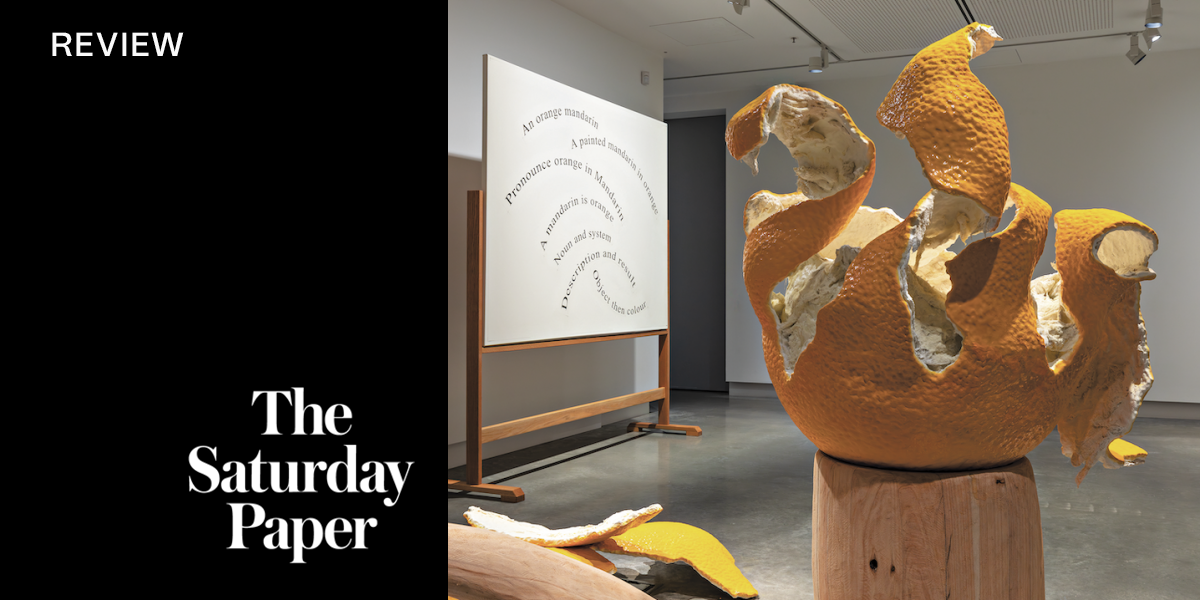
Her sculptures based on found orange peel explore the layered history of naming. In English orange is unusual in that the fruit term precedes the colour term. Arnold extends this anomaly through citrus variants such as mandarin, introducing cross-linguistic associations, particularly in Chinese, where orange carries connotations of luck and prosperity through homophonic play. These linguistic operations are grounded in material form. The discarded peels are digitally scanned and enlarged into sculptural objects that shift between the organic and the constructed.
This is an exhibition that requires time. The extent of text-based works and other documentation, together with tables for reading, transforms the gallery into a study-like environment that supports sustained engagement with the artists’ evolving motivations. With text presented in Chinese and English, the exhibition disrupts narrowly Western accounts of conceptualism by positioning the Chinese practices within a broader, globally distributed history of radical art.
Poetry goes no further than language: A historical moment of art becoming art again is showing at Buxton Contemporary until October 3.
This article was first published in the print edition of The Saturday Paper on
May 16, 2026 as “Poetic licence”.
For almost a decade, The Saturday Paper has published Australia’s leading writers and thinkers.
We have pursued stories that are ignored elsewhere, covering them with sensitivity and depth.
We have done this on refugee policy, on government integrity, on robo-debt, on aged care,
on climate change, on the pandemic.
All our journalism is fiercely independent. It relies on the support of readers.
By subscribing to The Saturday Paper, you are ensuring that we can continue to produce essential,
issue-defining coverage, to dig out stories that take time, to doggedly hold to account
politicians and the political class.
There are very few titles that have the freedom and the space to produce journalism like this.
In a country with a concentration of media ownership unlike anything else in the world,
it is vitally important. Your subscription helps make it possible.
Send this article to a friend for free.
Share this subscriber exclusive article with a friend or family member using share credits.


[ad_2]
Source link