[ad_1]
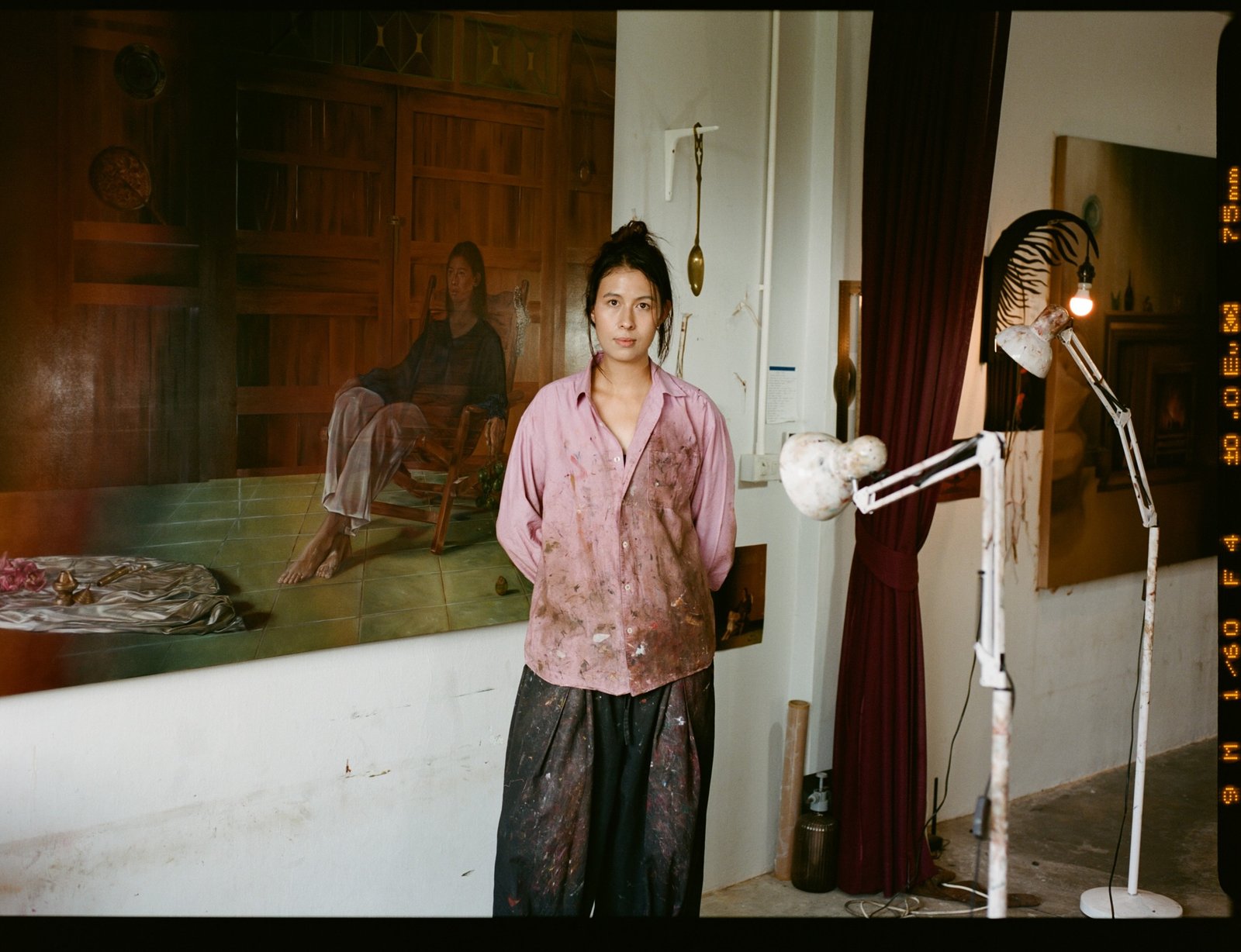
Natalie Sasi Organ (b. 1999) is a multidisciplinary artist working with painting, sculpture and text to explore scattered histories, transmigratory roots and the dichotomies of cultural hybridity. With her paternal roots splayed across Bristol, England, and her maternal lineage in Thailand, Sasi Organ’s works, like her cultural identity, reside in the in-between: bodies float, knives dissolve into palms, candelabras and crystal vases become otherworldly apparitions suspended in hazy shadows.
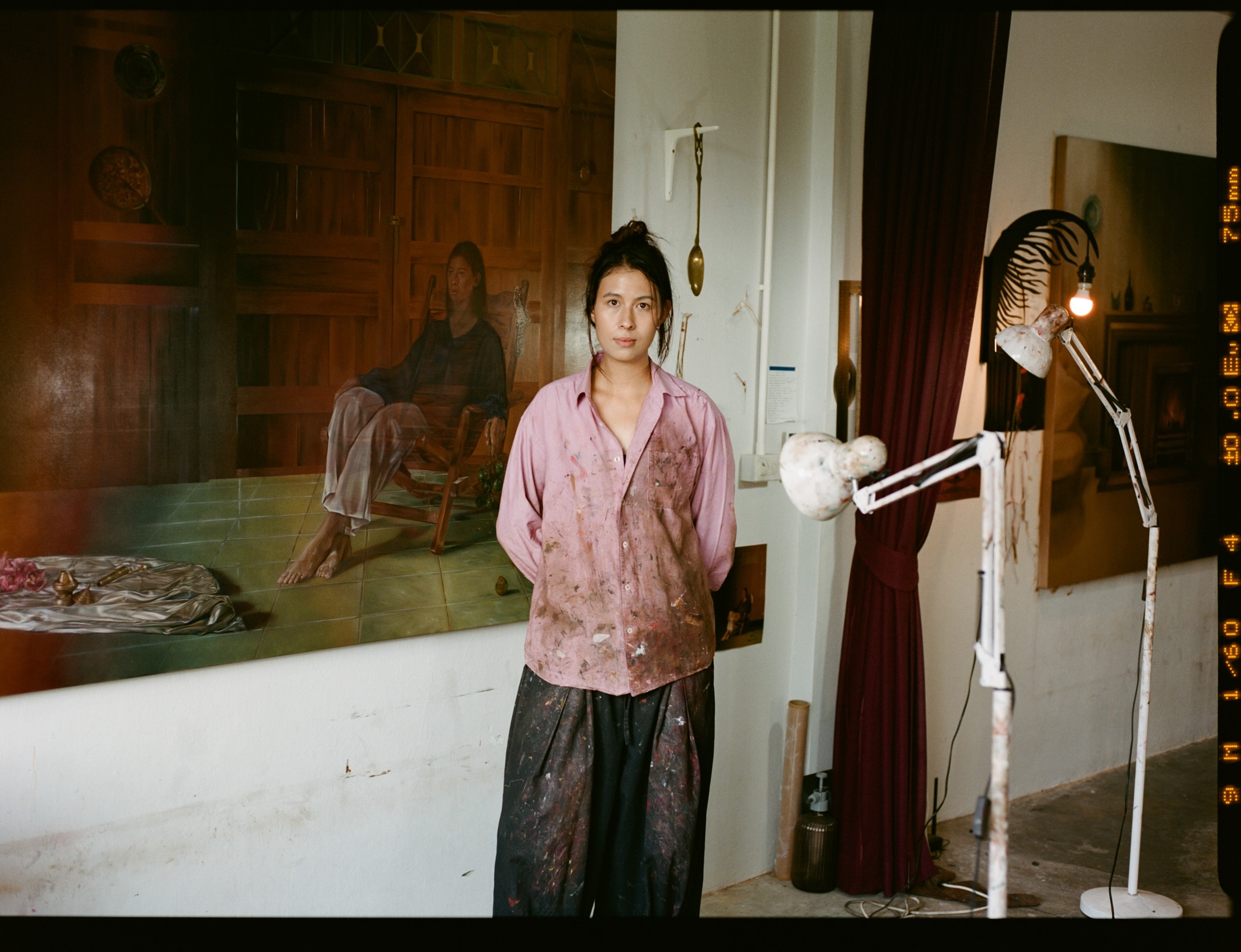
After completing her Bachelor’s degree at Central Saint Martins in 2022, the artist returned to her mother’s homeland in Thailand and has spent the last three years developing her distinctive ephemeral style. Through translucent surfaces and recurring motifs of fire, disturbing the notion of linear passage of time, and confronting different traditions, Sasi Organ constructs emotionally charged spaces, where personal memory intersects with broader questions of female experience and cultural heritage.

Masquerading memory
A recent diptych oil painting, I bloomed where cut, I burned where placed (2026), is imbued with the artist’s distinctive ephemeral quality. Sasi Organ deploys this cunning visual device to challenge Eurocentric assimilation and muddle how memory is stored, while also injecting humour into her work.

She appears in the composition twice herself: in the right-hand panel, the artist’s figure ripples translucent in her maternal grandmother’s dwellings in Hua Hin, like the distant horizon on a sweltering summer’s day; a mirage. Where did she leave? Where did she go? She is playing with us. We then catch the artist in the left-hand panel. With her body turned towards the fireplace of her paternal grandparents’ cosy home in Bristol, shrouded in a milky silk gown, she refuses to show her face to us – teasing the audience once again. Her upright, open posture is oriented towards the cluster of betel nuts crackling in the fire flames.
Betel nut chewing is a popular practice in Thailand, the South Asian and Taiwan region, and Sasi Organ recalls how her grandmother would often gnaw on the natural stimulant and narcotic. At times, she would smother it into her granddaughter’s skin to soothe mosquito bites – an effective home remedy, turning discomfort into tenderness. Facing the source of both her affection and disgust, as the title of her painting suggests, the artist confronts the whirlpool of contradictory emotions and memories which compose her identity.

The Time Masters
The artist’s decision to frame herself as the subject(s) of her work follows a long vein of women artists such as Lee Bul, Tracey Emin, or Frida Kahlo, who, through autobiographical narratives, explore wider collective themes of body policing and the violence enacted upon them through racial, geographical, and sexual borders.
Fuzzying the brushstrokes in I bloomed where cut, I burned where placed, Sasi Organ occupies different positions and times simultaneously, disrupting the linear flow of time. Through the milky folds of flesh and flickering trouser legs, she taunts us, as if to say: “I was never really here”. By refusing to ground herself entirely in her composition through the deft application of paint, the past and the present muddle together and absence and presence intermingle.
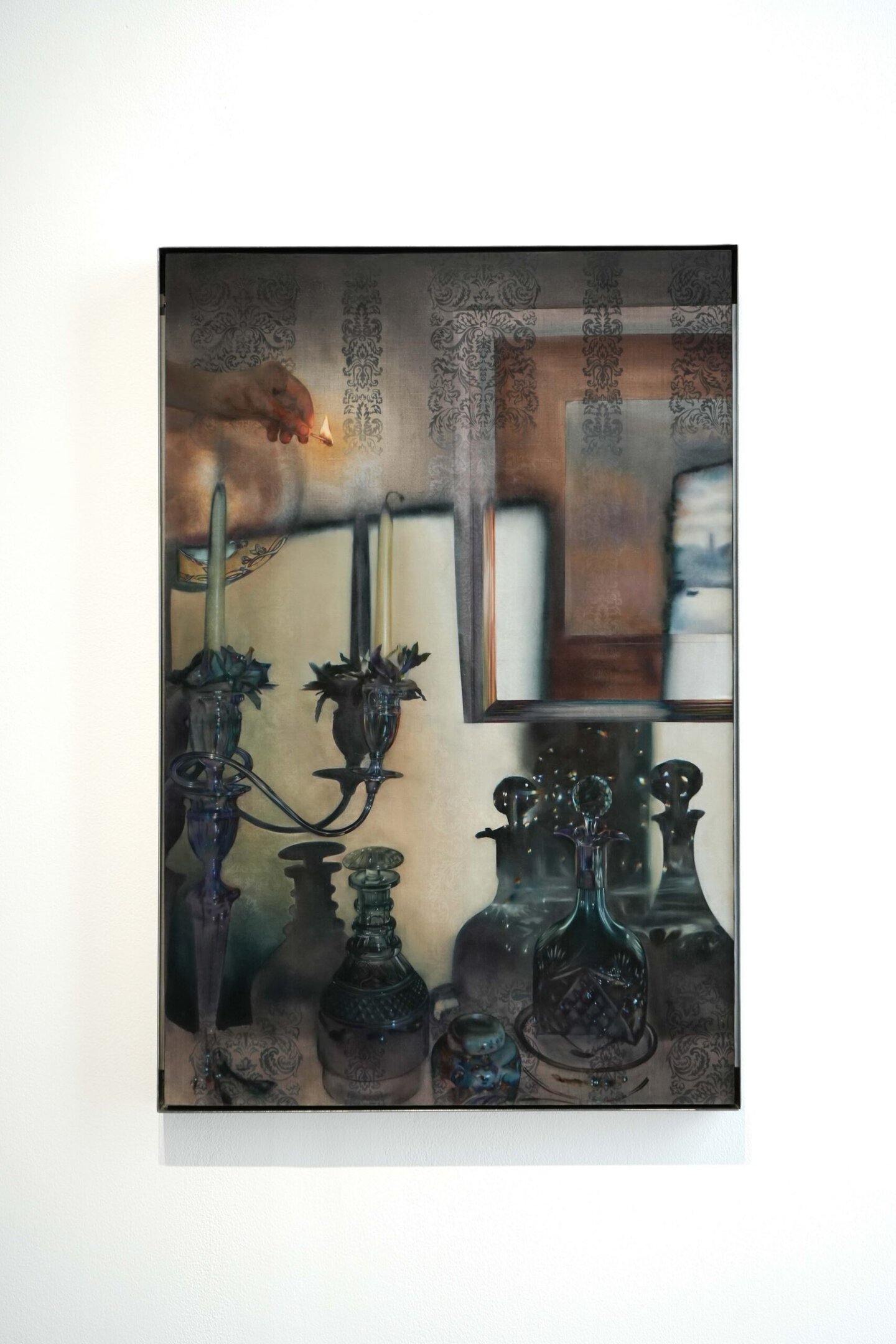
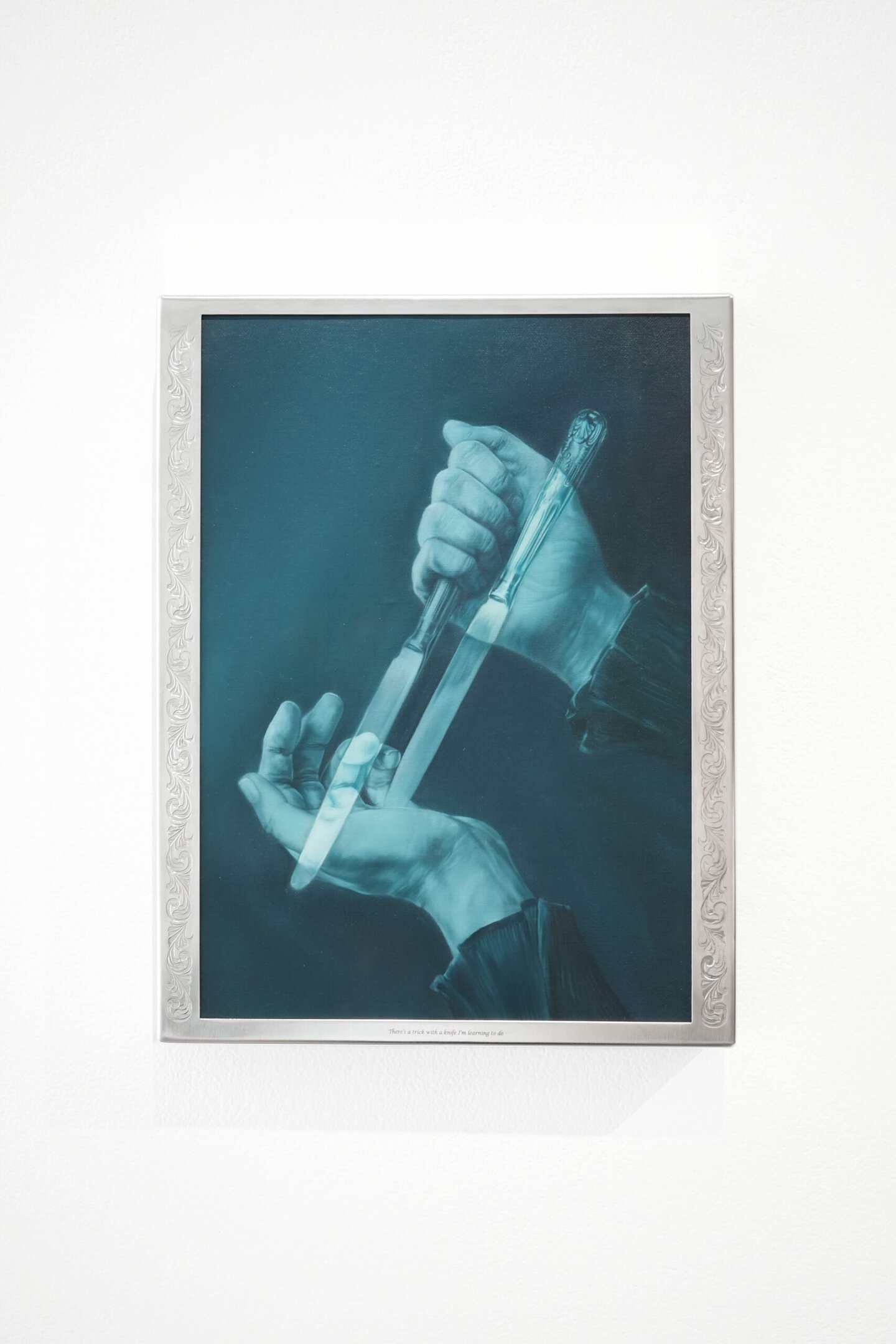
Cure for Bites (2026), Last Light (2026) and A blade of honey between our shadows (2026) are equally shrouded in this translucence. Functional and decorative objects of kitchen knives, candelabras, and glass ornaments become elevated to ethereal proportions through Sasi Organ’s glossy and lustrous application of paint. Yet beneath the sumptuous surfaces fester questions surrounding the structure of memory and remembrance – they are like what André Breton dubbed Frida Kahlo, a ‘ribbon around a bomb’.

Grandmother Muse
While Sasi Organ’s paintings retain a subtlety, her sculptural piece, Hold your feet to the fire (2026), raises questions of the archiving of history and recording of knowledge in a more astute and provocative manner. Reimagining the form of a firepit clad in stainless steel, the artist invokes the age-old Thai custom of Yu Fai, or “staying with fire”: a postpartum ritual using heat to heal the mother’s body after childbirth. She recalls how her grandmother underwent the practice for each of her eight children: transgenerational knowledge inscribed in flesh.
Since the mass monopolisation of Western medicine in Thailand, practices such as Yu Fai have become systemically marginalised, replaced by pharmaceutical market forces. Sanitised wellness resorts have substituted the original practitioners – the midwives, shamans and plant healers – who have become mythic legends in their own right, relegated to the esoteric and exotic in the Western imagination.
By casting the betel nut as the centrepiece of her swerving scarlet, disc-shaped altar, Sasi Organ reclaims the source of this ancestral practice, absolving it from the Western fetishistic gaze. She commemorates its diverse properties – as a socially binding agent used at weddings and ceremonies, and for its medicinal uses. Ceremoniously dipped in silver, here it is a talisman, a gateway between generations of women, a transcendental object.
As artist and critic Suzi Gablik notes in Has Modernism Failed? (1984), it was precisely this lack of transcendence which marked the twentieth century’s greatest failings. In order to elevate the cult of the individual, tradition, home, and ancestral connection are cast aside in favour of technological advancements and the drive of the ego. Sasi Organ’s work shifts the dialogue back outward onto the collective. Creating a space for sacred tradition, she honours one’s social self, a belonging to a cohort beyond our navel-gazing culture and commodified wellness industry. Sasi Organ’s weaves connections spanning generations – despite losing her grandmother, her traditions and memory continue, the fire stays with her.

The fire never goes out
It is a recurring motif throughout Sasi Organ’s work: the fire that flickers in the strike of the match of Last Light (2026), a determined ochre illuminating the crystalline ornaments, or in the title of her participatory sculpture Hold your feet to the fire (2026), nodding to the traditional Thai postpartum pain-relief custom Yu Fai. Fire sticks – it is tenacious, unyielding.
It’s the relentless hue that rages in the fireplace, and the red paste that heals hurt flesh. Like the vermillion red liquid that spews from the mouth of a betel chewer, Sasi Organ’s works defy staying encased in the borders that they have been given. They bleed and flow, like one’s never-ending search for living in the in-between.

BIO
Sasi Organ was born in Thailand, where she now resides, and completed her formal studies at Central Saint Martins in London, UK. She was awarded the Sovereign Art Foundation Student Prize, Affordable Art Fair Hong Kong in 2017 and was shortlisted for the MullenLowe NOVA Awards in 2022. In 2026, Sasi Organ received the Debra Porch Award: Visual Arts Residency award. She has participated in numerous exhibitions at London venues, including APT Gallery, Safehouse in Peckham, and Crypt Gallery, and has exhibited extensively throughout Singapore, Seoul, South Korea, Jakarta, Indonesia, and Bangkok, Thailand. Recently, she has had a solo exhibition She lit my mouth without a word at the ara contemporary in Jakarta, Indonesia.

[ad_2]
Source link