
[ad_1]
Back in October, a couple of days after the Wolves beat the Portland Trail Blazers 118-114 on opening night, FBI agents swooped in to arrest Blazers head coach (and former Wolves point guard) Chauncey Billups for allegedly participating in a nefarious mafia-run scheme to rig illegal poker games. Immediately after Billups’s arrest, everybody’s favorite viral high-meets-low-culture meme account, @artbutmakeitsports, posted a photo of Billups from his playing days juxtaposed with a painting from the Minneapolis Institute of Art’s collection, Dutch master Hendrick Ter Brugghen’s 1623 painting, The Gamblers. It was the perfect @artbutmakeitsports post—a smidge of art history together with a little pop culture commentary, wittily rolled into a tweet.
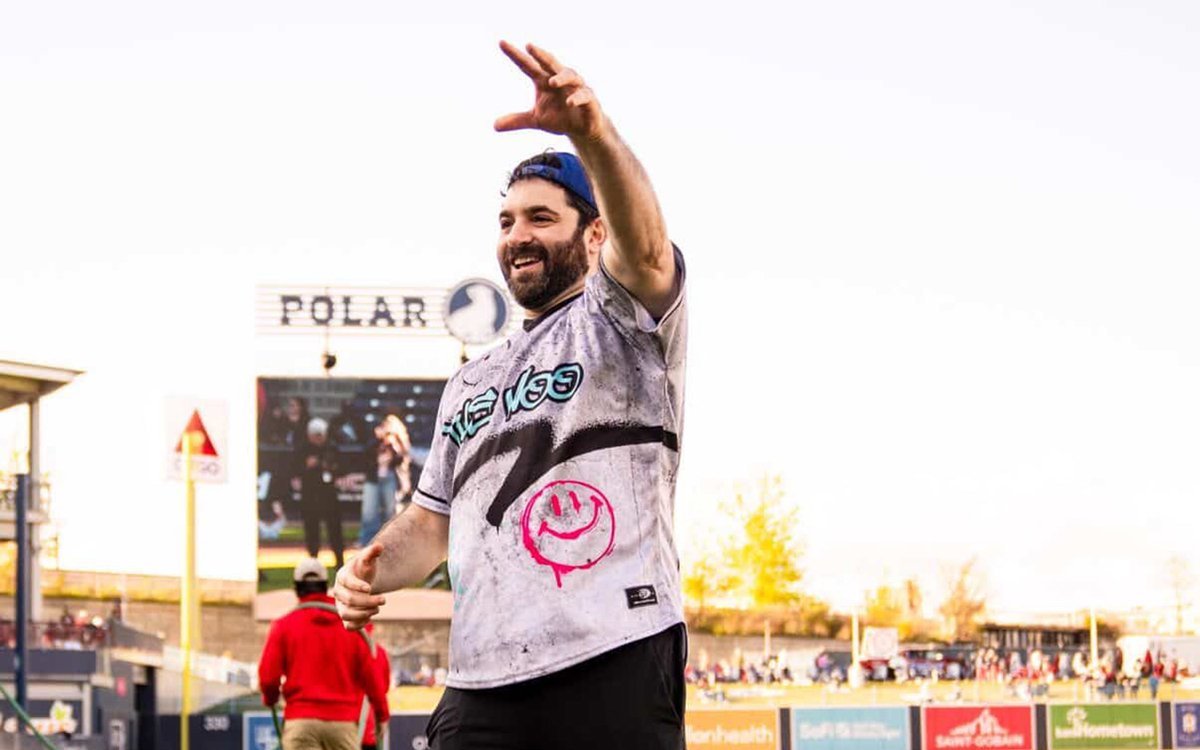
LJ Rader, the thirtysomething New Yorker behind the account, is familiar with Mia’s collection because he has a Minnesota connection. “I work for Sportsradar, a sports data and content company that has its global headquarters in Minneapolis,” he says during our interview in advance of this Sunday’s upcoming Art But Make It Sports book launch gallery tour at Mia. “I work out of our New York office, but I’ve visited Minneapolis over 15 times in the last eight years.”
As an analyst with Sportsradar, it’s his job to assist major sports leagues with data and content. “We have all this historic data and we help our partners find it,” he says. “We do data collection, statistical data, and then we build research tools, graphics integrations, all this stuff. You’re watching a Twins game, and you’ll learn, Byron Buxton just became the first player in Twins history to hit three home runs in the first six innings. That’s us.”
So Rader is more of a sports junkie than a fine art junkie, but with his social media accounts and new book, he’s established himself as a unique intersectional expert. He’s only taken one art history course at Vanderbilt, but his platform is based on an almost mutant-like talent—when he launched @artbutmakeitsports on Twitter and Instagram in 2019, he discovered he has an incredible memory for fine art images. When he sees a sports photograph, he can recall, off the top of his head, a pose, or a style, or even just a figure or a form, from a painting or a sculpture. And then he posts and just lets the two images comment each other. So when Anthony Edwards is taunting the Lakers’ Luka Doncic, he’ll make a special Easter Sunday post of that photograph next to Caravaggio’s The Supper at Emmaus, or when the Vikings sack Aaron Rodgers and toss him around like a rag doll, Rader will post that photograph next to Gericault’s The Raft of the Medusa.
Rader is a native New Yorker, so unfortunately, he’s a Yankees/Giants/Liberty fan, but as he’s grown to love the Twin Cities, he’s learned to more deeply empathize with our sports purgatory status. “I feel bad for all my Minnesota sports fan friends,” he says. “Outside of the Lynx fans!”
You grew up in New York City?
Like an hour north of the city.
And your grandparents owned a parking garage in the Village?
Yeah, way back in the day. They moved to Long Island after living in the city. But they had a garage, and lots of starving artists that couldn’t pay their bills would give them art. So they have a pretty great collection. Maybe not like household names, but artists with works that come up for auction every once in a while.
So you’re a Long Island kid?
I’m from Westchester, but my grandparents lived on Long Island, so yeah.
What are the New York teams you grew up rooting for?
Have my Giants shirt on. So Giants, big Knicks/Liberty fan, big Yankees fan, but mostly like a baseball fan in general. And I like the Nashville Predators—I went to school at Vanderbilt in Nashville, so I root for them. And then Vandy sports. Usually that’s like a scarlet letter, but these last few years we’ve been pretty good across the board.
It sounds like sports was your initial passion. You only took one art history class at Vandy, but you have this Bill James/Rain Man-style ability for pattern recognition.
You can call it that. Yeah, I don’t even know how I discovered it, but these days, I have 15,000 photos on my phone, and I’ve found that I can remember individual photos of paintings, or components of them. I can mentally track components in art history of certain poses or certain artist’ styles. I didn’t really know I had that in me.
Like so many others, I assumed you were relying on AI to make these posts, drawing on some vast machine-learning data bank. But I saw you on Pablo Torre’s podcast, and you were able to pull art history comps off the top of your head. Quite a parlor trick.
Yeah, it’s fun!
@artbutmakeitsports started in 2019. When did you realize that you had this gift?
I don’t know if there was an exact moment. I think the account first started as me captioning art—I would say, “This Francis Bacon painting looks like Philip Rivers screaming.” Then it was like, “Wait, I’m gonna just put up the picture of Philip Rivers screaming.” I always knew in my head, this is what this thing looked like. But it started taking off when I put the actual image next to the actual artwork. And it was a steady burn—steady growth, but never really something that I cared about. I’m gonna, you know, post it to however many people, and I’ll post however many more in the future. But it is fun to see the community that’s grown around it.
I think the reason your account resonates so much with me is because—and I would think this would be true for most human beings—is that both art and sports help us make sense of our own lives. Like they’re either holding up a mirror to society, or they’re giving us a model for beauty or suffering, or just moments of drama. And every time we watch sports, or see art, we experience these historical resonances—our brains automatically do this connective work. It seems to me that you had one of those revelatory ideas where it’s like: Voila! An idea that’s always been there, just been waiting to be discovered. So what connects art and sports for you?
I think what people appreciate about the account is the visual aspect, which makes it inviting and easy to digest. But I try to build in some additional layers and Easter eggs and make some more comparisons that show that these disciplines aren’t as different as people might think. It requires practice to be an artist and an athlete. There’s movement that needs to be captured in good art, and it’s the same in sports. Good sports photography has incredible movement. Lighting is a huge component—if you’re snapping at the right angles and with the right light, same with what an artist is trying to capture. And I think there’s just the gravity of certain moments that often play well. I think my best pairings come from artwork that has emotions comparable to what a sports photograph does. The best sports photographs extrapolate one moment out to what that whole game might have felt like. And what people often tell me is that, once I display it, maybe their head didn’t go there immediately. So that’s always gratifying. It’s like I’m providing a window into something that clicks for somebody else.
It seems like you’re most familiar with the sports world, but I see Jerry Saltz commenting on your account all the time. Obviously, you’ve expanded your art world knowledge base since that art history class at Vanderbilt. Who are some of the art world figures who have reached out to you? And which artists have become your art world version of the Giants and Yankees?
Yeah, so Jerry’s definitely one of them. I was talking to him like a week or two ago, about the Carol Bove show at the Guggenheim. I’ve met a ton of different people in the art world. I think the folks that I gravitate towards are the ones that are more like my age and into the sports side of art. And I’ve met a lot of folks that do sports art, which I think oftentimes is not great, but really, really good sports art blows me away. There are these two artists that started the Currency Project, where they take sports cards and paint on them. Then they auction them up on eBay, starting at a dollar. And they basically let their work dictate how much these things are worth. Sometimes the price on eBay is less than what it costs to procure the original card. So they’re sort of examining what is value and what is currency. They do beautiful work in terms of the paintings on these cards. I’ve collabed with them on a card before and I’m going to do another one in the future. I think people, myself included, can think the art world can be intimidating, right? And oftentimes folks think you need to have a lot of money, which in some capacities you do, to reach certain corners of the art world. But I really appreciate people like them that are artists at heart, doing something that has no barrier to entry. It’s a fun way to interact and weave sports in.
How important is sports memorabilia and card culture to your love of sports?
I was a huge baseball card/sports card fan growing up. But very much not in the this thing will be worth money someday. I guess I didn’t know it at the time and was maybe subconsciously doing it—but this is an incredible way to connect with my dad’s fandom. Because I had all his sports cards and it helped me to learn the history of the sport. Because otherwise you don’t really get exposed to the old school players that came before you. I think that helped lay a really good foundation. And I appreciate looking at sports memorabilia. It oftentimes comes up in interviews where people will ask, “What’s your favorite museum?” The auction houses are incredible because they are free, there’s no tourists, and the collection turns over every two weeks. And Sotheby’s does a great job with the sports collectibles. So it’s less about jerseys and sneakers, but they’re oftentimes working with certain athletes where they’re getting just unique pieces. In the Scottie Pippen one that they just had, there’s like a basketball that had all these Chicago Bulls hand-painted faces on it. This stuff is sick. I love looking at stuff like that. I don’t think I’d ever buy it—I don’t have a place to showcase collectibles, but yeah, I love looking at it.
You’re obviously telling stories in your work. You’re aware of what these figures mean to sports fans, and you’re aware of what these figures mean to art fans.
I think those are the best posts—the ones where the angles converge, and there’s a similar story on the art and the sports sides. Oftentimes people are like, “Can you write up the context?” That kind of defeats the fun of it. I think one of the reasons why the account does really well is oftentimes you find people in the art world who are extremely knowledgeable, but they’re very specialized in a single time period, or on a single artist. Whereas my approach to art history is across the board. I like anything and everything that I can visually connect with. And because of that, the account highlights anything and everything. And then it becomes sort of this survey of art history for people as opposed to just a single focus. So having that kind of depth, I think, helps my storytelling and helps bring people in and make them feel welcomed.
Are you seeing certain photographers rising to the top, either virally or in terms of quality?
I guess in lieu of leaving people out, I’d say there’s probably two Minnesota, or Minnesota-adjacent, photographers: David Sherman, who shoots the Lynx and T-Wolves. He’s been around the block and he’s a really good dude and has taken some iconic shots. And then Bri Lewerke. I know she’s got Twin Cities connections and she shoots, or has shot, Iowa basketball, and does a lot of stuff with Caitlin Clark and women’s hoops in general. Her stuff’s incredible and is always, always popping up. And then I guess like a national photographer would be Reginald Thomas. He’s the Spurs photographer. He’s so good. His stuff is just so much better than anybody else’s. It’s very different. He’ll do some traditional photos of games and stuff, but he does a lot in black and white and a lot of super-cropped components that, I don’t know, they just make you love basketball. It’s so, so good. He’s an artist at his core who happens to shoot sports photography.
So you wrote this book while you and your wife were raising a new baby, and you still have your sports data day job of course, so how much of your time are you still devoting to Art But Make It Sports?
My wife is a saint on the book front. She watched our newborn kid on weekends and stuff to let me work on that. So that was cool.
How old is your kid now?
16 months.
Wow, so you’re in it right now.
I love him, but he needs attention, which is fun! I don’t post as often as I did in the past. The account’s matured at this point, so I don’t need to be firing off posts three, four, five times a day. But for like big events like the NBA finals or the WNBA championship, I think those got like 3 or 4 posts. Super Bowl gets upwards of 10. And I’ve cut back on how much I’m personally scrolling social media. Oftentimes in the past I’d be scrolling, scrolling, and I’d see images and be like, All right, I’ll just do this. And now I’ll wait for images to truly go viral and that’s when I’ll start to pick them off. It’s my hobby. Now promoting the book takes time, prepping for museum talks takes time, but it’s fun!
This interview has been edited for length and clarity.
[ad_2]
Source link