a practice close to the ground
The creative process of artist Jasmin Sian, whose intricate works now hang at the Whitney Biennial, often begins outside among the weeds and squirrels. In a recent conversation after a bike ride on Randall’s Island in New York, she laughed about the unglamorous posture of her process.
‘When people see me, I’m always crawling around the ground,‘ she tells us. It’s far from the romantic image of plein air painting, and closer in spirit to the tiny animals nosing through the flowers. That image says a lot about the tender spirit of her work. Her drawings and cut-paper pieces come from close attention to small lives and bits of plant growth that many people pass by.
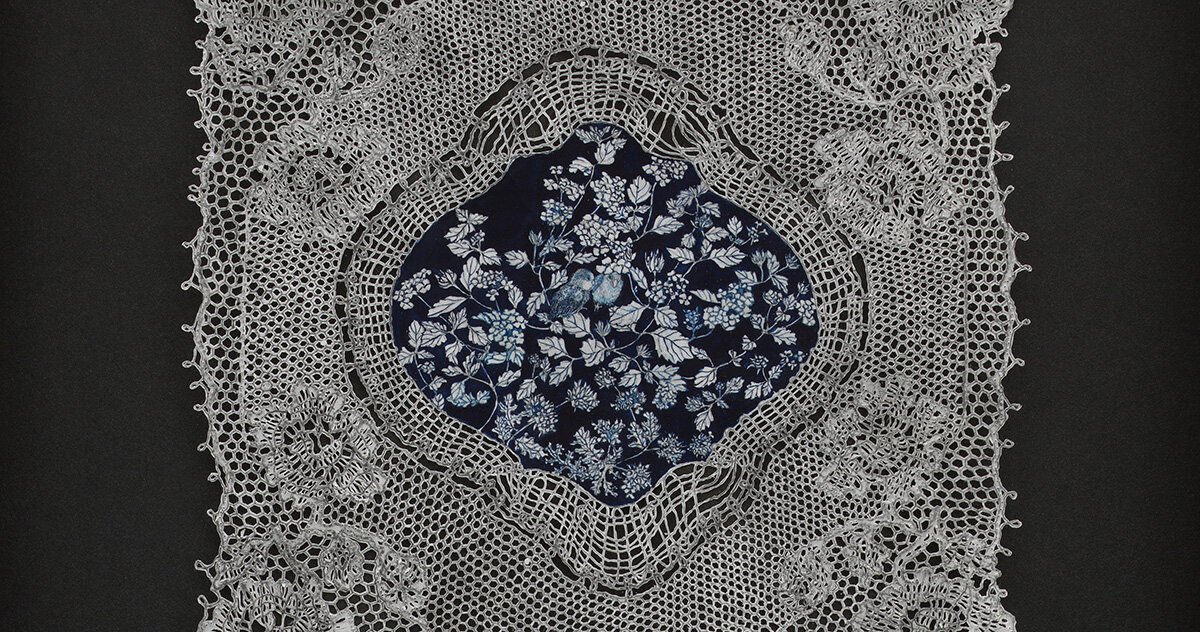
At the Whitney, her materials carry that same ground-level logic. Found deli bags become surfaces for gouache, lacquer ink, graphite, and cutouts, with those animals and plants framed by lace-like borders cut by hand with an X-Acto knife.

installation view, Jasmin Sian, Whitney Biennial 2026. image © designboom
found paper becomes a medium
The scale of artist Jasmin Sian’s work is intimate. One work — dovecote: a tree-pee in Bugoy’s favorite spot with Mrs. Manok in mom’s garden, Philippines — measures just 3 ⁵∕₈ by 5 3/4 inches, and shows a small field of finely cut scrap paper dense with attention. Living beings are rendered within these cut motifs that act as memorials in some cases and protective dwellings in others.
This paper, which would otherwise be waste, gives Sian a structure to think through. She likes its texture, its wrinkles, the way folds can become a guide, and how easily it cuts. The creases help her map the composition, almost like a hand-held terrain where direction, edge, and spacing can be found through touch.

installation view, Jasmin Sian, Whitney Biennial 2026. image © designboom
the strangeness of looking closely
For Jasmin Sian, looking closely has very little to do with illustration in a conventional sense. It is a way of allowing the world to become strange again. ‘Things in nature, you can’t make this up,‘ she says, while sifting through a patch of purple Siberian Squill. ‘It’s weirder in reality than something we could ever invent.‘
The flowers, weeds, leaves, and small animals arrive in her pieces with that sense of wonder. The artist studies where a petal sits, how many petals make up a bloom, how light changes the shape of a plant. She follows the logic of a living form, then builds a paper architecture around it through cutting and painting.

Jasmin Sian, ‘if i had a little zoo’, 2013. image courtesy Anthony Meier
drawing with graphite, ink and gouache
Jasmin Sian’s process moves between graphite, ink, gouache, and cutout. Areas drawn in graphite may later become ink. Painted passages gather around earlier marks. Cutwork enters once the larger space begins to reveal itself. Often, she starts with drawings of plants, then figures out how everything will settle in.
There is patience in that sequence, along with a certain trust in the material. In one moment while we sat together in the park, she noted that she is simply enjoying the drawings before deciding where the work will go. That particular piece, she thinks, may become a sleeping animal work. The animal has yet to fully arrive, but the space around it is already being prepared.

image courtesy Anthony Meier
art as contribution
The tenderness in Sian’s work has a practical edge. She speaks about art through the idea of a social contract, a responsibility to contribute something back to the world that sustains us. If a person has the ability to make things, she suggests, that ability comes with an obligation to offer something beyond the self.
For Jasmin Sian, that offering can be small and still matter. If an artist can move one person, or give someone a brief moment of joy, she says, that is meaningful work. Her pieces carry this belief through their scale and method. They ask for close viewing, then reward it with a feeling of protection around lives that often escape notice.

Jasmin Sian, ‘wildlife I love: Skippy and Pop in a field of thyme, oregano, clover, chickweed and violets’, 2023. image courtesy Anthony Meier