
[ad_1]
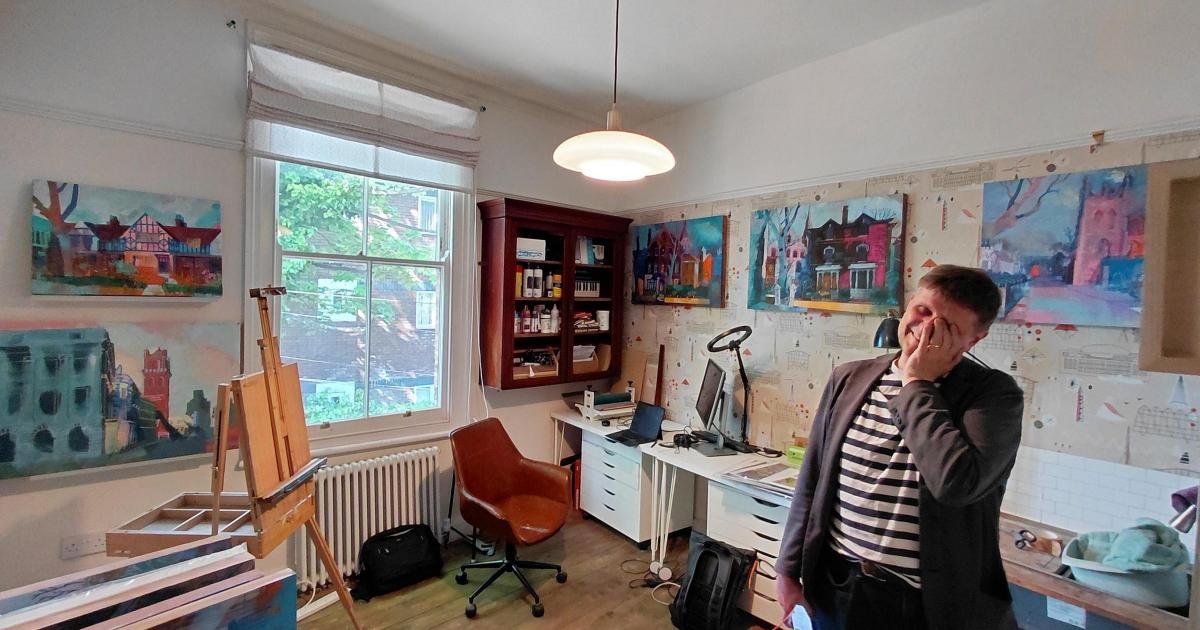
London-born Alexis Butterfield only started selling his paintings a couple of years ago. Most of the canvases hung throughout these airy, sun-dappled rooms are his work. So, even, is the ornate and meticulously restored plaster ceiling in his back room, which he credits for getting him back into fine art.

By trade, Alexis is an architect. But the 55-year-old’s dazzling paintings – which include some iconic Wirral locations such as Hamilton Square and Port Sunlight – have such a freewheeling combination of abstraction, precision, mischief and even darkness, that it’s hard to believe his day job is to draw sensibly.
So I’ve come to pick his brain at his home studio in Aigburth and find out how he sees Merseyside, as an outsider, and what makes him passionate about our architecture.
We also talk housebuilding, his favourite spots in Wirral, and his tips for social regeneration as someone who designs housing developments for a living.

Architecture and normality
Like all artists and bohemians, Alexis became an architect because it was approximate to what he really wanted. “I started studying fine art,” he says. “And then was told I was going to starve in fine art. So I went and studied architecture.
“Don’t get me wrong, I love nice buildings, but I’m more interested in the glue that holds society together. The invisible stuff. And if you can have nice buildings as well, that’s the bow on the top.”

Originally from South East London, Alexis has had plenty to choose from when it comes to sense of place. He has lived all around the British Isles, studying in Birmingham and living in Manchester, Devon and other parts of London.
The painter even lived, in the early 90s, in a cottage on the Cliffs of Moher in County Clare, Ireland. “But I was too young to appreciate it,” he says.
Wherever he has gone, Alexis has continued to work in urban design, specialising in residential neighbourhoods, in a career lasting almost 30 years.
He is a partner at Pollard Thomas Edwards, an architecture practice which designs neighbourhoods in tandem with housing associations, private developers and councils – usually building 1000 and 1500 homes at a time.
The company was behind the pioneering New Ground project in North London in 2017, which brought together a group of over-50s women in a Scandi-style “cohousing” community as an alternative to living alone.

The group of 26 residents collaborated with designers to mould a purpose-built environment with common facilities and an emphasis on neighbourly support. Their website says: “At New Ground, every woman contributes and every voice matters”.
How has the workload increased for Alexis since this government pledged to tackle the housing crisis and build 300,000 new homes a year?
Alexis hesitates: “What we find is that schemes are getting much, much bigger, but the numbers of homes that are actually built are getting much smaller.
“Every year we undershoot what we need, by about 50%, and we’ve been doing that for 20 or 30 years. So you’ve got to the point now where you’ve got huge overcrowding. Not for everyone, obviously, but it’s very unequal.”

The steady siloing of people, particularly families, in crowded areas, where it has become normalised to live at the “sharp end”, is something Alexis finds difficult to square with his own life.
“You’ve got people like me and my wife with a big house – we’re very lucky. Then you’ve got people in housing who are massively overcrowded, three kids in one room, no garden, miles from anywhere useful, can’t walk to the shops.
“And if they’re lucky, they’re there; if they’re not, they’re in a bed and breakfast. It’s horrible to be a single person in a B&B – but imagine being a family there for three years. There’s a very sharp end to all that, and it’s really depressing.”
The proliferation of houses of multiple occupancy (HMOs) has also been a stark shift. What was once seen as a necessary compromise for someone who wanted to work and live in London has become common nationwide as rents become unaffordable for people living alone.
“Yeah, HMOs have really exported,” Alexis says. “Watching that happen throughout my career and seeing it get worse has been quite depressing.”

Back to the drawing board
“So that’s your day job, and this is…?” I gesture around the box room, where every wall, shelf and drawer has prints, woodblocks and canvases of Alexis’ varied and wholly original work.
“This? This is mental health,” he replies. “I’ve been painting again seriously for the last two and a half years.”
After moving up to the North West to look after his father-in-law who was suffering badly with Covid, Alexis decided: “If we’re going to be in the North West, let’s be in Liverpool. This is the best place.”
He had met his wife Emma here back in 2000, falling in love with both her and the city. Now they had a reason to head north and get away from the London grind, they bought and renovated this house in the leafy suburbs around Sefton Park in 2021.

“The moment it was habitable,” he says, “I picked up a pencil and started doing art again. I’d been wanting to treat myself to that forever.”
What was it like that first time, after decades of artistic abstinence?
“The first day I did it was like, oh my God. I couldn’t believe how much I’d forgotten. And I was a very different person to the young person who last attempted it seriously.”
Since restarting his career, Alexis has grown a dedicated social media following on platforms like Instagram and Facebook, and has exhibited and sold paintings through the dot-art gallery on Queens Avenue.

Alexis has been commissioned to paint for exhibits at the Liver Building and the Williamson Gallery, and for two years in a row has been invited to compete in Sky Arts’ Landscape Artist of the Year – but turned it down. “I don’t want to go on TV,” he explains.
As an architect, does he feel his serious brain creeping into his art? “Oh, completely,” he points at his easel, where a work-in-progress on Castle Street is mounted.
This piece (which is in this month’s dot-art prize draw, £5 a ticket), is one of his “map paintings” which take an eagle-eye or drone-view of a landscape – in this case, one of Liverpool’s most architecturally complex and delightful thoroughfares.

But in an act of sheer defiance, Alexis has zoomed out far enough to smooth most of the gothic edges, revealing the surrounding streets and alleyways. The Liver Buildings poke themselves in awkwardly, almost irrelevantly in the top left corner.
Other details seem to reveal more of Alexis than the city: a streak of neon pink rushed from the Queen Victoria statue up to the Town Hall like a charge of human energy. One building is completely blacked out – a wry comment, he says, on the blocky blandness of modern architecture.

The whole thing has the stylised feel of a 60s Batman comic backdrop. Architecturally, it is not exactly faithful. Is this a form of rebellion against the strictures of his craft?
“This is absolutely the child making their town with toy buildings,” Alexis said. “Everything’s right but not quite. But it’s about your memory and experience of it, not a technical thing of ‘this is exactly this tall and this wide’”.

“I was in quite a funny mood doing these ones,” Alexis says as he rifles through a stack of some darker pieces. He holds up one of Williamson Square, with Liverpool Playhouse towering. “I loved the idea of this building, which has incredible presence on that square, having an almost animalistic quality. It’s like a body.”
As he says this, I notice the dimples across the building, which seem to blink like eyes.

So when did he start jumping on the Merseyrail over to this side of the water?
“It’s funny – all my Wirral ones are quite jolly!” Alexis laughs. “At first, I was basically just doing anywhere in walking distance or a quick train ride. But I’ve gradually been branching out further.”

We study a piece which has a view of Hamilton Square, with the redbrick tower of the train station in the background.
The outlines of the Georgian facades are there, but similarly to his Liverpool paintings, the whole scene is “semi-abstracted”. Alexis says its an “homage to 20th century art – heroic, simplified”.

I notice some fragments of Port Sunlight dotted around the room. He pulls one down – a piece which is due to be exhibited in the Liver Building this summer. This piece was painted upside down to give a dripping effect, which became the rows of blooming flowers.
“We spend a lot of time in Port Sunlight,” he says. “Because my wife really loves the Lady Lever gallery. What I love about it is the sense of domesticity and safety, it’s like a haven in a storm.”

How buildings shape us
The most important thing for Alexis, in both his art and his architecture, is the ineffable quality behind the harsh lines and the blunt bricks: the “sense of place”.
Housing crises, political polarisation and social media have all fragmented our sense of connection and community. So before we part ways, I want to know how Alexis – as someone who designs new communities for a living – would approach such problems here in Wirral.

“Birkenhead is a place which has just been destroyed by road-building and cars,” he says. “I think getting cars away from the heart of that place and restoring that sense of connectivity, being able to walk about.
“And bringing in places to do things that don’t cost money – markets, events. You’ve got beautiful buildings already. It’s about working with what you’ve got. If you tried to build [Hamilton Square] now, you couldn’t. The money isn’t there, the materials, none of it is there.
“One of the things I believe in is doing loads with very little. That can happen with painting, a little block of wood and some material. But that can also happen with place. Caring for what you have. And then people start to change. I genuinely think it’s transformative.”

You can’t understand places like Birkenhead without understanding deindustrialisation (Cammell Laird once employed half of the entire town) and the destruction caused by the influx of heroin into the city in the 80s and 90s.
But perhaps Alexis is right; we don’t fully appreciate how much cars, roads and buildings can also shape and harm our sense of place. And we certainly don’t make the most of the listed-building hall of fame that is Hamilton Square.
Leaving Alexis’ company after a hearty chat, I think about him saying painting started as a “mental health” strategy.

For a sensitive, socially-conscious person whose job is to design homes with thriving, sustainable communities in mind, it must be quite frustrating that once you pass them over to the residents, it’s out of your hands. You don’t know what’s going to happen – or if it’s going to work.
While he designs the structures themselves for a living, the urge to keep making these paintings proves Alexis is far more interested in the pulse of life which moves between them.
[ad_2]
Source link