
[ad_1]
Painterly sculptures? Or sculptural paintings? For more than three decades Angela de la Cruz has been not so much exploring as exploding the boundaries between painting and sculpture. Combining the language and history of both mediums, the artist’s drama-filled, genre-busting works have taken on a life of their own, forming emotionally charged relationships with the viewer and with each other in the process. “All my work is activated by human experience,” she told me when I interviewed her back in the 1990s. “My paintings are figurative objects.”
Performative physicality is still very much in evidence in Upright, de la Cruz’s current exhibition at Ikon Gallery in Birmingham (until 6 September), which is, shockingly, her first in a UK institution since her Camden Arts Centre survey in 2010 won her a Turner Prize nomination.
Dramatically opening Upright is Still Life with Table (2000): a large oily black canvas that has come off the wall to squat in the gallery space. Its stretcher gapes like a giant devouring mouth that almost completely consumes a table in its capacious fabric folds. At the same time it is impossible, for me at least, not to read the work as an audacious act of exposure—a giant flash—with a canvas skirt hoisted up to reveal the table’s underside and jutting legs. Throughout the show, other quasi-human characteristics are in evidence, whether in Limp (2000), where one unpleasant fecal brown painting is crudely inserted into the ripped surface of another, propping it up, or the uncanny fleshiness of Bloated 111 (Blue) (2012) a bulbous, dimpled wall-mounted rectangular cushion of hammered aluminium painted in rich layers of dark blue oil paint.
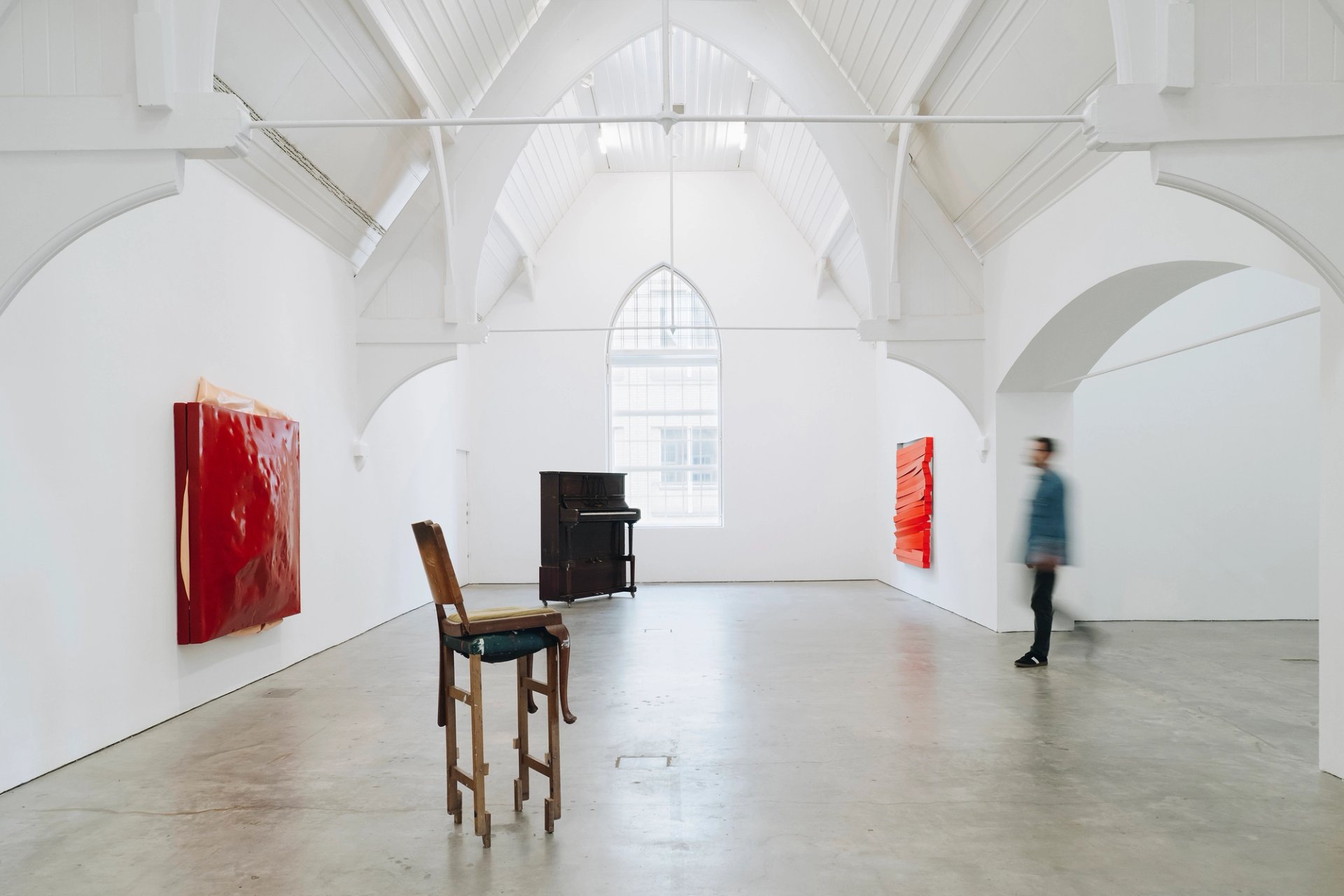
Installation view of Angela de la Cruz’s Upright Photo: Tom Bird
An irreverent hustler
“I use the language of Minimalism but I am not a strict Minimalist, since my work is very anthropomorphic and emotional at times,” de la Cruz has said. The artist, who was born in Spain but has been based in the UK since the late 1980s, credits “a compendium of different influences” in shaping her work. These range across art history, world events, literature and the personal and bodily. For example, as with much of her work, the dimensions of Bloated echo her own; while she points out that the perky pathos of Limp channels the Spanish literary tradition of the picaro, a cunningly charismatic hustler operating at society’s margins, using wit and deception to survive in a corrupt world.
Domestic furniture also features in her work, standing in for human forms and relationships. In Transfer (2011), a white painted aluminium box—again based on the artist’s dimensions—is suspended between the opposing poles of two white chairs, one a plushy white leather Modernist Knoll, the other a basic utilitarian plastic. In Upright 111, meanwhile, one of the works that gives the show its title, a three-legged chair is both raised and supported by a scruffy paint-marked stool, which in turn is heighted by blocks of wood. Titles are similarly crucial, with de la Cruz considering them part of the works themselves and a key to understanding their figurative aspect. For her, a piece is incomplete until it is given a name.
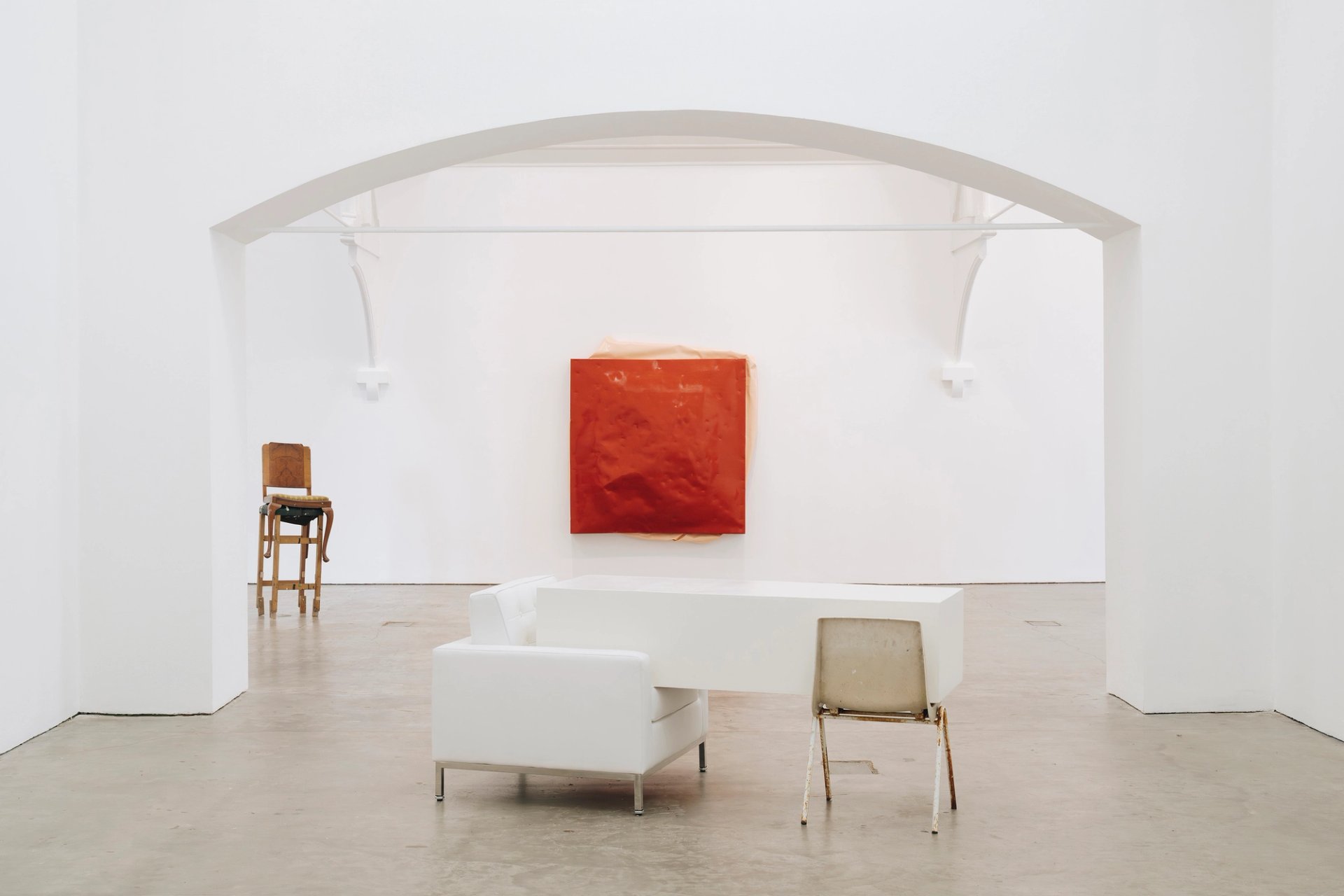
Installation view of Angela de la Cruz’s Upright Photo: Tom Bird
Although her language has evolved, de la Cruz’s desire to mess with Minimalism with an irreverent and often disquieting humour continues to infuse everything she produces. Since suffering a paralysing cerebral stroke in 2005 she has not been able to physically produce her work and observed in a 2018 interview that it has become “more general, more universal… more knowledgeable in a sense”. However, she is also quick to point out that she has always used assistants and collaborators as part of her process, declaring: “I have always organised my work as if I were a cinema director.” She mischievously observes that her output is now “more violent than before, but in a quiet way”.
This is certainly borne out by a new commission developed for Ikon in collaboration with the Birmingham Royal Ballet (BRB), on view in the show. Having watched BRB’s The Nutcracker, she became interested in the idea of the Nutcracker figure being repeatedly broken and fixed, seeing it as analogous with ballerinas breaking in their pointe shoes to mould with their feet. The resulting piece is Blister (2026) a visceral blood-red square of beaten aluminium that bulges from the wall, with slivers of fabric in traditional ballet-shoe pink seeping out from its sides. The work, which plays with ideas of rigidity, elasticity and resilience, is an excruciating reminder that behind the precision of every performance lies a throbbing foot. Like all of de la Cruz’s work it is both funny and deadly serious—and takes no prisoners.
- Angela de la Cruz: Upright, Ikon Gallery, Birmingham, until 6 September
[ad_2]
Source link