
[ad_1]
The three new additions to Raven Halfmoon’s show, Flags of Our Mothers, commissioned by Ballroom Marfa, are the opposite end of the spectrum from the large-scale figurative portraiture that contain matriarchal multitudes, yet these sculptures are instantly recognizable as her work, with a surface that shows every mark of her fingers, signature tags, masses of hair, facial tattoos, and thick, dripping glaze. Halfmoon’s Flags of Our Mothers debuted at The Aldrich Contemporary Art Museum in 2023 and has since traveled to several locations, including The Contemporary Austin in 2025.
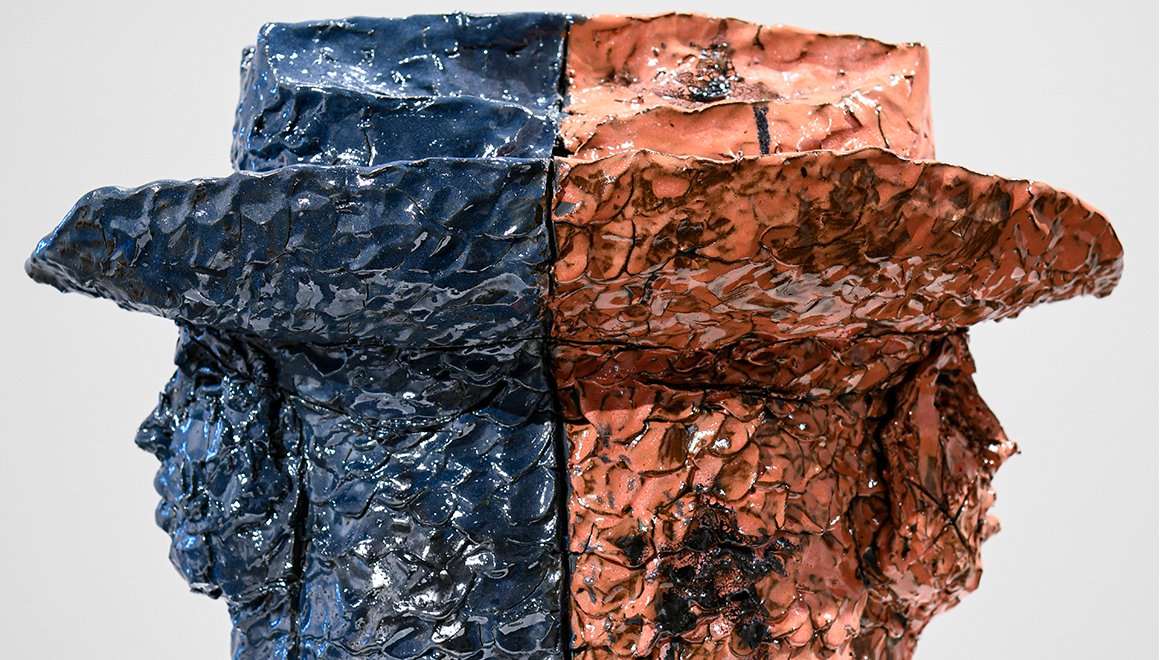
The glazes of these new works are less fiery, yet no less solemn. Other shifts include new glaze colors — pink replaces the red of previous work, dark blue instead of black — and the addition of stencils in lieu of free hand tagging. Cowboy hats and noticeably smaller portrait busts set these pieces apart. As her art garners wide attention these pieces demonstrate Halfmoon’s growing introspection and understanding of what she wants and needs to protect as she moves forward.
Where other portraits in the show represent members of the Caddo Nation, as well as Halfmoon’s family, the three new pieces are each a singular female portrait. The aspect of twinning remains in the new work; however, the back-to-back twins are less a representation of ancestors and history and more a sense of present and future.

Day and Night in Oklahoma and Riding Into the Sunset both have an eye to Halfmoon’s future. Glazes in buff, pink, and navy blue, with crosses on both aspects of the dark and light halves, represent balance as well as the four directions common in Caddo tradition. Halfmoon vows to reclaim the crosses and the stars for the Caddo Nation. Feather Stetson for the Party (2026), a buff colored hat with traditional facial tattoos and light blue feather stencils, is literally a jaunty nod to a feather in her cap.

Conversation with Halfmoon about her ceramic sculptures begins with the artist talking about how process-oriented people always come to her with the most technical questions about the particulars of her work. Known for her monumental portrait totems of ancestors, family, her horses and dogs, with a texture that from a distance looks as if it were knitted, or a ruffled fabric, created by her touch on the surface of the clay, an unusual effect for stoneware. Regarding the “knitted” look, Halfmoon says that’s coincidentally the technical term for the process of connecting the coils and the outer surface to the internal dynamic of the structure of the clay. Her fingers make the movement of knitting together as she describes the technique. Her every touch shows, even under the thick dripping glazes she favors.

All of Halfmoon’s pieces are fired where they are built, using local clay. These three commissioned pieces were built in Norman, Oklahoma, in Halfmoon’s studio, fired in her own kiln. The other pieces in the exhibition were fired in larger kilns at either the Archie Bray Foundation for Ceramic Arts in Helena, Wyoming, where Halfmoon has spent almost five years in residency, or at the University of California, Long Beach, where she was enticed by the eight-foot kiln and the mentorship of Tony Marsh, who refers to himself as an “instigator” to encourage her to work larger. There, Halfmoon spent over a year building an almost 13-foot-tall Flagbearer in three sections, firing for weeks and drying for months before glazing. Marsh is currently hatching a plan for Halfmoon to have a larger kiln at her Oklahoma studio so she doesn’t have to spend her life traveling to make large works.
Halfmoon has always painted, sometimes worked in bronze and most recently ceramic, so those practices will continue as she charts her time and work going forward. Halfmoon showed a photo on her phone of a ceramic work in progress of a very pregnant form, big belly and breasts. Still focused on the matriarchy yet without all the weight of history, a feeling of promise ahead.
Halfmoon also plans for time in Phoenix, Arizona at Mission Clay. There again she will team up with Marsh in a facility dedicated to the collaboration of art and industry, that caters to fabrication of commercial city pipes when not supporting and encouraging artists. There she will work in a new environment with industrial equipment.
Halfmoon loves riding her horses, making art, her dogs, family and her home. These three new pieces peer steadily ahead into her next chapter as she sallies forth, cheered on by the ancestors that are contained in her sculptures. These new pieces show a spirit all her own, yet still with the resolve, endurance, and unflinching quality of earlier work. The clear, consistent message of all the pieces: they are solidly planted . As a member of the Caddo Nation, a collection of tribes relocated to Oklahoma, the message makes sense: We are here. We have history, strength, and courage. We are here to stay, take up space and speak.
Halfmoon was introduced to the historic coil built clay work of the Caddo people at 13 years old, by another member of the Caddo Nation, Jeri Redcorn, whose traditional ceramics are pots; small, light with smooth surfaces lightly etched with delicate scroll and ornamentation. Halfmoon was, and continues to be a painter, however early in her college career in Fayetteville, Arkansas, the ancestral home of her tribe, she studied painting and cultural anthropology. While on an archeological survey, she found herself holding the actual ceramic pots created by her forbearers and decided to shift her practice to ceramics. Taking the Caddo tradition away from pots to portraiture, Halfmoon has made this style her own, her singular, signature interpretation.
With the exception of the three newly commissioned pieces, all of the other works in Flags of Our Mothers were created in the past five years and have already been exhibited at five venues. The exhibition will continue to travel until 2030. Halfmoon quoted her mother, Stacey Halfmoon, as saying, “… by then it will be “Flags of Our Grandmothers.”
Raven Halfmoon’s Too Ancient To Care (2024-2026) is currently on view at 82nd Whitney Biennale through August 23, 2026, and her West Side Warrior (2025) is installed on the High Line in New York City.
Raven Halfmoon: Flags of Our Mothers will be on view through October 11, 2026, at Ballroom Marfa.
[ad_2]
Source link