
[ad_1]
This article is part of a series of pieces celebrating Glasstire’s 25th anniversary. To see other stories from this series, go here. To see pieces from the month of May, around the theme Training Grounds: Studios, Students & Schools, go here.
In the early 2000s, when the University of Texas at Dallas (UTD) had an Arts & Performance degree and its Art & Technology program was still in the early stages of development, John Pomara and Greg Metz taught the vast majority of its graduate and undergraduate art courses in a two-story aluminum building, lovingly referred to as “The Art Barn.” I first stepped foot in the building and met John and Greg in May 2001, when my work was included in the Texas Visual Arts Association’s annual high school juried exhibition, hosted at UTD. Upon meeting them at the opening reception, the dynamic duo invited me to interview for a full scholarship, which I ultimately received.
During one of my first classes with John, likely 2D Design or Intro to Visual Elements, we were working on a gridded drawing assignment. I brought in a photograph I had taken of a high school friend to employ as my source material, and used the office copy machine to enlarge the image, focusing on their face. Immediately, disaster struck. Maybe it was low toner or a roller issue, but the copy was distorted with lines of ink missing and the image fading more and more from top to bottom. Annoyed, I brought the print to John and sought help with the machine. To my surprise, he was delighted with the misprint and asked if he could keep it and use it, which was fine by me, as long as I could get an actual print of my photograph and get to work on my project. That glitched image would go on to form the basis of John’s new series of paintings. The sense of joy, wonder, and curiosity that John embodied that day is a hallmark of who he is as an artist, as an educator, as a friend, and, I imagine, as a father.

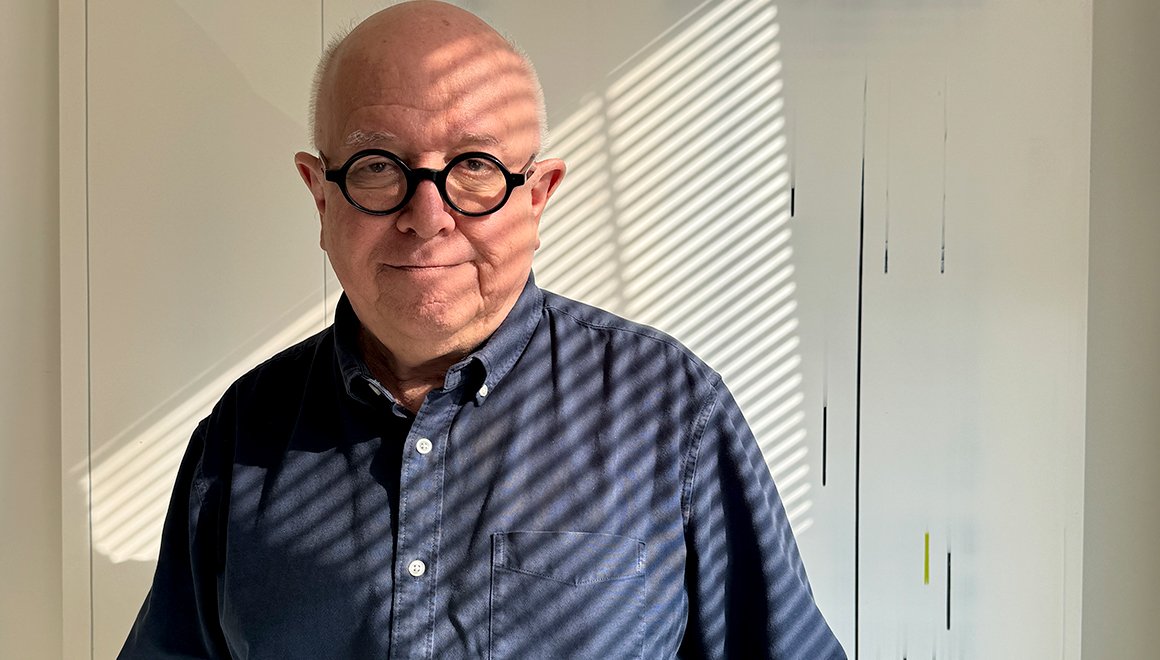
Now, after 30 years of teaching at UTD, John Pomara is retiring. Over the last three decades, much has changed at the school, both in the physicality of the campus and the breadth of the art program, but every step along the way, John has shaped, informed, and navigated the shifts with his students’ best interests in mind. And beyond these big-picture infrastructure changes, John has also affected the lives of his students through his care and approach to teaching.
Painter and University of New Mexico professor Raychael Stine attended UTD from 1999 to 2003, and she credits John with her success as an artist and educator. She also notes that he was “the first healthy male role model” she had in her life. Stine explained that John and Greg awarded her a full scholarship to UTD, helped set her up a makeshift, but necessary, studio space in The Art Barn, encouraged and assisted her involvement in the Dallas art community, and supported her practice by allowing incredible flexibility with her coursework.
Regarding John, Stine told me, “He was the best teacher, and I think the reason why… I became a professor myself. I was inspired by John to be someone who can help students give themselves permission to do the weird thing and be who they are, and [who will] actually see them for who they are and let them know they’re being witnessed and supported.”
Another attribute of John’s teaching Stine pointed to is his exhaustive knowledge of artists. “He knew everything there was to know about contemporary art… [and he was] always linking things to current reality in the present and your life.”
Greg Metz shared similar sentiments, telling me, “He is one of the most informed professors of what’s going on, certainly in the painting world, but in the art world over all… He’s really progressive in what he’s teaching, especially being able to blend technology into what otherwise would be a traditional university painting [program].”
These are things I, too, experienced with John. From receiving direction and support about video artists I should know to being encouraged to turn in my experimental video pieces as “paintings” in his painting courses, it was clear that he was a wealth of knowledge and taught from a place of expansion and openness. This also showed up in the courses he constructed: An iconic John Pomara class was Collision of Visual Culture, which combined theater and performance art, the fashion world, graphic design, expanded painting, installation art, and literature.

Of course, John taught this way because as an artist he works this way. He is influenced by an ever-growing list of things, people, and cultural moments. His interest in the synthesis of painting and technology has put him at the forefront of expanded painting in Texas. John’s work explores “glitching” in its many forms, often inspired by low or old tech (like my distorted photocopy), but incorporates an array of technology throughout the different modes of his artistic process. Though his oeuvre is distinct, the threads of his approach are clear in his students’ works. Stine, Liz Trosper, Luke Harnden, and many others hailing from UTD probe glitching and the intersection of painting and technology in various ways. I’ve seen this in my own work and watched it unfold across generations of John’s students, but hadn’t really ever considered the why behind his fascination with the glitch.

Last fall, John explained that the glitch creates a “chance effect” — it is an openness to the randomness of the world and a letting go of control, finding the beauty and wonderment in the unexpected. John pointed to a class he used to teach, called Chance Effect, that began with Marcel Duchamp’s dropped thread pieces and went through the late 1970s and early 1980s to the computer glitch. But glitching is just one part of a multistep process in which John toys with letting go of and regaining control through the application of technology, collaboration, stencils, paintbrushes, squeegees, and more. What looks like (and surely is informed by) deliberate accidents is a thoughtful, mediated practice guided by John’s characteristic curiosity and exuberance for life and the world around him.

Speaking about John’s influence on her work, Trosper, who is now a professor at the University of Texas at Arlington, told me, “When I went to undergrad, I felt super unfulfilled by traditional academic painting… then when I found John’s work, [it was] exciting. It’s not trying to be beautiful or easy to love… He really helped me understand that art making in general, and painting in particular, is a process of inquiry… He basically was the permission slip to not be easily recognizable or easily understandable, and [to embrace the act] of breaking things or doing what you’re not supposed to do. His full philosophy behind the glitch gave me permission to use Adobe Suite and reproduction tools… it gave me the unquenchable thirst for experimenting… and reversioning things as part of a digital process… there’s an excitement in not having a fixity, in having these moving parts.”
I asked John about how, as such an involved professor, he has been able to have a successful career. He credited his efforts to stay connected to the art scene in New York City, where he lived in the early 1980s, and his diligence in traveling often to see art, attending the Venice Biennale and important exhibitions in NYC and beyond. He was clear he couldn’t have done these things as frequently as he did without the support of UTD and Greg, who held down operations at the campus while John was out of town and accompanied him to more than half a dozen Biennales.

Though John was born and raised in North Texas, he made his way to NYC in 1979 as he was wrapping up his MFA from East Texas State University (now Texas A&M Commerce). He spent a few years there, and in 1984, when his wife was pregnant, he took a temporary, two-year teaching position at East Texas State. The couple returned to Texas, and even after the two-year job was over, decided to raise their daughter here. As with most newly graduated MFA students, work was spotty for a few years. Along with adjuncting, John did odd jobs, painting houses and landscaping, and even worked at a liquor store for five years. In 1994, he was offered a part-time position at Brookhaven College in Dallas, and the following year he was a Visiting Lecturer of Painting at the University of North Texas. Vernon Fisher, who had a competitive but respectful relationship with John, was taking a sabbatical, and put a good word in for him; this role shifted John’s trajectory.
In 1996, John joined UTD in a part-time capacity as Senior Lecturer. Greg was already on staff, having been hired two years prior, and Kazuya Sakai, who had been a painting professor at UTD since 1980, was slowly winding down his career. So, in 1998, UTD was suddenly hiring a tenure-track painting professor, and Greg was advocating for John. The university undertook a highly competitive national search. Ultimately, John was one of the top three candidates, all of whom were invited to meet with students and faculty, give a lecture, and interview with Dennis Kratz, Dean of UTD’s School of Arts and Humanities from 1997 to 2019.
As John tells it, Dean Kratz informed him that the faculty was split down the middle, with half in favor of John, and, ultimately, the decision would come down to the Dean. John recalled, “He said, ‘Tell me why I should hire you. Why are you better than all the rest?’” And in that moment, in Dean Kratz’s office, feeling a bit defeated, John focused in on the window behind Kratz and imagined the opportunity flying out of it. But, as a father, he knew he needed the financial security of this position to support his family.
“I had to get this job, and I knew whatever answer I gave him was going to be definitive. So, I went for broke: I did something that I knew he’d never forget… So, I said, ‘You know, Dennis, I’m too good for this job, and I don’t think I want it,’” John told me. Kratz was floored, and told John that no one else had told him that — that they were too good for UTD — and no one had told him that he didn’t have a good program. And John explained, “They’re all afraid to tell you the truth.” So Kratz grabbed a pad of paper and asked, “If I hire you, what do you need to build a program that would be as competitive as UNT?”
John responded that he needed five things: Greg Metz to remain on staff for at least five years, five scholarships each year in the early stages to build the program, freedom for students to use independent studies to do in-depth focused learning, five years to make the program a success, and he needed to connect Dean Kratz and UTD’s art program to the Dallas art world. John’s bold statement and insightful plan landed him the job and shaped the burgeoning program into what it is today. And Greg remained on staff for another 20 years, the two of them working together to bring rigor and innovation to a program that has shaped countless artists and arts professionals.

It’s impossible to tell the story of John’s 30-year career at UTD without talking about Greg. Students often remember Greg as the disciplinarian — strict and critical, but always pushing them to do better — and John as the sympathetic professor — nurturing and lenient, if not sometimes a little too soft. The truth is, as young, vulnerable art students, we needed both, and that was the magic of the odd couple that ran UTD’s art program.
Some may not realize that John and Greg have known each other, in some capacity, for most of their lives. When I asked Greg when he first met John, with a laugh he responded, “Oh… 1957.” The two grew up in the same neighborhood, spent summers at the same community center, and played on the neighborhood baseball team together — which is why John still affectionately refers to Greg as “Mr. Baseball.” They attended the same junior high school, high school, and undergrad. Though they were not particularly close in those years, I imagine a shared upbringing accounts for part of their close professional and personal connection.
Over the last three decades, John and Greg and Marilyn Waligore (who has been a photography professor at UTD since 1989) have had a major hand in several UTD initiatives, including the satellite graduate studios and residency program at CentralTrak, which ran from 2008 to 2017. They also assisted in shaping the vision for the Edith O’Donnell Arts & Technology Building, which opened in 2015 and led to the eventual closure and demolition of The Art Barn. In May 2025, John and Andrew Scott, a UTD Professor teaching 3D mapping and projection, began spearheading an initiative to establish a satellite space in Dallas’ Tin District. The Bass School Satellite Space will open later this year and will include nine graduate studios, a gallery, and a teaching space.

While the Arts & Technology Building is a beautifully designed space, it does not fill the hole The Art Barn left. That slanted roofed aluminum building was messy and raw, a place for experimentation. The lower level featured a large open gallery space used for student exhibitions but was also activated by John, Greg, and other professors who curated interesting and significant shows. One of the early exhibitions curated by John was PIX, for which he invited North Texas art critics to each select their top emerging artist from the area. His clever premise brought writers and promising artists to The Art Barn, putting them directly in touch with UTD’s art students. In comparison, the Arts & Technology Building does not have a dedicated exhibition space, which makes the Bass School Satellite Space such an important endeavor.


The Art Barn also housed an administration office, faculty offices, a small mezzanine gallery, a spacious woodshop, a multiuse classroom, a painting studio, a few small student studios, a printingmaking studio, a photography darkroom, and a small computer lab. (A nearby building was home to the developing Art & Technology program and held additional computer labs for digital video and animation courses.) So much happened within the walls of The Art Barn, and even though it was less refined than the new building, it (unofficially) granted students unlimited access. I remember often working late through the night on random projects, including shooting a horror film with my then-boyfriend in the wee hours of the morning. Generally, if you were there after hours, as long as you didn’t leave and try to get back in, campus police seemed unfazed by the activity in the building.
As plans for the Arts & Technology Building developed, John, Greg, Marilyn, and Dean Terry (UTD’s first hire for the Art & Technology program, who served as Director of Emerging Media and is still a faculty member in the department) were asked to weigh in. Many had concerns about the lack of graduate studio spaces and an exhibition space. John focused a lot of his energy on ensuring the painting studio would be high caliber. He told me that at one point in the design process, the architects wanted to cut the painting studio in half, which was unthinkable to him. So, he snapped into action; he gathered indisputable data. John called professors at the local community colleges, asking about the square-footage of their painting studios, and found that they were roughly half the size of the proposed studio at UTD. He then pointed out to the committee that if they wanted to have a world-class institution, they couldn’t have community college-sized classrooms. The painting studio stayed as it was originally designed, and is now such a highlight of the building that it is often the site for fundraisers.


The Arts & Technology Building opened in 2015. As the arts programs transitioned into the new space, The Art Barn was “on life support,” as Greg described it. Ultimately, the iconic and beloved aluminum building was knocked down in 2017. John recalled that once all of the furniture and objects had been removed from the Barn, before demolition, a few administrators walked him and Greg out of the building and told them, “We figured out you two guys got away with murder for 20 years over here… You did all this stuff, night and day, that we just didn’t even know was going on… we want you to know, we really respect you, but those days are over.”
Greg retired in 2018, due in part to some health issues. John has continued his work to engage, challenge, and support students and to build an important art school in North Dallas that rivals longstanding institutions like the University of North Texas. John Pomara and Marilyn Waligore are both retiring this month, which feels like a massive changing of the guards. But what an amazing legacy the three of them have left at the arts program of UTD and for generations of artists.

The saying, “The way you do anything is the way you do everything,” rings true for John Pomara. His energy, curious nature, and radiant joy shines through in his playful, experimental works, his studio wall filled with delightful magazine clippings and paint remnants, the innovative courses he developed, and his caring and inquisitive approach to students. I feel honored that I had the privilege of learning from John, and I am saddened that more students won’t have that rare opportunity. But I know that John’s energy will reverberate through UTD in the creative and talented professors — Dean Terry, xtine burrough, Laura Hyunjhee Kim, Kevin Sweet, Diana Rojas, and Andrew Scott — who will continue to push the program forward, through the legacy of his students who have gone on to be professors at other universities, and through the forthcoming Satellite Space. And I am truly grateful that after 30 years of balancing teaching and a successful art career, John will have some time to simply focus on his art. I can’t wait to see what he does next.
[ad_2]
Source link

