
[ad_1]
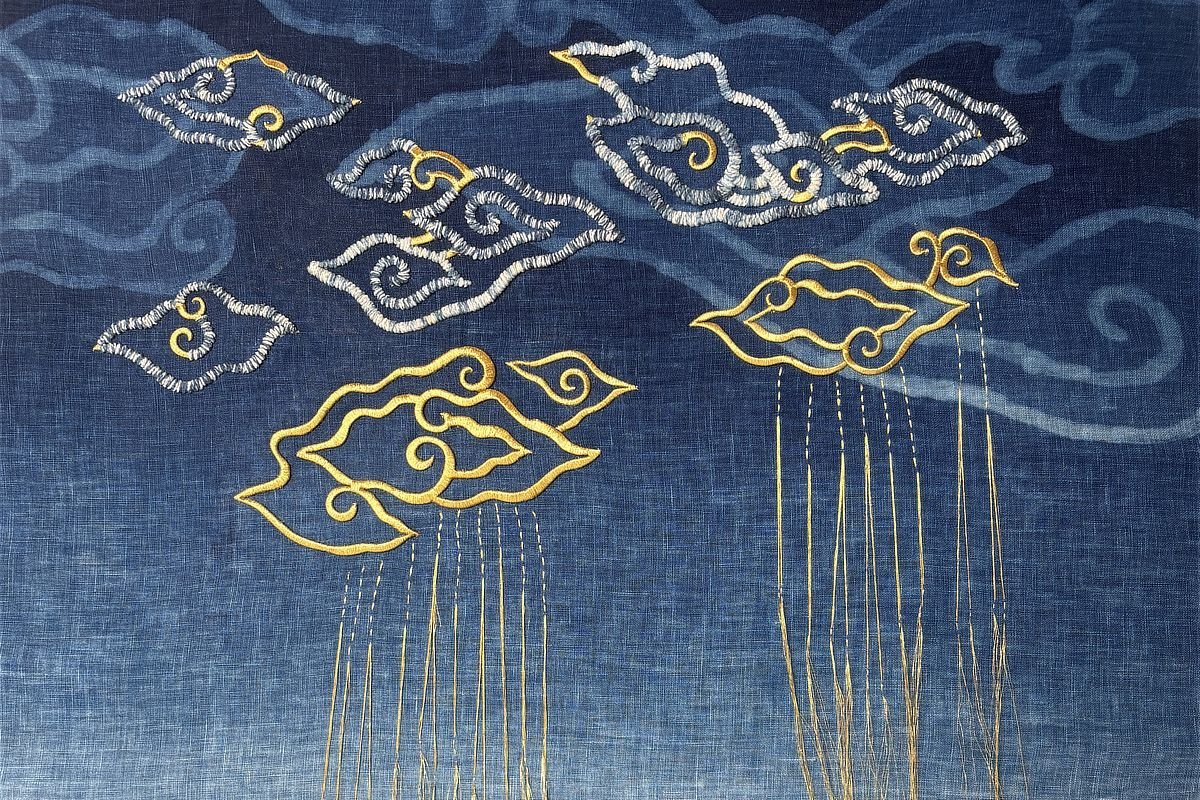
Textile artist Yann tilts her head at her work Blessing, where clouds and fine golden threads fall over an indigo batik linen backdrop.
“I think I need to shake it a bit more,” she says, before lifting the large frame and giving it a vigorous shake, adjusting the loose threads to better echo the sunshowers that inspired it.
Her work looks back at traditional craft, while keeping a clear eye on its future.
At Temu House in Petaling Jaya, Selangor, Inspired By Tekat fills the space with contemporary reworkings of the traditional Malay embroidery craft of tekat.
On view until May 31, the exhibition brings together nine contemporary artists and nine students from the Textile & Fashion Design department of the Malaysian Institute of Art (MIA), alongside works by master tekat artisans.
The inaugural project under 3R Media’s Arts Heritage Artists (AHA) programme aims to reconnect audiences with tekat through exhibitions, demonstrations, artist talks and hands-on sessions that bring makers and visitors into closer dialogue with the craft.
“The project began from a simple but urgent realisation. When we spent time with tekat artisans in Kuala Kangsar (Perak), we saw both the extraordinary skill behind this centuries-old craft and the challenges it now faces,” says Lina Tan, project director.
“Tekat is at risk due to the time and cost of production, limited demand, and a shrinking pool of successors. At the same time, many contemporary artists and younger audiences have little exposure to it,” she adds.
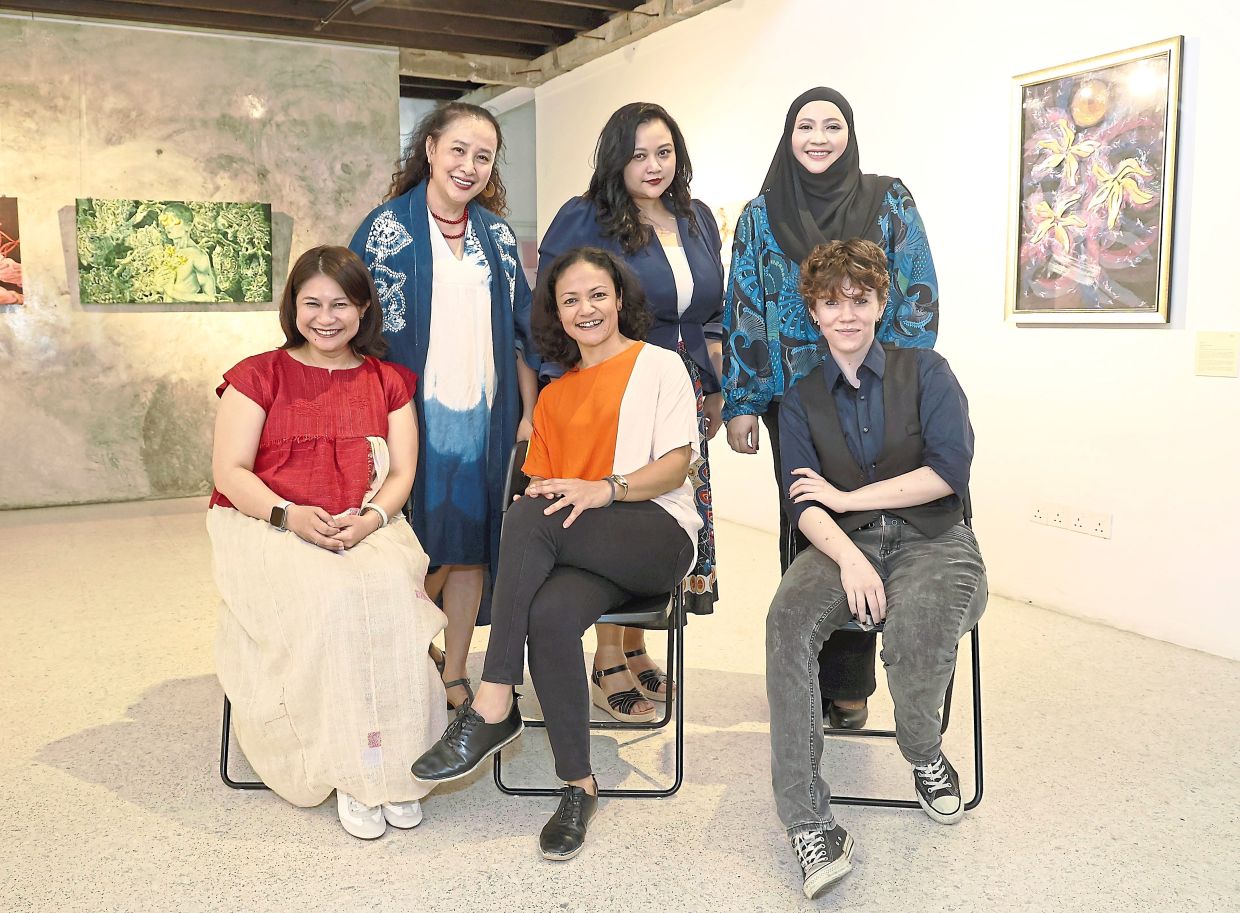
The show – a multi-generational mix – features artists Afiza Abubakar, Chau Xhien, Daisy Ooi, Hannah Nazamil, Nadirah Zakariya, Ummi Junid, Xeem Noor, Yann, and Yante Ismail, alongside nine participants from MIA, including lecturer Wan Nor Atikah and students Ariane Paul, Lee Rong Ze, Natalia Hilliker, Russell Chin, See Ru Thern, Siti Humaira Sheik Sharufuddin, Tan Jing Xuan, and Yong Ru Yee.
Preserving the craft
Tracing its origins to the 15th-century Melaka Sultanate, tekat is a traditional Malay embroidery technique that involves couching gold or silver thread over a raised core (mempulur) to create intricate motifs on velvet.
Once associated with royal and aristocratic households, it was traditionally used to adorn ceremonial textiles, with motifs carrying meanings tied to cultural identity and status.
Yet the craft remains demanding to master. From last December to March, participating artists – including some new to textile work – underwent an intensive introduction to tekat with master artisans Adiguru Kraf Tekatan Benang Emas Azizah Adam and her daughter Nor Faizatol Fazleha Mohd Rasdi, who guided them through both technique and cultural context.
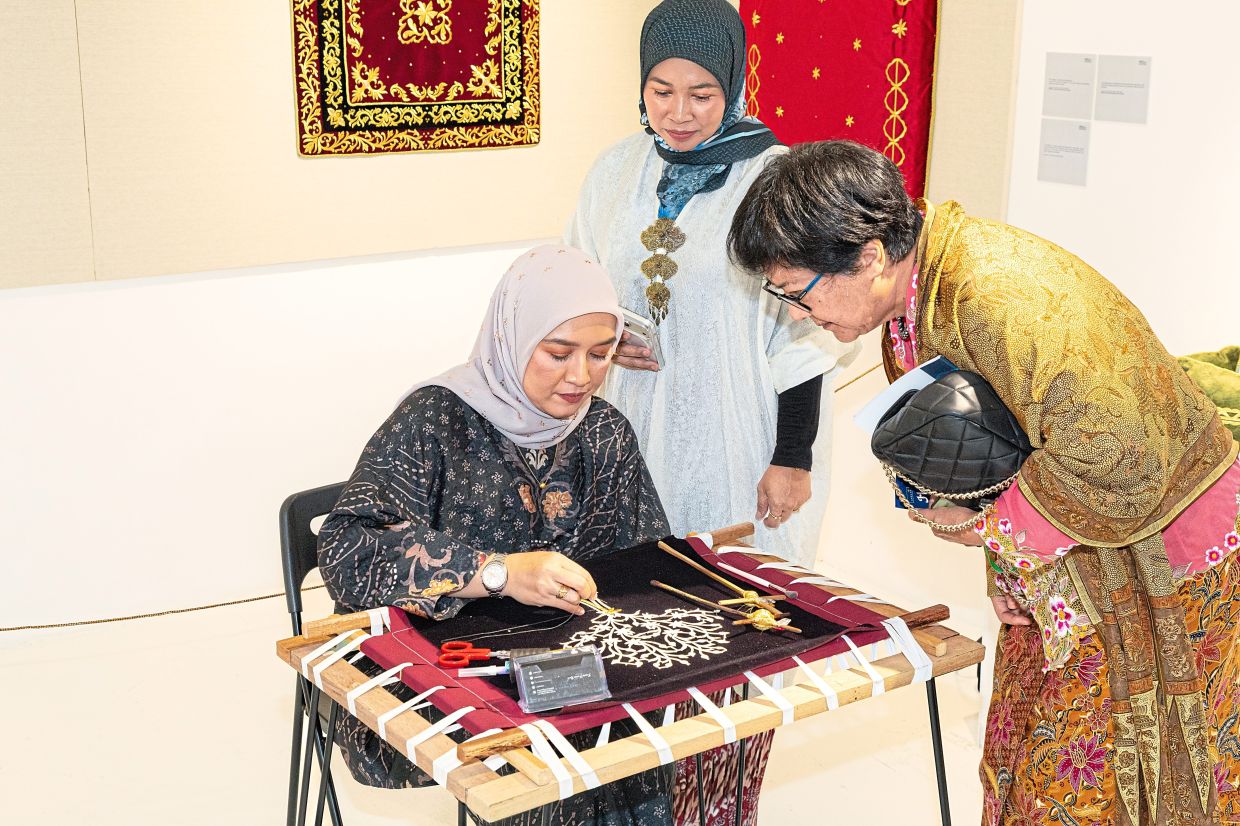
At 66, Azizah, affectionately known as Mak Zah, has nearly 50 years of experience in tekat, both as a practitioner and a teacher.
“It worries me that there is no successor generation,” admits Mak Zah in an essay featured in the exhibition booklet.
“Tekat will disappear if we don’t do something.”
Nor Faizatol, 42 – affectionately known as Kak Faz by the artists – represents a younger generation of tekat practitioners exploring new applications beyond traditional forms.
Together with a team of women artisans, she balances heritage with contemporary business sensibilities, producing more accessible items such as hand mirrors, photo frames and clutches featuring tekat motifs.
“These artists can bring new perspectives to tekat, and I’m excited to learn from them,” says Kak Faz.
A meticulous discipline
The artists soon discovered that tekat is deceptively difficult. Once tasked with couching gold thread beneath the mempulur, requiring precise control of needle and thread, some found themselves close to giving up.
At a recent gallery interview, the artists reflected on putting together the show.
“My first few attempts turned out all bumpy-lumpy,” says Afiza, a Tokyo-based textile artist who specialises in saori weaving, a Japanese style of hand weaving.
Afiza was one of the 20 artists selected for the recent Ilham Art Show 2025 at Ilham Gallery in Kuala Lumpur.
“Halfway through the tekat process, I started questioning life,” interjects Yann, prompting a chorus of agreement from the other artists.
As a non-textile artist, Yante is more familiar with sculptures and paintings, and says that it was already a challenge from the start, as learning tekat required picking up a whole new skill set.
“Tekat requires a lot of patience. At first you think, ‘it’s no big deal’, but once you learn it, you realise how challenging it is. When you look at the artisans’ work and how smooth it is, it looks like liquid gold,” she says.
After the intensive workshop, the artists were tasked with translating what they had learned into contemporary works informed by their own practices.
To preserve the essence of tekat, each work had to incorporate three key elements: the couching technique central to tekat, a mempulur, and some use of gold.
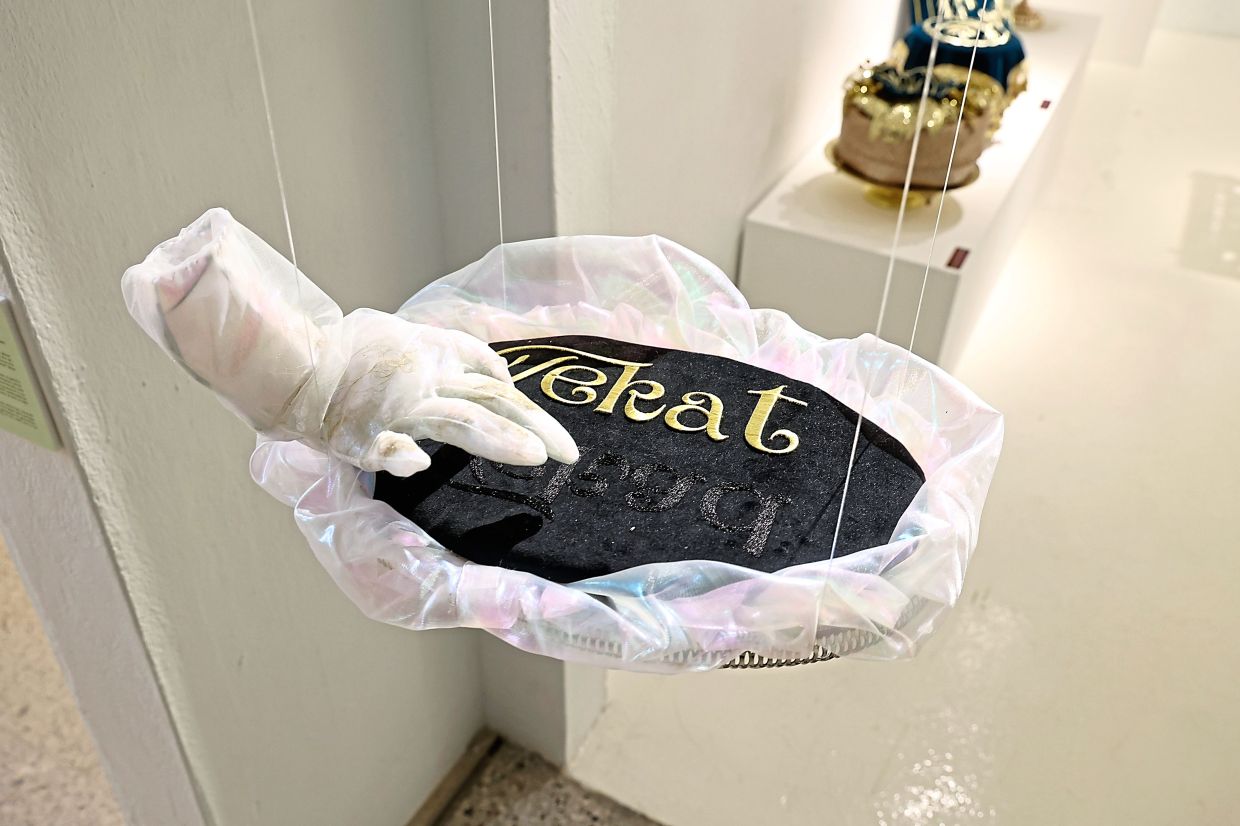
Curator Sharmin Parameswaran noted that the artists’ interpretations were a welcome surprise, offering fresh perspectives on the traditional craft.
“Through Inspired By Tekat, we wanted to shift perceptions of how tekat can function as an art form and reveal its visual potential,” says Sharmin.
“Seeing how meticulous and time-consuming it is, I worried the artists might struggle, but they rose to the challenge,” she adds.
For example, Xeem Noor – who recently showed in the National Art Gallery’s Single series – contributes Tekat Dengan Tekad, a textile and fibre sculpture placed between the traditional tekat section and contemporary interpretations. The work plays on the word tekad (determination), reflecting the resolve needed to master tekat.
Through their own lens
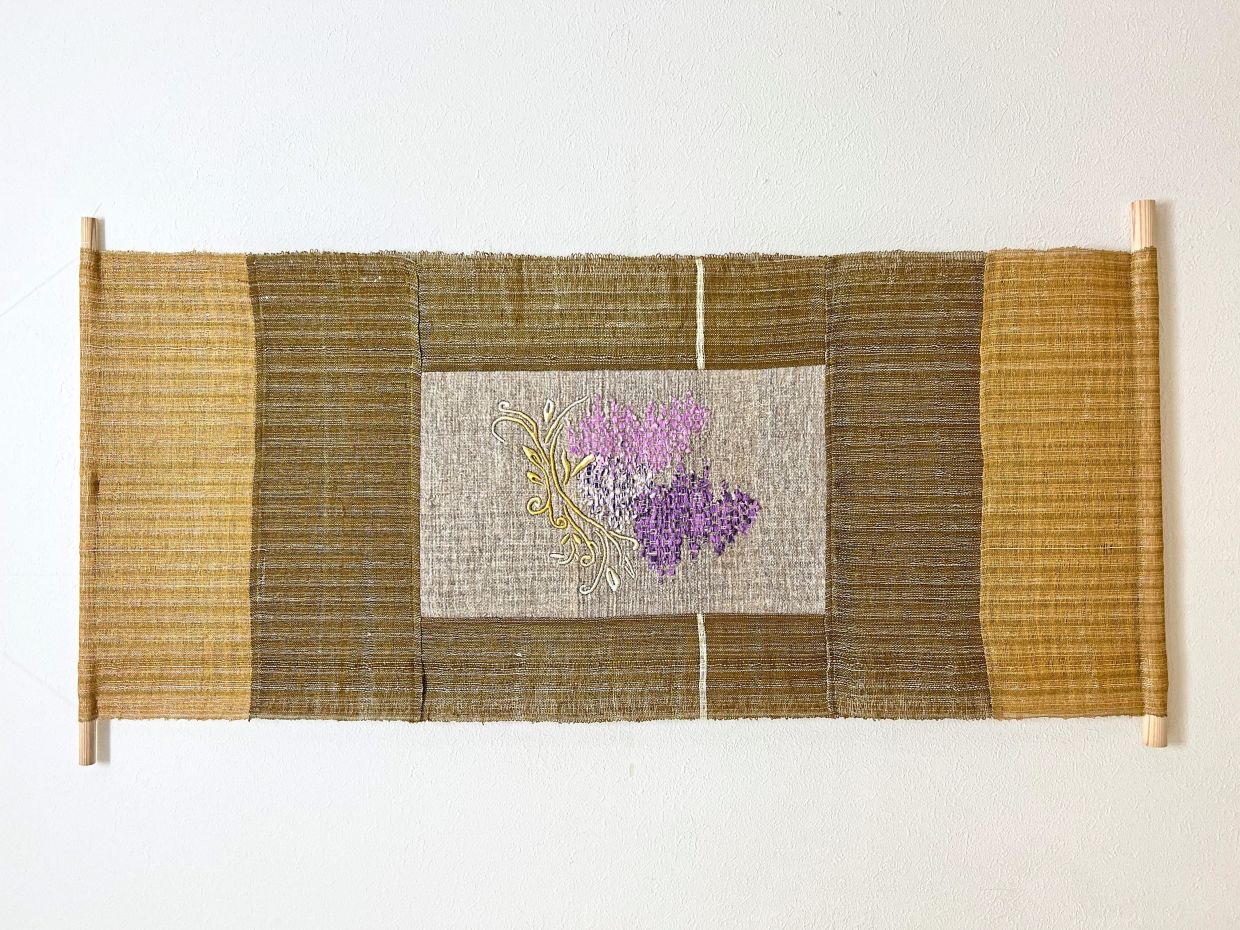
The biggest challenge for Afiza was adapting tekat techniques into her own practice, which centres on handwoven textiles.
“My weaving is very fluid and organic. I was worried the traditional approach to tekat might feel too rigid, so I experimented with different bases and mempulur until I found the right balance,” she shares.
In Cascading Into Existence, she gently fuses the discipline of tekat with her intuitive process, drawing parallels with kakejiku, the traditional Japanese hanging scroll used for painting, calligraphy or poetry.
In Yante’s Rooted, she pays tribute to the women artisans of tekat by using a humble mengkuang mat as the base. The work depicts a woman whose dress extends into a network of gold-threaded roots, binding her to land, memory and cultural legacy.
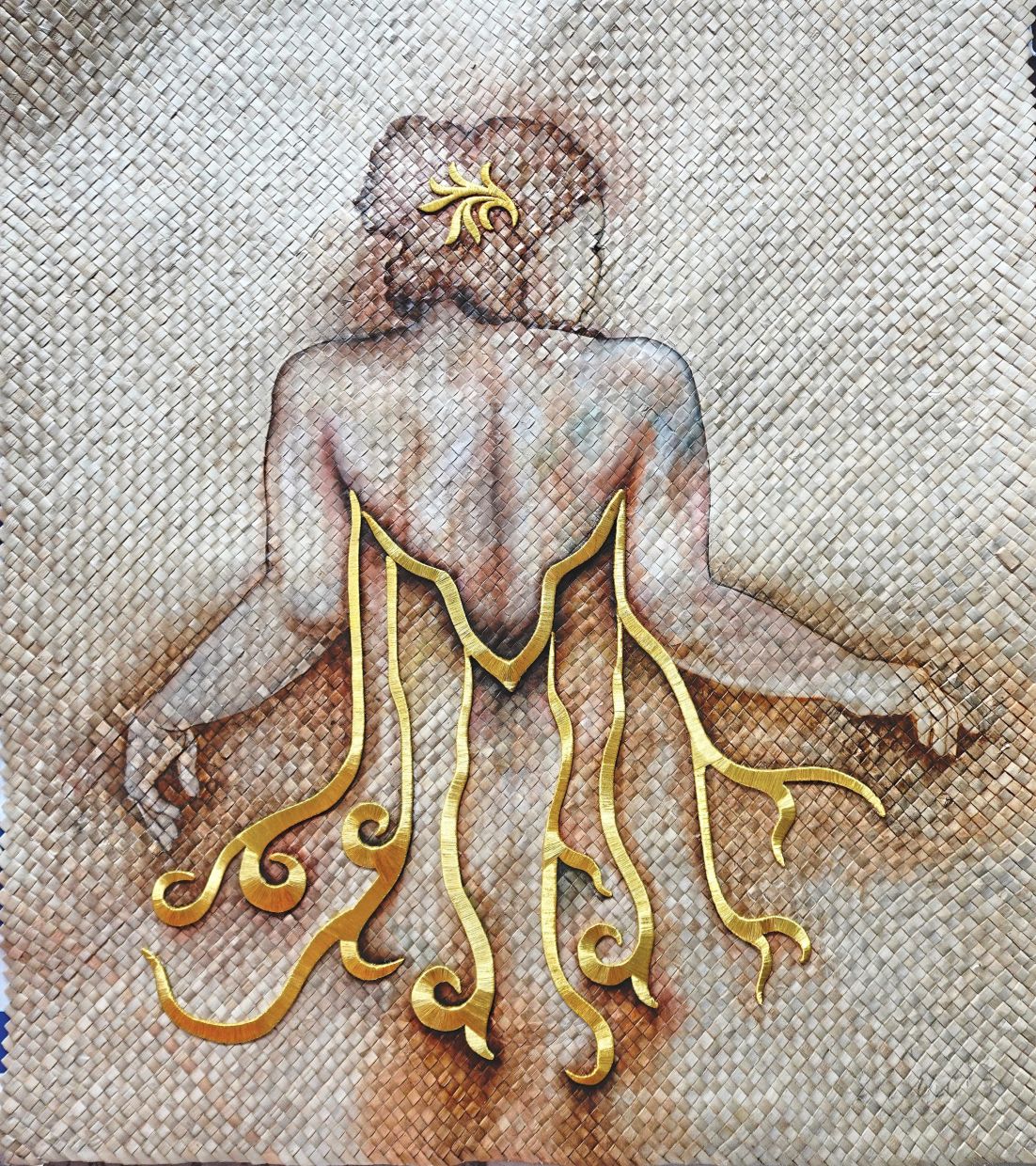
“Tekat has always felt inaccessible to me, tied to ceremony and aristocracy. In this piece, it is reclaimed as a craft that belongs not only to history or hierarchy, but also to the people,” she says.
It is also a traditional art form that draws you in, regardless of how challenging it is at the outset.
“When I finished my piece, I thought, ‘never again’. But as I was packing up, I realised I still had all this gold thread and had already gone through the trouble of learning it – so I’m now working on another tekat piece,” Yante says with a laugh.
“I’ll never match what the master artisans can do, but I can do it in my own way. I think this project has succeeded in inspiring a new generation of artists to keep the craft alive,” she concludes.
The Inspired By Tekat show is supported by Yayasan Hasanah’s grant programme Arts For All Seasons (ArtsFAS).
Inspired By Tekat is showing at Temu House, Petaling Jaya until May 31. Free admission. Opening times: Friday to Sunday, 10am-5pm. More info: temu.my.
[ad_2]
Source link