[ad_1]
The artworks presented in “Dispossessions in the Americas” at Wrightwood 659 are stories within a larger story—each playful, violent, responsive, imaginative, and often blurred along its borders. Despite the diversity of the more than 40 works on view, they all share a common concern: How do Afro-descendant, Latino, Indigenous, queer, and trans communities from different cultural sites maintain their sense of subjectivity, tradition, history, and relationship to the land?
This exhibition is not a historical survey of colonialism across the Americas; rather, it is an assemblage of diverse perspectives and lived experiences shaped by the social, political, and physical forces of colonial violence. The artists are the actors and narrators of difference within the Americas. Curated by Eduardo Carrera and Jonathan D. Katz, the exhibition brings together works that are committed to a feminist examination of gender, sexuality, race, and class.
The concentration of artwork can risk flattening the diverse perspectives into a homogeneous view of colonialism in the Americas, especially for viewers who do not engage with the pieces and their varied history critically. Discussions about diaspora and migration could easily dominate the narrative if not carefully considered. This brings to the forefront an important question: How does one engage productively with the various tensions within communities, cultures, and individuals who are spread across different regions—including the Caribbean, the U.S, South America, and, in one instance, Spain—each shaped by distinct histories of displacement and dispossession?

Credit: Shanti Knight
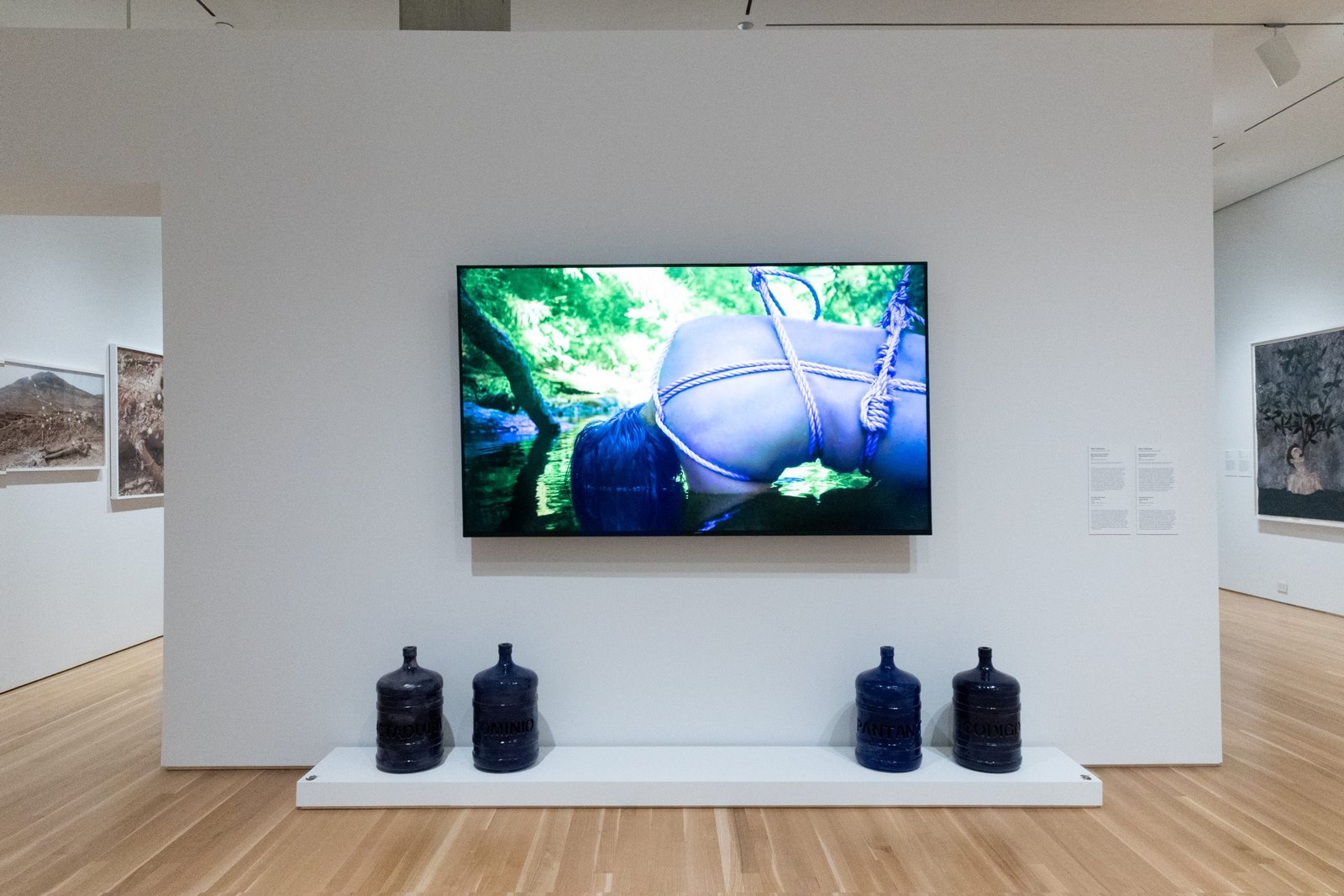
Many of the artists’ works contend with their relationship to the land and water, as evidenced by the works of Carlos Martiel, Seba Calfuqueo, and Thomas Locke Hobbs. In Calfuqueo’s short film Kowkülen (Ser líquido) [Liquid Being], the artist explores the fluidity of their body and its relationship to a river—two fluid forms that resist the defined usage and limits of their existence. Martiel’s short film Lazos de sangre [Bloodline] allows the artist’s blood to flow into the ocean through two catheters inserted into his forearms, creating a visceral and direct link between his flesh and the water. Hobbs presents a series of photographs that explore the continuities and disruptions in human alterations to the landscape in South America, reflecting on the intimate relationship between their presence and the Amazon.
This attention to the body and land extends into the works of Regina José Galindo and Joiri Minaya, but with a specific focus on the political violence inflicted on both people and territories. In the short film Tierra [Earth], Galindo captures her naked body in a Guatemalan landscape, as an excavator removes dirt around her. It is a powerful reference to the mass graves of Indigenous communities stemming from the Guatemalan civil war. Minaya, in her photographs of cloaked monuments, challenges the authority of public sculptures that celebrate racist and genocidal figures—monuments that often fail to appropriately convey the brutal truths of their histories.
Deborah Thomas’s film, Tidalectic Repair, queries the histories derived from the Middle Passage: Africans liberated on St. Helena, the bones buried on the island and later unearthed through new development; the traditions and rituals brought to Jamaica through colonial networks; the natural environments that are exploited by large corporations and those being defended by their local communities; and the broader historical and contemporary events linked to these legacies.

Credit: Shanti Knight
Taken together, the works confront the viewer with a complex web of beliefs and values that guide these artists through the world—beliefs arrived at through the routes of colonialism and global capitalism. Many of the artists, through their sustained focus on the performance of gender, race, and sexuality, expose the limits of colonial logics. The works question what colonialism has built as much as what it has destroyed.
To borrow from Thomas’s film, the exhibition invites us to consider the layered nature of colonialism—its enduring presence in the landscapes and across the bodies of water and people. While colonial violence is the foundational process that has shaped much of what we know as the Americas (and has also erased so much of what could have been), these artists work through lenses shaped by that very violence.
If the nature of colonialism is palimpsest, so too are the ancestral legacies and traditions that connect us to the universe. It is through these artists’ perspectives that we begin to see not only destruction but also the generative possibilities that emerge from the histories of violence. This tracing—of what has been lost and how creative practices can transform cultural traditions—is less of a fixed history than a process: a simultaneous desire for and refusal of the histories that have shaped their contemporary world.
“Dispossessions in the Americas”
Through 7/18: Fri noon–7 PM, Sat 10 AM–5 PM, Wrightwood 659, 659 W. Wrightwood, advance tickets required
Reader Recommends: ARTS & CULTURE
What’s now and what’s next in visual arts, architecture, literature, and more.

In their joint exhibition, artists Mike Cloud and Nyeema Morgan prompt us to reflect on how narratives are constructed and circulated.

Works by Nordic artist Sofia Hagström Møller light up the Swedish American Museum for its 50th anniversary.

This season, exhibitions in Chicago provide canopy cover from the chaos of infinite wars.

Will Quam’s new book shows that the story of brick and the story of Chicago are forever intertwined.

John A. Knudsen fashioned a visual symphony of simultaneous urban motion.

Critic Pia Singh surveys the scene at EXPO Chicago and beyond.
[ad_2]
Source link