
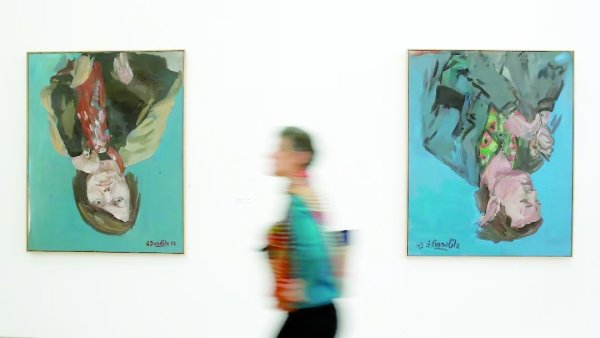
German artist Georg Baselitz, whose expressive paintings and sculptures stirred controversy in West Germany before winning global acclaim, has died aged 88.
His death was confirmed to AFP by Ropac Gallery, which had a long-standing professional relationship with the artist.
A statement from the gallery said Baselitz died peacefully and described him as an artist who defined German visual art for a generation.
Born Hans-Georg Kern in 1938 in Deutschbaselitz near Dresden, he was among Germany’s most prominent contemporary visual artists with a career spanning more than six decades.
He adopted the name Baselitz in 1961 as a nod to his hometown and studied art in East Berlin before moving to West Berlin in 1957 amidst political pressure and fears of forced labour in mining.
His first West Berlin exhibition in 1963 was condemned, with two paintings confiscated and the show closed, leading to a high-profile legal dispute.
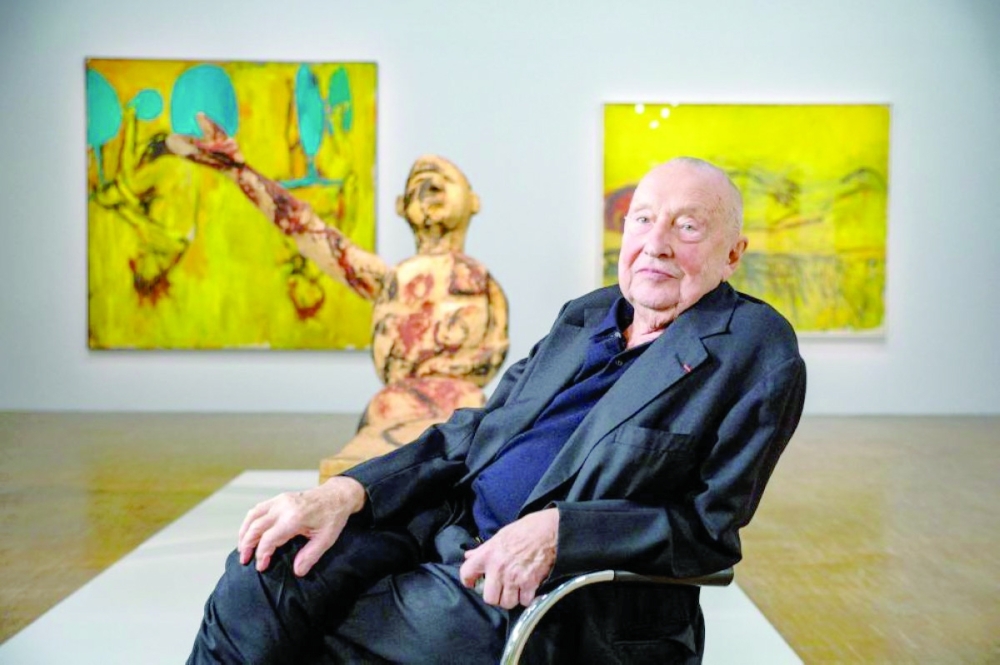
German artist Georg Baselitz poses near some of his artworks displayed at the National Museum of Modern Art. — AFP
He gained recognition in 1965 in Florence with his ‘Heroes’ series, marking an early international breakthrough.
His works often reflected Germany’s traumatic twentieth-century history, particularly the war and post-war division, and became central to postwar European art discourse.
In 1969 he began painting canvases upside down, inverting motifs to challenge perception and balance abstraction with figuration.
His influences included German Expressionism, abstract painters such as Jackson Pollock and Willem de Kooning, and elements of Pop Art.
He aimed to shock viewers and create images that forced reflection, saying that surprise was central to artistic purpose.
His wife, Elke Kretzschmar, became a frequent subject in his work after their marriage in 1962.
Baselitz achieved international prominence after the 1980 Venice Biennale alongside Anselm Kiefer, establishing him among leading postwar German artists.
His works are held in major international collections and museums worldwide. — AFP
He was elected to the French Académie des Beaux-Arts in 2019 and had a major retrospective at the Centre Pompidou in 2021.
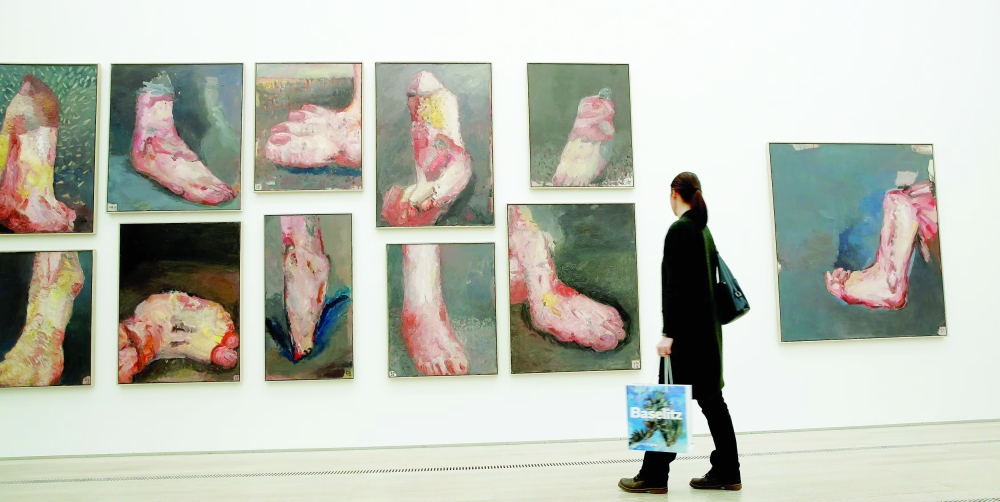
A woman stands in front of the paintings ‘P D Feet, 1960-63’ and ‘P D Foot-Interior, 1963’ (R) of German artist Georg Baselitz. — Reuters
His final works are scheduled for exhibition in Venice at the Fondazione Giorgio Cini.
Across his career, Baselitz reshaped postwar German art with his provocative imagery and distinctive inversion technique, leaving a legacy that influenced generations of painters and sculptors.
He remained active into his later years, continuing to produce paintings and prints that revisited historical themes and personal memory while refining his visual language.
Critics widely regard him as one of the most important German artists of the postwar period, known for challenging conventions and redefining figurative painting in contemporary art.
He leaves behind a body of work that continues to provoke debate within the international art world.