[ad_1]

The Susquehanna River Art Collection begins with native people
The Susquehanna River Art Collection will be on exhibit at the Susquehanna Art Museum in Harrisburg for four months, opening March 13, 2026.
- An art collection tells the story of the Susquehanna River, from ancient petroglyphs to modern paintings.
- The collection is curated by artist Rob Evans, who has a personal connection to the river.
- The art is temporarily housed in a historic farmhouse, with plans for a permanent Susquehanna River Art Museum.
It all started with a petroglyph.
The petroglyph in question was among a collection of carvings in rock found near Safe Harbor in the lower Susquehanna River, etched onto stone with crude tools by the artisans of the Algonquian tribes that inhabited the region long before the arrival of white men from Europe.
Some of the petroglyphs were created 1,000 years ago, making them the first known examples of Susquehanna River art. They depicted animals and humans. They marked boundaries. They depicted celestial events and told the story of a culture that would, unbeknownst to the artists, eventually disappear.
But that culture did not vanish. Its story remains carved in stone.
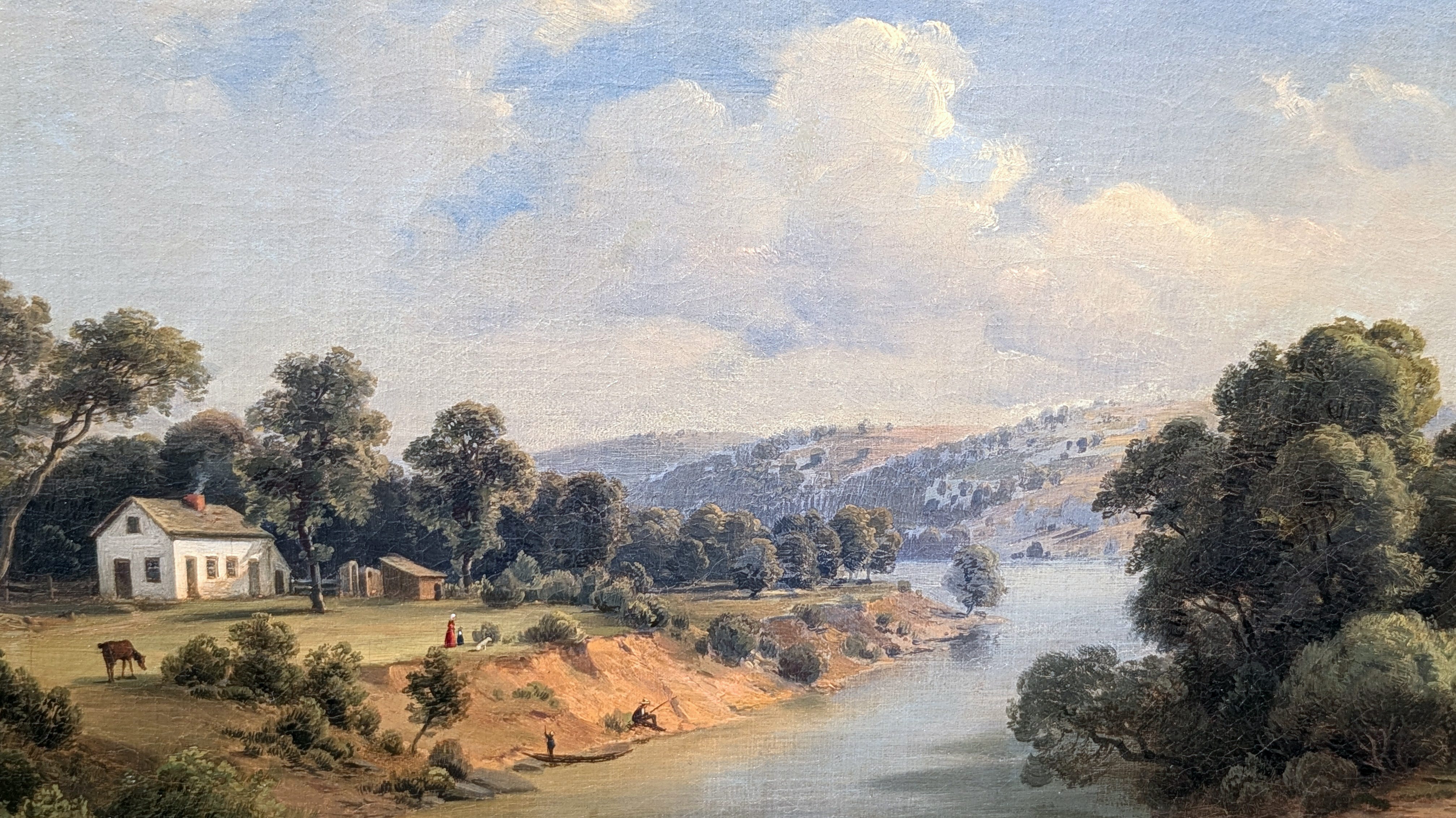
One of those stones resides in the collection of art that depicts the Susquehanna and tells the story of the evolving nature of the river, from the Susquehannock to the English who reveled in the region’s bucolic nature to the attempts, successful and unsuccessful, to tame the river for monetary gain.
Rob Evans, the curator of the collection, has a personal connection to the river, having grown up spending summers at his maternal grandparents’ home atop a promontory that afforded panoramic views of the Susquehanna.
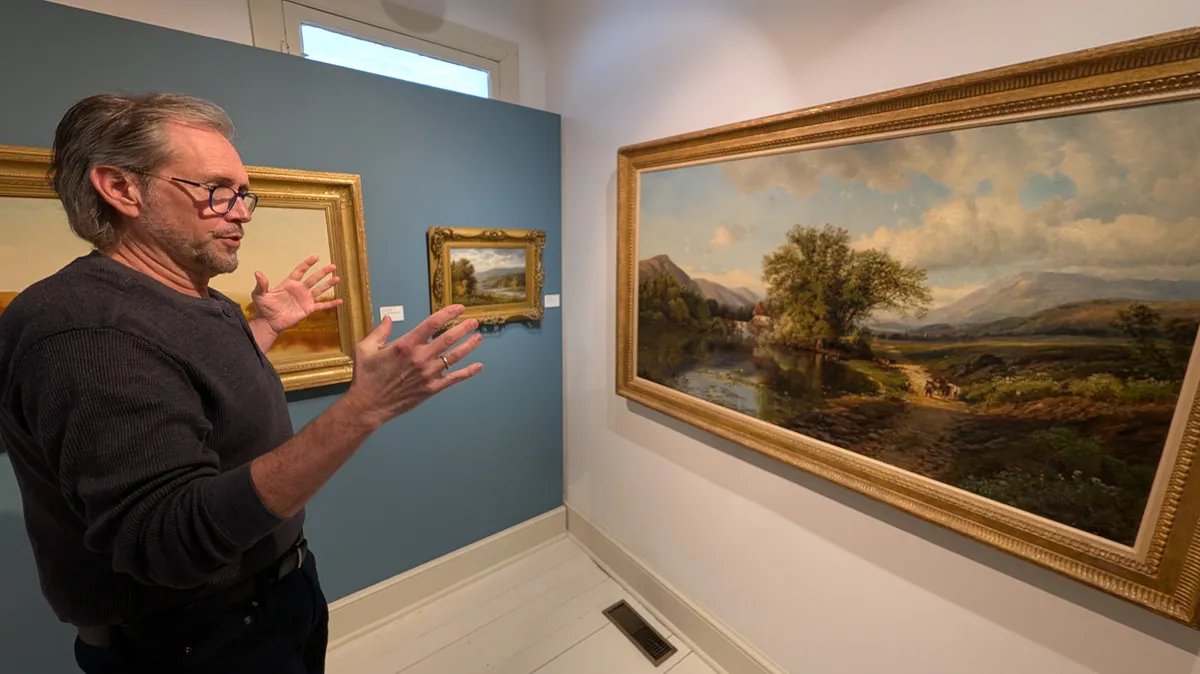
As he guides visitors through the collection, he tells the story of the art, the river, and this country’s gestation and birth.
A new home for the collection
The Susquehanna River Art Collection is housed in a historic farmhouse on the grounds of the Historic Hellam Preserve, just south of Hallam Borough. The restored farm covers about 50 acres, surrounded by woods, farmland and, to the north, a townhouse development, mostly obscured from view by the woods.
It is a fitting home for the collection. A log house on the property dates to the 1750s and a stone bank barn, to the 1790s. The farmhouse is a fairly modern addition to the farm, built in the late 1800s.
But it is just a temporary home. The collection has been there for some time, but the hope is that it will be moved eventually to a Susquehanna River Art Museum on the grounds of the Susquehanna Discovery Center and Heritage Park, a project spearheaded by the Susquehanna National Heritage Area.
The complex, planned on the site of the Mifflin Farm just outside Wrightsville, has its own storied history, once serving as a stop on the Underground Railroad. The finished project will include the discovery center, a 79-acre park on the site of a Civil War era skirmish that led up to the Battle of Gettysburg, some commercial and hospitality space and the Susquehanna River Art Museum, billed as the first of its type, documenting more than four centuries of history through the works of artists for whom the Susquehanna and its environs served as their Mona Lisa.
The farm is open to the public on Saturdays from 10 a.m. to 4 p.m. from May through October, with guided tours available three times a day. For more information, visit the heritage area’s website.
Fundraising is underway to finance the project. In the meantime, the Susquehanna River Art Collection will be on exhibit at the Susquehanna Art Museum in Harrisburg for four months, opening March 13.
‘I didn’t know how famous the river was’
Rob grew up in suburban D.C., but his summers were spent at Roundtop, a renovated 19th Century stone house owned by his maternal grandparents. The house was perched on a wooded ridge high above the river; you could see the river wind through the valley from the home. “It was a magical place,” Rob said. When he was a kid, according to his biography on his website, he would roam the woods and collect insects, bones and other natural artifacts. He liked praying mantises and would walk around with one perched on his shoulder, like a pirate’s parrot. “It freaked people out,” Rob said.
Praying mantises show up in his artwork. One painting depicted one of the insects in the foreground of a Susquehanna River landscape, making the image look like one of those ‘50s sci-fi movies in which giant insects terrorize Peter Graves.
When he graduated from college – earning an art degree from Syracuse University – he moved back to Pennsylvania and settled in a farmhouse on Roundtop. (He and his wife still live there.) He has painted a number of subjects but has always painted landscapes of the river.
About 20 years ago, he was asked to curate a show of Susquehanna River paintings and he was hooked. “I began to dig deep,” he said. “At that point, I didn’t know how famous the river was.”
He began collecting paintings of the Susquehanna. About 10 or 15 years ago, he met Jim Snyder, who grew up on the river. Snyder, who now lives in Atlanta, revisited the river in 2024, kayaking its entire 444-mile length from Cooperstown, N.Y., to Havre de Grace, at the river’s mouth in the Chesapeake Bay.
Snyder recalled seeing Roundtop from the river when he was younger and has said it looked like a castle perched atop the bluff. He and Rob got along immediately, bonding over their passion for the river and the art that tells its story.
They worked together securing pieces for the Susquehanna collection, scouring auctions, eBay and, even, Facebook Marketplace. He found one painting, depicting the construction of Safe Harbor Dam, on Facebook Marketplace. The owner told Rob he “didn’t want it hanging on his wall anymore.” He found another piece, a chrome-plated Currier & Ives lithograph plate, on eBay, posted by its owner in Spain, who asked $900 for it. “I couldn’t hit ‘Buy It Now’ fast enough,” Rob said. The owner then realized that the piece may be worth more than $900 and balked and after negotiations, Rob acquired it.
The works in the collection have their own stories. Speaking of Currier & Ives, the company often took work from other artists and copied for their lithographs, copyright law not being what it is now. Other pieces tell the story about how the Susquehanna played a role in the Hudson River School, a loose collection of artists who romanticized the American wilderness in the mid-19th century, believed to be the first art movement in America. Rob believes, though, that many of those artists began by painting the Susquehanna and that the river should claim the mantle of inspiring the country’s first art movement.
Mostly, though, the collection – from the petroglyphs to the oil paintings of the Conowingo Dam – tells the story of the river and the culture that evolved along it.
The natives, Darwin and the Civil War
The Susquehannock did not fare well.
After the petroglyphs in the collection are paintings that depict the Native American through the eyes of the settlers who drove them from their land. A map drawn by explorer John Smith depicts a Susquehannock warrior as a giant. The Susquehannock towers over a settler.
Some of the early drawings and paintings weren’t exactly journalistic in their accuracy. One depicts a Susquehannock settlement surrounded by palm trees and the men tending to a herd of cattle wading in the river. Rob believes the artist conflated images from accounts of explorers. “A lot of explorers were in the Caribbean, and they put it all together in an image of the New World,” he said.
Things turned dark for the Susquehannock as Europeans began settling along the river, a prime location, the river providing commerce and transportation, among other things. A painting depicts an attempt to burn John Harris alive. It had to do with booze and Benjamin Franklin. Franklin – of all founders, considering his ample appetites for vice – had banned alcohol at colonial outposts, angering the Susquehannock who decided to take their ire out on Harris by tying him to a mulberry tree and setting him ablaze. The story has a happy ending – for Harris. Some friendly Susquehannock came to his rescue, the moment captured in the painting. Interestingly, the painting is done in color while Harris is black and white. Mostly white.
Another painting depicts a massacre of Susquehannock in 1763 in Lancaster. During a campaign to drive the Susquehannock from their land and force them to flee to Canada, some of the tribe’s women and children were rounded up and incarcerated in the Lancaster Prison, located on what is now the site of the Fulton Opera House. The Paxton boys, the story goes, stormed the prison and massacred the women and children on the Lancaster square. In the painting, the boys are armed with scythes and muskets. “The Paxton boys are wearing top hats and suits,” Rob said. “I kind of doubt that.” Native Americas soon vanished from Susquehanna River artwork.
Artists of that period – post Revolution and pre-Civil War, a period of expansion into the wilderness – made the Susquehanna famous. Their art was exhibited in the cities on the coast and in collections of the wealthy who came to America to make, or expand, their fortune. Depictions of the river found their way to pottery, a method of transferring the art to pottery, rather than having to hand-paint each piece – put the river on dinner tables throughout England on Staffordshire stoneware. One of the exhibits in the collection depicts the Columbia-Wrightsville Bridge on a platter, a pitcher, a tea kettle, a coffee pot and a soup tureen. Rob found the soup tureen on eBay and when it arrived, he said, “It was in 50 pieces.” The shipper hadn’t placed any padding between the lid and the tureen. He was able to piece it together.
There are some odd connections among the works, one of which connects the Susquehanna River to the theory of evolution. The artist Alexander Lawson once did a lithograph of naturalist Samuel Haldeman’s home near Chickie’s Rock. Lawson had also worked on a book by Alexander Wilson, known as “the father of American Ornithology,” his studies of birds predating the work by some guy named Audubon. Haldeman liked the lithograph Lawson did of his home so he hired Lawson’s daughter, Helen, to work on illustrations for a book about snails, which wound up influencing a British naturalist named Charles Darwin, who cites Haldeman’s work in the preface of his groundbreaking “Origin of Species.”
As civilization encroached on the river, art reflected the vanishing wilderness, Rob said. Soon, paintings of the river included foundries and river boats as the river was exploited for commerce. “Logging and coal mining became a big business on the river,” Rob said. Those industries that were reflected in the art.
The encroachment on what had been the frontier was not just reflected in the visual arts. In James Fenimore Cooper’s trilogy the Leatherstocking Tales, the first book, “The Pioneers,” considered the first American novel, depicted the conflict between the old ways of frontiersman Natty Bumppo and the new laws of encroaching civilization. It was set in New York State, at the headwaters of the Susquehanna. A first edition of the book is in the Susquehanna collection. In turn, Rob said, Cooper’s work inspired visual art. Thomas Cole, the founder of the Hudson River School, painted Susquehanna River landscapes frequently and Cooper’s work inspired his “A Landscape with Figures: A Scene from the Last of the Mohicans.”
The Susquehanna is also featured in the 1872 book edited by William Cullen Bryant, “Picturesque America,” a collection of prose and engravings that celebrated the nation’s natural landscapes as industrialization swept across the country. It was intended, Rob said, to bolster America’s image in the post-Civil War era, a counterpoint to images depicting the burning of the Wrightsville-Columbia Bridge in the days leading to Gettysburg. “America’s image was it was a place where everybody was trying to kill each other,” he said.
‘Part of an artistic movement’
Rob has been painting the river since the early 1980s and still paints landscapes – he has a studio in the historic farmhouse and serves as its artist-in-residence. A gallery in the farmhouse has 40 years of his work on display, made possible by patrons who purchased the paintings back from collectors and other galleries. And he expects to continue his evangelical quest to gain notoriety for the Susquehanna River art movement.
Discovering this rich heritage, and what could be described as an art movement, was a pleasant surprise.
“I had no idea I was part of an artistic movement,” he said. “It’s pretty cool.”
Columnist/reporter Mike Argento has been a York Daily Record staffer since 1982. Reach him at mike@ydr.com.
[ad_2]
Source link