
There’s something quietly beguiling about this pencil drawing. The woman’s eyebrows are ever so slightly furrowed. Her eyes are drawn downwards. Her features are evoked subtly, gently, via marks that have left the lightest impression on paper – not by the bold strokes and thick impasto of some of the splashier portraits that surround her. Here we see absences, the freight of empty space.
Nearby is a portrait of a daughter with a petulant glare, posing for her artist father. A pair of cousins, faces haunted, figures huddled together, a portrait of girlhood as dark and dreamlike. Still, something compels me towards the pencil drawing, perhaps its half-finished quality. A woman’s interior in the process of articulating itself. In search – a lifetime after the artist made it – of a place to rest.
Self portrait (circa 1940) by Yvonne Boyd adorns the yellow wall that opens The Hidden Line: Art of the Boyd Women, an intelligent and evocative exhibition curated by Sophie O’Brien, now showing at Bundanon Art Museum. The gallery and arts centre unfold on 1000 hectares of land by the Shoalhaven River, where the Dharawal and Dhurga language groups are Traditional Custodians. The property was donated in 1993 by the Boyd family – synonymous, until now, with Yvonne’s husband, the renowned modernist artist Arthur Boyd – as a gift to the Australian public.
Entering the gallery, I’m struck not by Arthur Boyd’s singular artistic vision but by a response that feels harder to articulate. It’s a sense of the cumulative power of creative expression, the presence of art as chorus, as emerging out of relationships, its meaning shared.
There’s a narrative about Arthur Boyd that casts him as part of the group of Australian artists, including John Perceval and Sidney Nolan, who he was related to by marriage, that midway through the last century overturned Australia’s staid cultural establishment. As this show makes clear, he was equally part of another kind of dynasty: five generations of artists – so many of them women – for whom art-making wasn’t some grandiose statement of individual genius, a largely Western concept. Over the course of more than 300 works we see art intertwined with life, as natural and inevitable as breathing, the act of making not reserved for the grand arbiters of the culture but for everyday people.
The wall on which Self portrait hangs salon-style recalls the interior of a living room and it’s hard not to revel in its jumbling of generations, its delightful lack of hierarchy. Portraits by Boyd and Nolan are accompanied by works such as Alice, a mesmerising circa-1970 portrait by Arthur’s daughter, Polly Boyd, of her cousin Alice Perceval, and Lucy Boyd aged about 21 years (circa 1936) by his mother, Doris Boyd, of his sister Lucy Boyd Beck, her face, lips curled in a slight smile, hovering in midair.
Mothers and daughters. Lives that make other lives possible. When we think about lineage, we assume forward motion, building on what came before, but what if legacy – that old masculine word – could move back and forth in time, take on shapes that are stranger, more elliptical? I’m entranced in the next space by the work of Arthur Boyd’s grandmother, Emma Minnie Boyd. Emma Minnie was supported by her mother, Emma Mills, who had inherited wealth, to pursue art full-time, and her paintings – shown everywhere from the Victorian Artists Society to the Royal Academy of Arts in London – are closely observed and intricate. Her landscapes, painted en plein air, are sensitive evocations of place, impressions of rivers, rainforest and beaches. They chime across the room with the work of her daughter-in-law Doris Boyd, who studied under Frederick McCubbin and could powerfully evoke water: the mirror-like surface of the bay at Port Melbourne, the precise blue of the sea as imagined from the vantage of scrubby headland.
I’m drawn most to how Emma Minnie rendered domestic spaces, in ways that bristle with emotion and detail – ornaments, arranged on a wooden shelf, in Corner of a drawing-room (1887), and a delicate watercolour of a female figure in Woman washing dishes (circa 1902), her mood of quiet absorption conjured via the barest washes of paint.
The home looms large in this show, both as medium and idea; on the other side of the valley, at the Bundanon Homestead, works by the Boyd women adorn the bedrooms and the sitting room. Ceramics, etched with patterns and images, line the cabinets, the work of several couples in the family, such as Hermia and David Boyd, who worked together as studio potters.
This sense of the domestic as inextricable from the realm of art ripples through a needlepoint of the Herbig family tree, a South Australian gum, by Narelle Jubelin. It’s an acknowledgement of settler histories, one of eight new commissions – interspersed throughout the space – by contemporary Australian women artists including Pat Brassington, Helen Johnson and Tjunkaya Tapaya. And again in Tiled coffee table (circa 1955), which bears exquisite impressions of flowers, a collective effort by Yvonne, Arthur and Doris, alongside John Perceval, Neil Douglas and Mary Nolan, blurring the lines of authorship.
In the next room, a high point of The Hidden Line is a presentation of family photographs, taken by Mary Nolan in the ’60s, handprinted from negatives held by the National Library, never shown together before.
Spending time with the show, I return again and again to these luminous pictures of girls painting outside, brushing their teeth in the river. Long-haired young women, gangly and beautiful, in Suffolk, Hampstead and Arles, sharing secrets, sitting on the grass threading daisy chains. I marvel at these scenes of languid creativity, the freedoms of class and privilege, which belong, I think, alongside some of the defining images of the era.
Mary Nolan had trained as a painter and ceramicist before marrying John Perceval and, later, Sidney Nolan, who she had known since she was a girl. Her children, Tessa, Alice, Celia and Matthew, grew up to become artists. There’s a photograph I love, Mary and Celia, Highgate, London (circa 1963), in which Mary and her daughter are mirrored in the frame, an accident of double exposure that’s also a metaphor for one of the most important threads in this show. Artistry not as lineage but as language, that can be shaped by power and circumstance but also surface in mysterious ways.
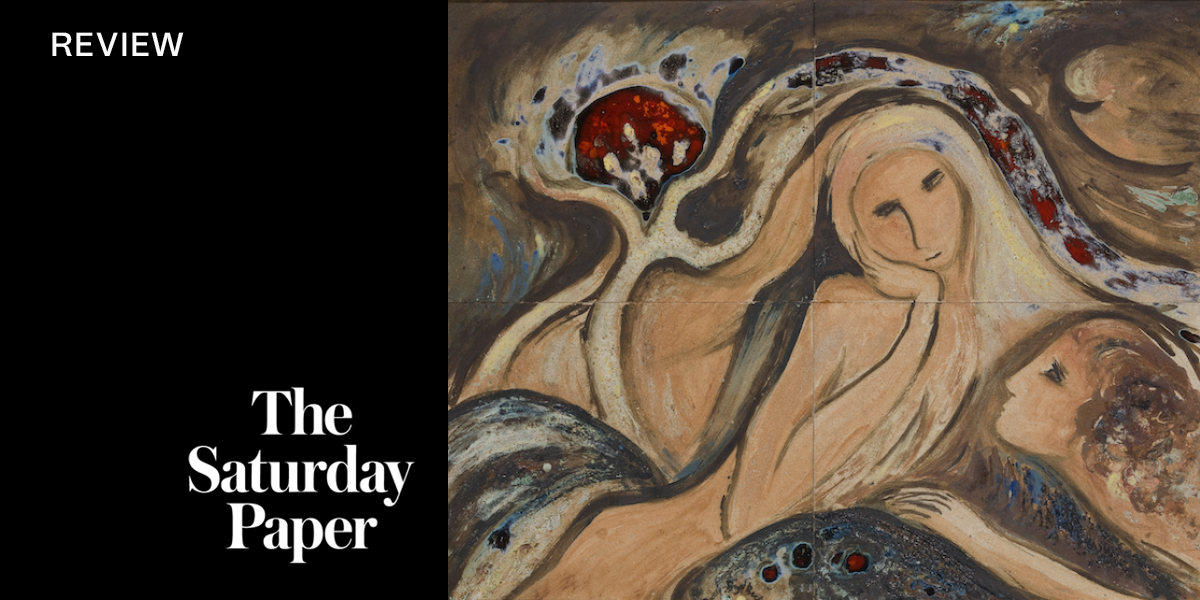
The Hidden Line explores the irrepressibility of the creative spirit. In the largest gallery, which features freewheeling paintings by Cassandra Boyd, I’m moved by Lucy Boyd Beck’s surreal riffs on Greek myth – swirling figures, limbs reaching for each other, evoking Orpheus and Eurydice. There’s a wildness in these works, an outsize sense of imagination that’s picked up by SUPER POWER / heads held by heads (2025), a radiant UV print by Diena Georgetti.
Our culture now is interested in unearthing the hidden contributions of women, but often the podcasts, art books and exhibitions do little to challenge the politics of visibility or ask questions about what kind of art counts as legitimate or how we might be drawn to overlook what already exists. Yvonne Boyd, like many women of her generation, stopped pursuing her career as an artist when she met Arthur, focusing instead on cultivating her children’s talents and nurturing the landscape that would become Bundanon. Unlike the women of my generation, who were promised that we didn’t have to choose between family, career and creative work, Yvonne’s lost potential, enraging as it is, was her choice shaped by the possibilities of that time. Lineage suggests a forward progress, a reprieve from these problems. Taking in The Hidden Line, it strikes me how little has changed but also that maybe I had been looking at art the wrong way.
Across from Lucy Boyd Beck’s paintings, beyond a plinth displaying a bronze by Lenore Boyd, a ceramic teapot by Celia Perceval, I admire Melbourne tram (1944). Yvonne Boyd’s arresting observation of wartime life in Melbourne, it’s a depiction of city dwellers on a commute: faces downcast, contained by the carriage, their faces furrowed with feeling, deeply, darkly human.
This work is as astute and penetrating as any paintings by her male contemporaries, the artists that she studied with, those whose legacies we celebrate. I think about the trajectories that art and life can take – and what it might mean to expand them.
The Hidden Line: Art of the Boyd Women is showing at Bundanon until February 15.
Neha Kale travelled with the assistance of Bundanon.
ARTS DIARY
EXHIBITION It Takes a Village
Art Gallery of New South Wales, Gadigal Country/Sydney, until January 18
PHOTOGRAPHY Women Photographers 1900–1975: A Legacy of Light
NGV International, Naarm/Melbourne, until May 3
CULTURE Too Deadly: Ten Years of Tarnanthi
Art Gallery of South Australia, Kaurna Yarta/Adelaide, until January 18
MULTIMEDIA John Nixon: Song of the Earth
Heide Museum of Modern Art, Wurundjeri Woi Wurrung Country/Bulleen, until March 1
EXHIBITION Objet d’Art – Theo Koning and his creative self
Walyalup Fremantle Arts Centre, Whadjuk Noongar Country, until January 26
Last Chance
CLASSICAL Mahler Nine
Concert Hall, Meanjin/Brisbane, until November 29
This article was first published in the print edition of The Saturday Paper on
November 29, 2025 as “Expanded realms”.
For almost a decade, The Saturday Paper has published Australia’s leading writers and thinkers.
We have pursued stories that are ignored elsewhere, covering them with sensitivity and depth.
We have done this on refugee policy, on government integrity, on robo-debt, on aged care,
on climate change, on the pandemic.
All our journalism is fiercely independent. It relies on the support of readers.
By subscribing to The Saturday Paper, you are ensuring that we can continue to produce essential,
issue-defining coverage, to dig out stories that take time, to doggedly hold to account
politicians and the political class.
There are very few titles that have the freedom and the space to produce journalism like this.
In a country with a concentration of media ownership unlike anything else in the world,
it is vitally important. Your subscription helps make it possible.
Send this article to a friend for free.
Share this subscriber exclusive article with a friend or family member using share credits.
