
Miya Chahal,Nottingham and
Ellie Tutt,Berkshire

 BBC
BBCA group of tattoo artists are calling for tougher regulations to be introduced to prevent people convicted of violent and sexual offences from entering the profession.
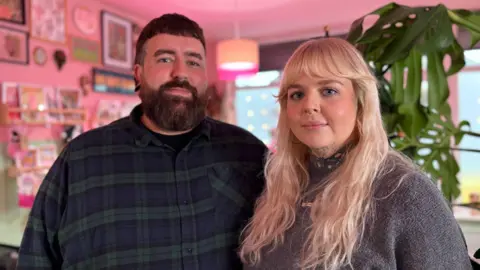
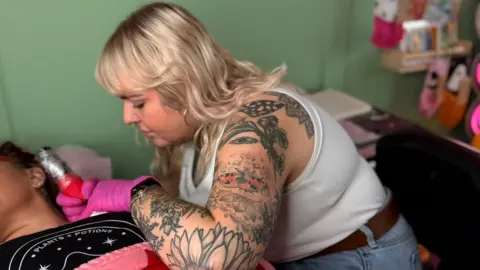
Tattooists Natasha Thompson and Matthew Castle, from Nottingham, are among the founders of the “Draw the Line” project, which is campaigning for mandatory DBS checks for tattoo artists in England.
The checks are already a requirement in Wales after being introduced in 2024 as part of wider health and safety reforms for the tattoo industry. However it is not mandatory in England.
The Department of Health and Social Care has been approached for comment.
To obtain a tattoo licence as an individual artist in England, you must apply to your local council to register yourself and your premises before paying a registration fee at rate set by the local authority.
A council officer will then inspect the premises to ensure you are compliant with health and safety regulations but no background checks on individual artists are required to take place.
This differs from the system in Wales, which was updated in November 2024 to introduce stricter hygiene rules and mandatory DBS checks for tattooists.
The Welsh government said the checks allowed local authorities to see whether an applicant has any unspent convictions or “relevant” offences, with those that do facing additional scrutiny.
The Draw The Line campaign is arguing for the rules in Wales to be enforced in England.
Mr Castle, 37, said the existing regulations were “too relaxed” and allowed anyone to “pick up a tattoo machine and start a business”.
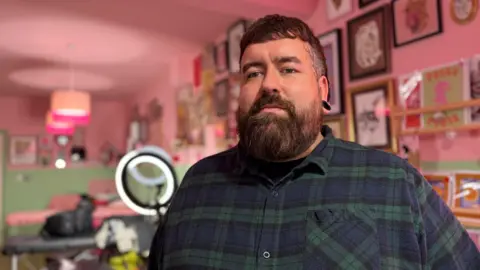
He and Miss Thompson have co-owned Bleeding Hearts Tattoo Studio in Bakersfield since 2024 and have been tattooing for over six years.
The couple argue that people with a history of committing serious violent or sexual offences should not be able to obtain a tattoo licence and hope mandatory DBS checks will prevent this.
They have petitioned the government for the changes, alongside others from across England, including Wigan-based tattoo artist Gemma May Farrimond.
Their petition currently has 5,000 signatures, with 100,000 needed for it to be debated in Parliament.
Miss Farrimond, who says she was previously assaulted by a tattoo artist, had been posting on social media calling for tighter regulations in the industry.
She said Bleeding Hearts engaged with her posts, and the three of them decided to develop the campaign.
“When I got in touch with [Bleeding Hearts], we got a group of us together and there was more reach and momentum,” she said.
“This campaign doesn’t just impact tattoo artists. Your son or daughter could get tattooed by somebody dangerous – it impacts the public as a whole.”
 Nottinghamshire Police
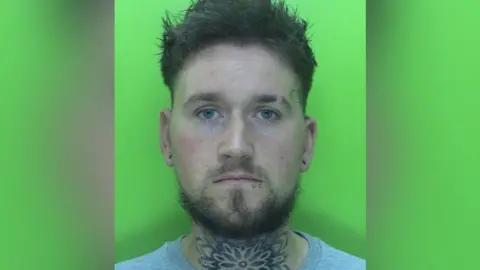
Mr Castle said the “necessary push” to launch the petition came when 30-year-old Ashley Lilleyman, a tattoo artist based in Mansfield and Chesterfield, was found guilty of 14 counts of sexual assault against a number of his clients.
He was sentenced to six years and four months in prison in August.
Mr Castle said the news came as a shock to him.
“I’d been thinking about [the campaign] for some time, but hearing an incident like that happen so close to home – it made it feel so real,” he said.
“As a man, you want your clients to feel as safe as possible, but knowing there’s people tattooing with the wrong intentions…it’s scary.
“We are in a percieved position of power as tattoo artists, and that needs to be respected.”
‘Clients are vulnerable’
Miss Thompson, 31, said she hoped DBS checks could keep people like Lilleyman out of the industry.
“When you’re getting a tattoo, it is a vulnerable experience for clients, especially in intimate placements,” she said.
“You could be getting tattooed on your thighs or sternum and breasts. You’re exposed in that situation, and you need to feel safe.”
She said DBS checks were necessary requirements in other professions and tattooing should be no different.
“If you are a nurse, care-worker or teacher, you need these checks because you’re dealing with vulnerable people,” she said. “The same should be true for tattooing.
“We are not trying to penalise people who were convicted of offences that aren’t relevant, or someone who made a petty mistake when they were young.
“We are focusing on certain kinds of offences which threaten client safety. Councils can then make their own decision on whether to offer a licence to an artist with [previous convictions].”
 Supplied
It is not just clients being tattooed who are at risk of abuse.
Siobhan, who has given her first name and chosen to waive her anonymity, told the BBC she was sexually assaulted after being offered an apprenticeship by a tattooist in Berkshire in 2011.
On her first day as an apprentice, she expected to enter a busy studio, but instead, found herself in an empty shop.
“We go into the studio, and he locked the doors behind us. It was just me and him,” she said.
“As soon as those doors were locked, that’s it. [He started] twisting my hair…grabbing it. Holding me against the wall by my throat.
“He went to put his hands down my underwear, and at that point I jumped up. The flight, fright and freeze kicked in.”
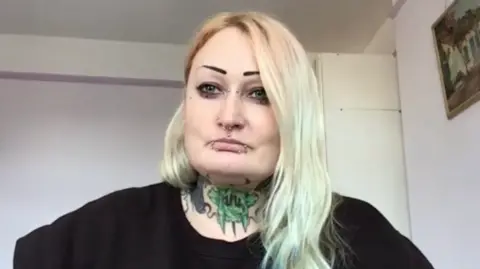
Siobhan, who was 19 at the time, also remembers the artist describing his behaviour towards other apprentices in detail.
“He told me about his previous apprentices, young girls, and how he had “[sexual acts] on tap” and that he had certain expectations from apprentices,” she said.
“I’m pretty sure there was mention of me having sex with him on the tattoo bed. I wasn’t there for that. I really wanted that apprenticeship. He was just happy to take advantage.”
Siobhan reported the incident to Thames Valley Police but the force said the investigation was discontinued due to “insufficient evidence.”
Reflecting on her experience, Siobhan says she feels there are not enough checks on tattoo artists and the lack of regulation made it a “wild west”.
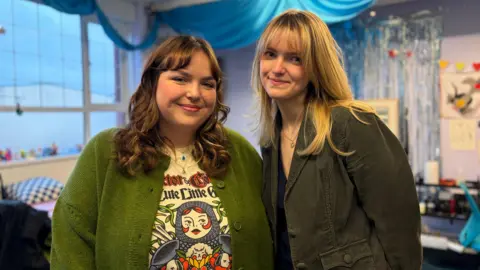
Siren Studio is a tattoo studio in Sneinton solely made up of women and non-binary artists.
Eleanor Bishop runs the space and said the majority of their clients come to them because they are worried about getting tattooed elsewhere.
“So many of our clients have come to us saying they’ve had negative experiences with tattoo artists,” she said.
“Whether that be uncomfortable touching, getting a tattoo they didn’t want, and in some cases, being sexually assaulted.
“We are aware of tattoo artists that have been convicted of serious offences, who then open a studio in a different city under a new name, and they can continue tattooing.”
“DBS checks should stop that from happening. Why wouldn’t you want your clients to be safe? I don’t think [the checks] are a problem unless you have something to hide.”
Miss Thompson said she believes DBS checks will put the industry in the “right direction.”
“Will DBS checks fix everything? No, but they’re a start,” she said.
“They are a great first step to getting these issues tackled, and to making it safer for artists, apprentices and clients.”
The Department of Health and Social Care has been approached for comment.
If you have been affected by any of the issues in this story, support and information is available at the BBC’s Action Line.