Standing next to paintings, sculpture and other artwork in a museum isn’t necessary anymore and Indiana University’s Eskenazi Museum of Art offers “Collections Online.” It’s a web-based portal the museum has initiated and is now working to expand and improve.
Looking at 47,000 items online at Eskenazi Museum of Art will take time. How long depends on your reasons for looking.
Where to start? Try some premade packages, which are on both the museum’s home and explore pages. Search by collection area, what’s currently on view, or burrow in to a featured collection highlight such as Marcel Duchamp’s Readymades.
Duchamp questioned art’s creation and purpose, pioneering the Dada movement. The “readymade” works opposed art’s “need” to be beautiful. Disappointed Dada-movement artists saw the War as an example of failing social structures causing violence.
The Eskenazi has been improving “Collections Online,” its web-based portal to the museum’s more than 47,000 works. The project took off in late 2019, and users’ responses are helping fine-tune it.
Last October, staff refashioned “Collections Online,” culling what didn’t work. Following are some favorites of two Eskenazi experts, Jessie Waymire, director of creative services, and Cassi Tucker, manager of museum technology.
Favorite pieces to view online from Esanazi’s collection
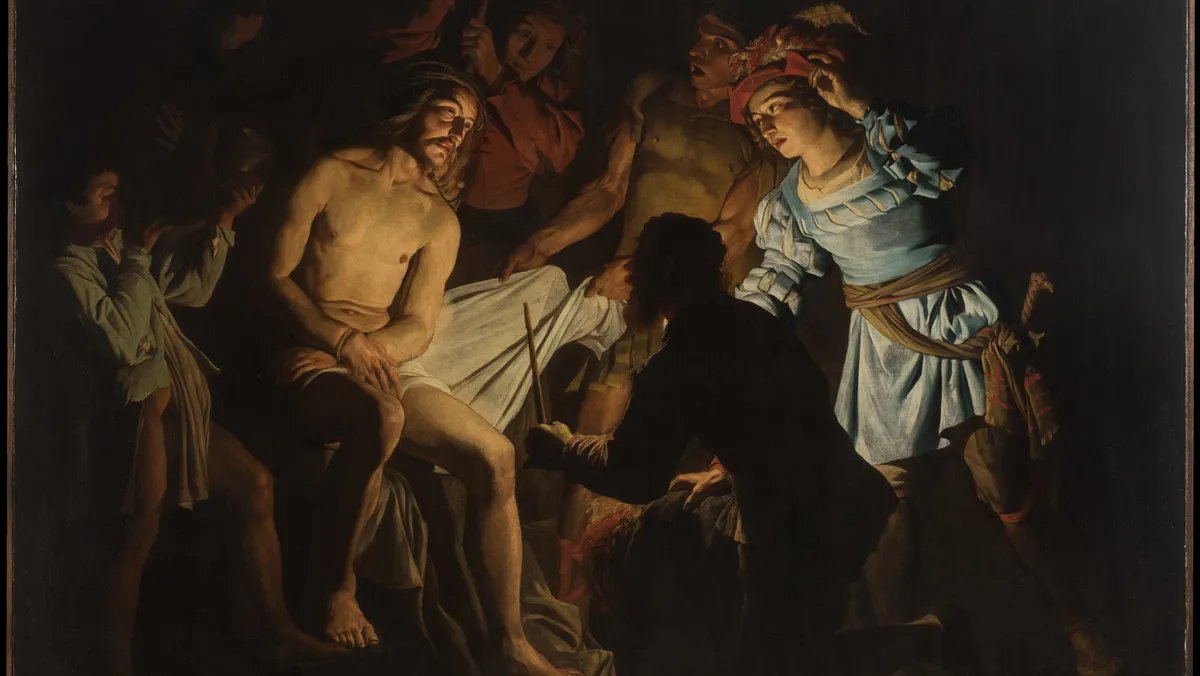
“The Mocking of Christ,” Matthias Stomer — “Matthias Stomer’s ‘The Mocking of Christ’ has captivated me each time I’ve walked through the Jane Fortune gallery — which has been many times since I arrived at IU in 2010 as an art history and design student,” Waymire said in an email. “Stomer’s style follows baroque lighting techniques that enhance the drama of a scene — I don’t know that it gets more poignantly dramatic than Christ, having been beaten, stripped, and mocked, awaiting his imminent crucifixion.”
“The Vision,” Sigmund Walter Hampel — “I love the detail and stippling technique of this (‘The Vision,’ by Sigmund Walter Hampel),” Tucker said, “and regularly spend time with it in the gallery where it’s on view.”
Japanese netsuke of a reclining cat — When she began to work at the Eskenazi, she said, the art had been packed away to make room for the building’s renovation.
“But the then-curator of Asian Art, since retired, showed me photos of the netsuke carvings. I still love these items — they are tiny, beautifully carved objects.” See the Eskenazi’s “Japanese netsuke of reclining cat.” Japanese netsuke are tiny objects that have impressive carving and design and were used as toggles to secure the cords of a man’s sagemono (hanging objects) on his kimono belt (The Mini Time Museum of Miniatures).
‘In addition to being important … they are simply fun.’
Visitor favorites, Waymire said, are the “Readymades” (the Readymades); she believes it may be their “playfulness and irreverence.” For example, look at “Why Not Sneeze, Rose Sélavy?”
“In addition to being important pieces of art in the collection, they are simply fun,” Waymire said.” Often surprising visitors is a collection of contemporary African art. “El Anatsui’s “Untitled” is a premier example. “It draws viewers in with its broad, shimmering gold surface and delights them with the beer and soda bottle caps.”
Scholars, amateurs, the curious: Come one, come all
Professors and students are a large portion of the visitors to Eskenazi’s collection; researchers from other art museums and art historians come, too. But there’s plenty of traffic from those who simply are curious.
“They could be planning a visit to Bloomington,” Waymire said, “researching us as prospective Eskenazi School students, or discovering our collection … for the first time.”
How much time to spend on “Collections Online” depends on why a visitor is there. Someone seeking provenance information might plunge in to multiple objects’ data for weeks, while a drop-in might spend a minute with three or four pieces each.
Unplanned pandemic pushes numbers viewing “Collections Online”
The COVID-19 pandemic served as an unplanned experiment for the museum’s website. And, as access to digital collections grew elsewhere, Eskenazi staff, too, wanted a more robust, sustainable system.
The pandemic, then, expanded interest in “Collections Online” as IU students and faculty had grown used to checking the original site instead of and in addition to visiting in person.
“Throughout this circumstance,” Waymire said, “we became aware of not only the unexpected merits of remote digital engagement, but also the many limitations of the original site.”
They analyzed the system infrastructure and looked at site-development alternatives. Two big attempts to fix the system failed. So, they took a new direction for the site. Now their limited staff can sustain it, and it’s also shareable with other collection-holding places at IU.
Staff looked at other museums for research. Not only do employees use other museums’ online collections, they already knew many of their peers at other institutions. They particularly connected with university art museums whose technology, staff and collections look something like Eskenazi’s.
What’s coming?
“The year 2030 is an ambitious goal,” Waymire said.
One plan could allow the museum to grow the number of published records from the current 11,000 to nearly 47,000 with a few tactical changes to how records are approved.
“Unfortunately,” Waymire said, “there are no shortcuts to photographing works of art, so while publishing artwork data by 2030 is tangible, it is less likely that those works will all be accompanied by images, though we are working toward photography support, too!”
How did they do it?
Eskenzi’s collection is managed through a museum-industry software called TMS, by Gallery Systems. “This database houses information for each of our more than 47,000 works of art,” Tucker said.
“As you can imagine, that is a lot of data. This vital system is maintained by our registrar staff, curators, art handlers and conservation team.”
Tucker and colleagues are looking at additional software, but for now stay focused on improving “Collections Online” and its associated systems, such as TMS.
Something that has involved a lot of work in digitizing the art is the vastness of the museum’s data. The Eskenazi has six curatorial areas, each with its own data priorities, Tucker said.
“It has been a majorly collaborative effort to identify essential data across the collection, review artwork records to ensure accuracy, and develop new workflows to address the backlog of yet-to-be-published collection data.”
Tell the Eskenazi what you think; they really want to know
The Eskenazi asks the public for feedback on its “Collections Online”; use this link, https://artmuseum.indiana.edu/machform/view.php?id=27786.
“A major theme of the feedback we have received so far,” Waymire said, “is collection searchability.”
They are working on ways to let users do advanced searches and access filters on their initial search results. This is the main goal for their “Collections Online 2.0.”
“We welcome and greatly appreciate all feedback — good, bad and ugly — and want to hear about your experience with Collections Online. We’d love to hear from you.”