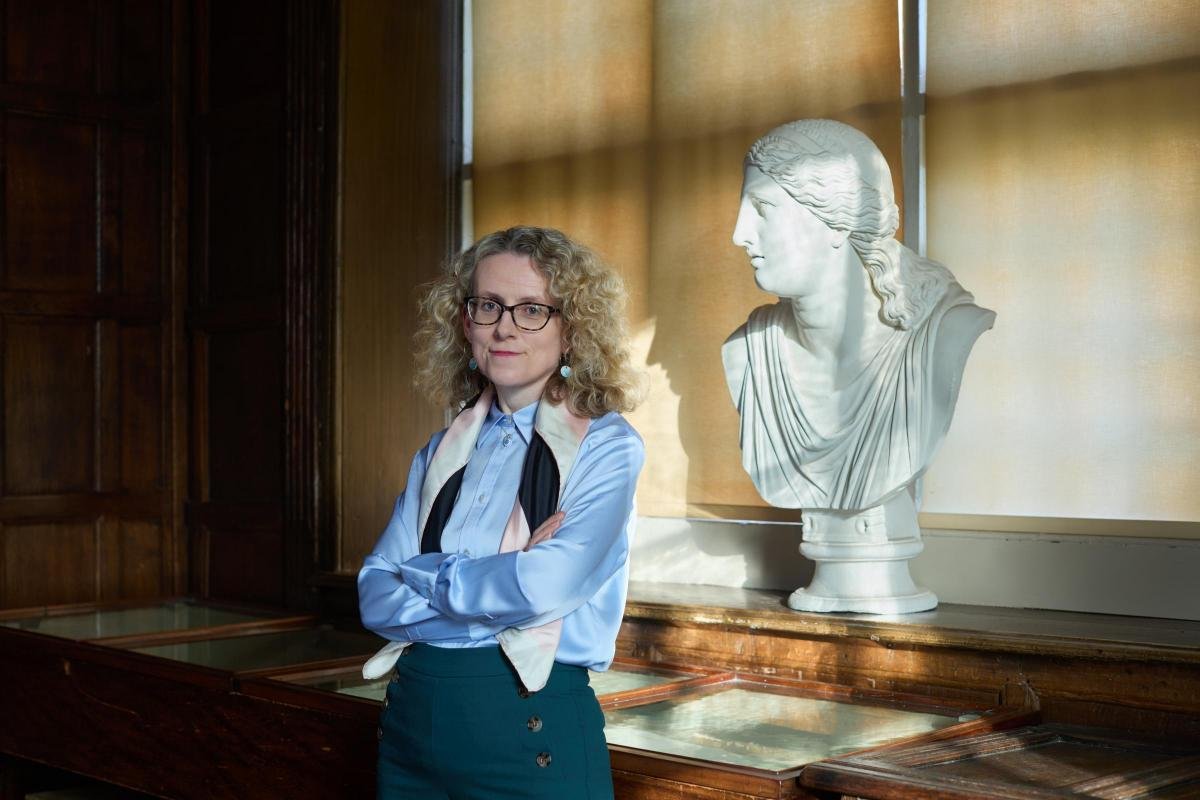
Curious, generous, intellectually rigorous, and quietly joyful, Emma Roodhouse is one of Suffolk’s most influential cultural voices, and her work resonates far beyond the region.
As Art Collections & Learning Curator at Colchester and Ipswich Museums Service, Emma has curated an extraordinary range of exhibitions spanning centuries, disciplines, and audiences.
From John Constable to Rodin’s The Kiss, from children’s book illustration to Ed Sheeran, from hairstyles in art to 500 years of surgery, explosives, and East Anglian printmaking, her work is united not by subject matter, but by intent: a deep and unwavering belief that art should be for everyone.
Alongside her regional curatorial practice, Emma’s expertise is recognised nationally.
She has undertaken research and collaborative work with Tate, contributing to wider scholarship and interpretation around British landscape painting, including Thomas Gainsborough, J.M.W. Turner and John Constable.
EADT Emma Roodhouse looking at more drawings (Image: Supplied)
This national perspective sits alongside, and strengthens, her commitment to regional collections and stories.
Emma is also a freelance researcher and author, who has published on Suffolk artists, particularly Constable.
Her long-standing research into Constable’s early Suffolk years, the artists, patrons, friends, and supporters who shaped him long before his landscapes became world-famous, was supported by a grant from the Paul Mellon Centre for Studies in British Art.
That research has directly informed major exhibitions at Christchurch Mansion, including Creating Constable in 2021, and now the three landmark Constable 250 exhibitions: Constable: A Cast of Characters (March-June), The Hay Wain: Constable’s Landscapes (July-October), and Constable to Contemporary (October-February 2027).
As part of the anniversary year celebrating Constable’s birth, one of the most significant moments will see The Hay Wain make its first-ever return to the county it depicts, arriving in Ipswich from The National Gallery, a once-in-a-generation moment for Suffolk and its cultural life.
Throughout her work, Emma consistently seeks to remove barriers—intellectual, physical, and emotional—inviting audiences in with clarity, warmth, and respect, and encouraging people to look again, and more closely.
Passionate, approachable, endlessly curious, and always, by her own admission, on the hunt for decent cake, Emma brings humanity to scholarship and generosity to curation.
Here, she talks to Gina Long about her journey, her working life, what drives her belief that art truly is for all, and why Constable and Suffolk still matter so deeply today.
It’s Mother’s Day weekend, how has being a mother shaped the way you see the world and perhaps even the way you curate and tell stories?
It took a while before I became a mum, and those early years were an absolute whirlwind.
I’m not sure it gets any easier now we’re in the teenage wilderness, it certainly makes for interesting times.
It has connected me to so many different stories and unexpected interests.
I wouldn’t naturally be drawn to Arsenal football club or the world of Warhammer, my children are and because of that, I probably know too much about those subjects.
It has also influenced my curatorial ideas more directly.
I became keen to break down barriers between the traditional art gallery space and the kind of environment where children can play, be noisy, and feel comfortable.
That thinking led to the playful exhibition Animals in the Art Gallery, which brought together our natural science and art collections in a way that welcomed younger visitors and encouraged exploration.
What does East Anglia mean to you?
Home, forests, the beaches, endless skies, timber-framed buildings, flinty churches, muddy walks, warm cafes, delightful bookshops, windswept river views, and ancient trees.
East Anglia has become the place I am rooted to in my family and work.
EADT Emma Roodhouse in Christchurch Mansion (Image: Supplied)
What was your very first job?
My first serious job, after the odd bits like handing out flyers for a gym, serving breakfasts at Watford Gap, and babysitting, was with a public art charity in Birmingham.
I handled administrative tasks and worked closely with artists.
One artist even asked me to run around the Jewellery Quarter with printed poems tucked into tiny ring boxes and leave them as surprises for the public at bus stops and cashpoints.
It was all about making art accessible to everyone, and I absolutely loved it.
What first sparked your interest in art, and when did you realise you wanted to work with it professionally rather than simply admire it?
I’m not sure there was one pivotal moment.
I always loved drawing, creating stories, and collecting postcards featuring all kinds of art, from William Blake to the Pre-Raphaelites.
I was also lucky to have an amazing art teacher at secondary school who encouraged us to explore different styles and artists.
I was doing a project on stripes, becoming completely absorbed in Bridget Riley’s paintings.
Researching her work and then going to see it in person really opened my eyes, and I think that’s when I first started imagining a career in galleries and museums working with collections and artists.
Your career spans an incredibly wide range of subjects and audiences. What connects everything you choose to work on?
People.
Stories from both the past and the present fascinate me.
I’m always drawn to finding points of connection, even between the most obscure collections or characters.
When I began researching East Anglian children’s book illustration, it led me to discover a whole network of artists with roots at Ipswich Art School.
One of them was the wonderful Helen Oxenbury, of We’re Going on a Bear Hunt fame, who studied in Ipswich.
And when you look at the oozy mud in that story, you can completely see how her art is grounded in the landscapes of East Anglia.
It’s those threads between people, place, and creativity that keep me inspired.
Curating often involves translating complex ideas for very different people. How do you approach that balance?
For me, everything begins with strong storytelling, allowing the objects, artworks, and collections to carry the narrative.
No one wants a book’s worth of curatorial explanation stuck on a wall; interpretation should feel natural, inviting, and flexible enough for different kinds of visitors.
People engage with exhibitions in very different ways: the parent racing around a display with a four-year-old who wants to touch everything, or the older couple with time to absorb the detail, who may need more places to sit.
EADT Emma Roodhouse looking at drawings (Image: Supplied)
A good exhibition anticipates and supports all these experiences without compromising on depth or clarity.
We’re incredibly fortunate at Colchester & Ipswich Museums to have an outstanding exhibitions team (Charlotte, Grace, and Connor) who constantly consider how complex ideas can be translated through design, even down to the smallest detail, like the paint colour on a plinth.
The staff at Christchurch Mansion also play a vital role, welcoming visitors, guiding them, and sparking conversations about every aspect of the exhibition.
That human connection is just as important as the labels or the layout.
What does a “typical” working day look like for you, if such a thing exists?
I’m up with the early birds so I can grab five minutes of peace before the day really begins.
I’m not sure a truly “typical” day exists as I mix freelance writing and research with my work in Ipswich Museums, there is usually a blend of the practical and the bizarre.
There are the standard meetings and emails, of course, alongside writing for articles or books, funding bids, drafting exhibition labels, and diving into files for research.
Some days involve moving artworks, cataloguing and meeting poets, artists, collectors and then dashing between different sites.
Somewhere in the middle of it all, there’s always time, however briefly, for a cuppa.
You’re known for being collaborative and generous in your approach. Why is that important to you?
That is genuinely the part of the job I love most.
You simply can’t work in isolation, and the collaborations I’ve been involved in have brought me huge joy over the years.
One of the first exhibitions I curated in Ipswich, in the Town Hall Gallery, was Change in Charcoal with the Ipswich artist Valerie Irwin.
The show featured her extensive series of charcoal drawings documenting the demolition of Cranfield’s Flour Mill down on the docks and subsequently the construction of DanceEast.
As I got to know Valerie, I learned how she had spent years, often in miserable weather, drawing thousands of images: vehicles moving back and forth, buildings being torn down, pigeons scattering, men working on scaffolding, even brick-cleaning.
No one had commissioned her to be there; she had simply recognised the significance of a changing townscape and captured it with extraordinary dedication.
I was new to Ipswich at the time, and she welcomed me into her studio with warmth, conversation, and genuine friendship.
I’m very fortunate that many of the people I’ve worked with since then have also become firm friends for tea and cake.
You are beginning to see the running theme through my work: tea, cake, and friendship.
You’ve curated exhibitions that are playful, challenging, emotional, and deeply scholarly. Which have stretched you the most?
Kiss and Tell was definitely the biggest logistical challenge, especially when it came to bringing Rodin’s large-scale marble sculpture into the Mansion and installing it safely.
The paperwork and planning meetings alone could probably fill three volumes.
Once the exhibition was up, we also had a huge amount of fun.
One particularly memorable moment was hosting an evening viewing for a local naturist group, who even recreated the famous pose from The Kiss.
I remained clothed!
How do you deal with the pressure that comes with caring for collections, histories, and public expectations?
I don’t really see it as pressure at all.
I feel incredibly fortunate to work with historic collections, remarkable buildings, and a team who care deeply about making those stories accessible to everyone.
For me, being a curator is fundamentally about caring, about people, looking after objects, honouring the people connected to them, and ensuring that the public can engage with their history in meaningful ways.
When you see it through that lens, it becomes a joy rather than a burden.
You’re also a researcher and writer. What does research give you that exhibition-making alone doesn’t?
As much as I thrive on collaboration and working with lots of different people, I really cherish the quieter moments spent in an archive, library, or collections store.
Gathering information, uncovering stories, recording details, and piecing together disparate threads brings immense fulfilment.
Research is the foundation of any decent talk, exhibition, or publication.
It has its own rhythm and rewards: the satisfaction of discovery, the calm of focused concentration, and the opportunity to raise awareness of stories that have in the past been nudged to the side and ignored.
Living and working in Suffolk has clearly shaped your practice. What does place mean to you professionally and personally?
When I first moved to Suffolk for work, I barely knew the area, apart from having had one very lively night out in Ipswich as a student.
Because my role focused so much on artists who depicted the East Anglian landscape, I quickly found myself absorbed by the place.
I began spending time with watercolours by the 19th-century Woodbridge artist Thomas Churchyard, and then walking the routes he must have taken generations earlier.
That connection between art and landscape opened everything up for me.
You really can’t understand Constable without physically being in the places he painted.
When you see Dedham Church rising in the distance while you’re rowing a boat down the Stour, you suddenly grasp why it appears so prominently in his work.
The geography, the light, the watery spaces, all of it deepens your understanding of a place when you walk through it.
You’re a passionate believer that art is for all. What still gets in the way of that ideal, and how can museums do better?
Art is for all, and it surrounds us constantly.
However, one of the biggest barriers is the persistent belief that “art isn’t for me”, usually because someone thinks they can’t draw or paint.
Yet most people engage in creativity every single day without even realising it: decorating a home, sewing an outfit, painting your nails, building a cabinet.
It’s all creative expression.
I was chatting to a fellow rugby parent recently who said he wasn’t arty and that Constable wasn’t for him.
Then he showed me photos of a beautiful wooden box he’d made.
People often don’t recognise their own creativity because they think art should just be in a big gilt frame.
“Museums can help break down those barriers by showing that creativity comes in many forms, and by welcoming people into conversations about art and reflecting their experiences.
Who or what has influenced your way of thinking the most over the years?
It has to be the person I’ve spent most of my life with, my husband, Toby.
When we first met, I remember thinking, he talks about armour a lot, and that hasn’t changed.
What has mattered far more is his steady support for every endeavour I’ve thrown myself into, whether that’s signing up for a performance dance show or heading off on a wilderness survival course.
We are there for each other and he is, without question, my soulmate.
Turning to Constable, you’ve spent years researching his early Suffolk life. What first drew you into that period of his story?
I was thinking about this the other day—when did my obsession with Constable begin?
I can’t pinpoint a single moment; I know it started with discovering the people who supported him in his early career, the ones who rarely get mentioned outside art-history circles.
One of them was George Frost, a working-class artist based in Ipswich whose day job was running the coaches between Ipswich and London.
He was an exceptional observer of daily life, endlessly sketching the river, the churches, and Cornhill.
He was also a great admirer and collector of Thomas Gainsborough’s work.
EADT Emma Roodhouse in the Library (Image: Supplied)
Constable sought him out for advice and guidance on drawing.
Ipswich now holds over 400 of Frost’s artworks, offering a remarkable window into ordinary Georgian life.
Yet for far too long he was reduced to a footnote in Constable’s story.
The same is true of Elizabeth Cobbold, the Georgian geologist, writer, artist, and remarkable social networker.
She played a pivotal role in giving Constable his early introductions to the London art world.
Her influence was profound, but her name was often side-lined to the more well-known male artists in London.
Both Frost and Cobbold now have blue plaques in Ipswich, and I’m glad that exploring Constable’s story has helped shine a light onto these wider, interconnected histories.
Describe yourself in three words.
Determined, patient, and curious.
What’s your guilty pleasure?
Married at First Sight Australia and Call the Midwife.
The amazing exhibition team at Christchurch Mansion know this!
What brings you joy outside of work?
Date days with my husband.
Meeting friends for tea, cake or wine.
Walks by the Deben.
Oh, and of course laughing with my boys.
Your favourite place to switch off?
The We Are One day-time rave run by the fabulous Tallulah Goodtimes in Woodbridge.
When these raves happen, I am not thinking about work at all, just the good beats and twinkly lights.
Your favourite café (especially when cake is involved)?
Ah, there are so many to choose from!
“Obviously, if you want Constable cake, then the best place would be the tearoom at Flatford, who also make a good bacon sarnie after a walk.
Honey & Harvey in Ipswich can always deliver calorific cake and a reliable cheese scone.
Your favourite tipple?
A glass of fizz always goes down well.
If it is cold outside, then pour me a good red wine.
Your mastermind subject?
Could I go on Traitors instead?
What’s the most important lesson the past year has taught you?
Don’t let opportunities slip by and don’t be afraid to ask.
The Hay Wain is making its first-ever return to the county it depicts, arriving at Christchurch Mansion from The National Gallery. How significant is this moment for Ipswich and Suffolk, and what do you think it will mean for people to encounter this painting here, in Constable’s home county?
It may sound like a cliché, but this truly is a once-in-a-lifetime moment.
To have The Hay Wain on display in Ipswich is something that, years ago, felt almost impossible.
It will be joined by exceptional loans from Tate, Royal Academy, V&A National Galleries of Scotland, and private collections.
I’m immensely grateful to all the lenders and The National Gallery for their openness to lending, and for building partnerships that break down barriers to collections that are, ultimately, held for all of us.
Also, to the amazing funders who have placed their support in this project: the National Lottery Heritage Fund, the Weston Loan Programme with Art Fund, the Friends of Ipswich Museums, Kerseys Solicitors, East Anglia Art Fund, and Art Friends Suffolk in their support of the Constable 250 exhibition programme.
Its arrival also feels like a profound recognition of Ipswich’s place in the story of British art, and of how Suffolk has shaped and nurtured artists of national and international stature, from Gainsborough to Constable.
I think seeing this painting here, in the very landscape that inspired it, will be incredibly moving for people.
My hope is that it not only deepens people’s appreciation of Constable but also sparks new creativity.
I’m genuinely excited to see what our community, schools, and local artists will make of this moment through our partnerships with Aspire Black Suffolk, Suffolk Archives, Suffolk Community Libraries, Community Hub Ipswich (CHIp) and Suffolk Artlink.
Finally, when visitors leave Christchurch Mansion after seeing this exhibition, what do you most hope they feel, about Constable, about Suffolk, and about art itself?
I hope they leave feeling a sense of connection, with Constable as a boy who with quiet determination pursued his dream of becoming an artist, and infused his landscapes with such feeling that they still move us centuries later.
I hope they step outside with a renewed appreciation for Suffolk: its light, fields, river, paths, and the way this place continues to shape creativity.
And I hope they reflect on the fundamental importance of our natural world and how it supports and shapes us.
Oh, and it would be lovely if they came back to see future exhibitions and for a cuppa at the Mansion.
New book coming out in May
Constable 250 – Amberley Publishing
All about the exhibitions
Constable 250 Exhibitions | Ipswich Museums
instagram @ginageelong