[ad_1]
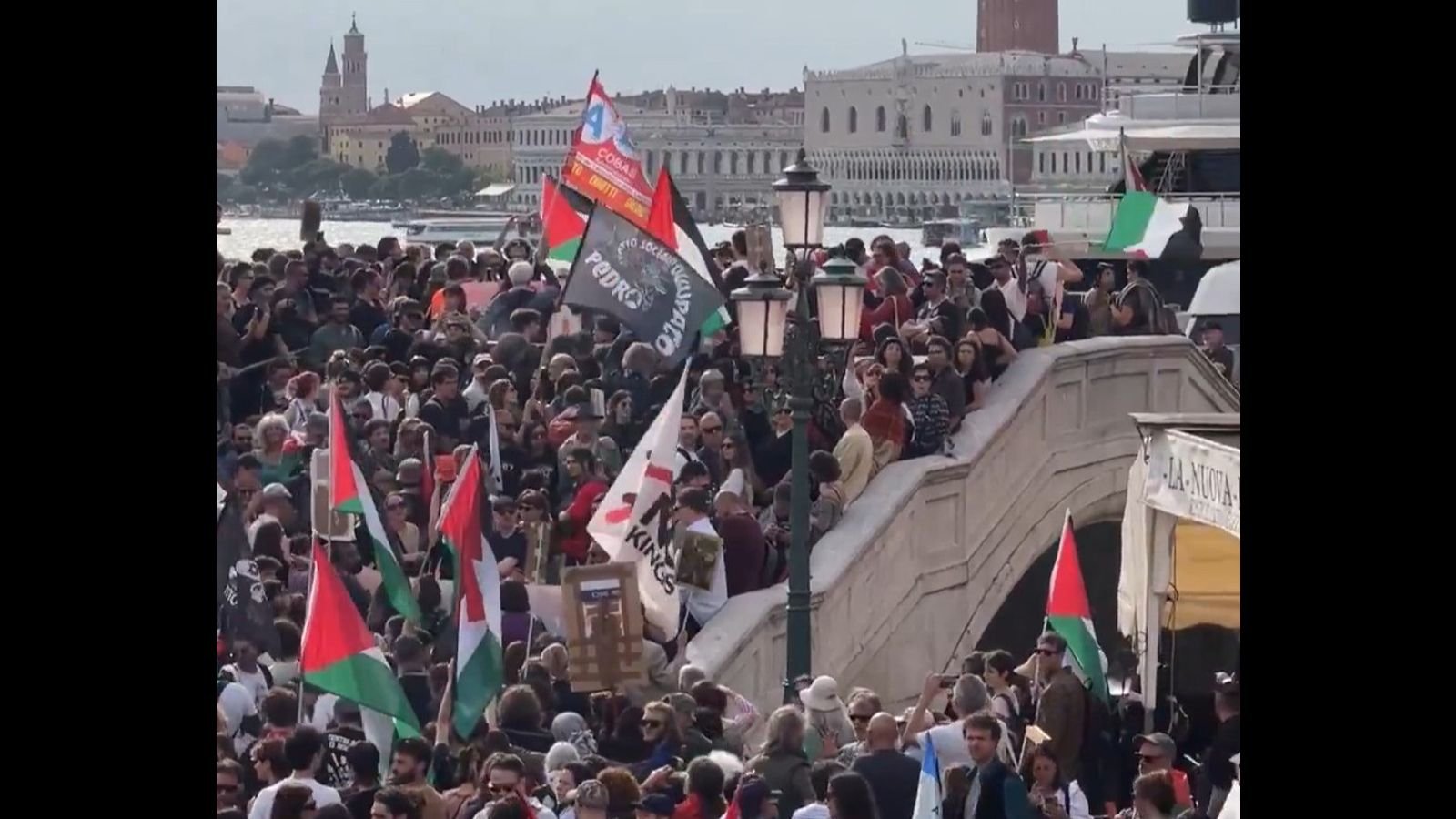
One day before the opening of the 61st Venice Biennale, the massive global art exhibition, thousands of marchers took to the city’s narrow streets to protest Israeli genocide in Gaza and now Lebanon. Marchers included many of the festival’s artists and workers who took strike action and closed for a day an estimated twenty-seven of the Biennale’s 100 national pavilions. Signs on a number of the pavilions read “We Stand with Palestine.”

The strikers and demonstrators were responding to a call from the Art Not Genocide Alliance (ANGA), supported by a number of other activist groups. ANGA announced that the action was the largest of its kind in the history of the Biennale, which runs from May 9 to November 22.
In a press release ANGA declared
Israel has killed over 73,000 people in Gaza, with a further 10,000 missing. It has systematically destroyed hospitals, schools, refugee camps, cultural institutions, and civilian infrastructure. Its leadership faces ICC arrest warrants for war crimes and crimes against humanity. The Biennale knows this and it chooses to accommodate Israel anyway.
In response to the mass opposition, the Israeli pavilion at the Biennale remained closed and guarded by armed police who at one point clashed with protesters. The main exhibition at the Biennale, “In Minor Keys,” in the Arsenale remained open in the morning, but some artists exhibiting had attached Palestinian flags or pro-Palestine signs to their works.
In pamphlets distributed in the course of last week ANGA had called for a boycott of Israel’s “genocide pavilion” and encouraged “no parties, no press, no art-washing.” The group also distributed a “guide to complicity and protest,” identifying supporters of violence against Palestinians participating in the huge art fair, first and foremost the United States, Israel’s principal military backer and largest arms supplier. Calls have also been made in the course of the week for the closure of the US pavilion due to its support for Israel.
In line with the increasing aggressive incursions of the Trump administration into cultural life, the State Department had demanded that proposals for the US pavilion should “reflect and promote American values…without supporting DEI initiatives” – i.e., diversity, equity and inclusion. In the event, the US pavilion features around 30 sculptures, that, according to the State Department, function “as a symbol of collective optimism and self-realization, furthering the Trump Administration’s focus on showcasing American excellence.” God forbid!
While angry resistance to Israeli participation has come from grass-roots organisations such as ANGA, leading European institutions have exerted strong pressure on the Biennale through a combination of political condemnation, funding threats and diplomatic pressure in an attempt to block Russia’s participation at the art festival.
The European Commission publicly condemned the Biennale Foundation’s decision to reopen the Russian pavilion after that country had effectively been absent from the Biennale since 2022. Commissioners Henna Virkkunen and Glenn Micallef warned that allowing Russia to participate was “not compatible with the EU’s collective response” to the invasion of Ukraine.
The Commission warnings were not merely verbal. It went on to threaten to suspend or terminate roughly €2 million [US$2.4 million] in European Union (EU) grants allocated to the Biennale Foundation. It also opened a formal procedure questioning whether Russia’s participation violated EU sanctions.
There was also considerable parliamentary and diplomatic pressure. A group of members of the European Parliament wrote to Ursula von der Leyen (President of the European Commission) and Kaja Kallas (High Representative for Foreign Affairs and Vice-President of the Commission) demanding “urgent and decisive steps” to prevent Russia’s participation. According to reports, Ukraine and representatives from 22 European countries also protested the reopening of the Russian pavilion this year.
Pressure also emerged indirectly through political boycotts. Italy’s far-right culture minister Alessandro Giuli refused to attend the Biennale opening because of Russia’s presence. The UK government abstained from official participation events linked to the Biennale and the opening of the Polish pavilion was attended by a number of East European cultural ministers who defended Ukraine’s NATO proxy war and denounced Russia. The Latvian minister wore a white T-shirt with the Thomas Mann title “Death in Venice” in English, underneath an image of the Doge’s Palace in blood red next to a Kremlin tower.
All of this reeks of intense and obscene hypocrisy. Russia’s invasion of Ukraine was a reactionary action taken by the Putin regime, but it was a war deliberately and transparently provoked by NATO to weaken Russia and create conditions for its eventual carve-up. As for “democracy,” Zelensky rules in Ukraine as a dictator, who has banned political opposition and locked up opponents. All the NATO powers that instigated the war against Russia and now piously denounce its presence in Venice have enthusiastically supported the mass slaughter in Gaza, the West Bank and now Lebanon.
Venice as a hub of culture has repeatedly been at the centre of protests against the Israeli genocide and the escapades of the super-rich. In 2024, more than 22,000 artists signed a petition calling for the exclusion of Israel from the Venice Biennale, arguing that “platforming art representing a state engaged in ongoing atrocities against Palestinians in Gaza is unacceptable. No Genocide Pavilion at the Venice Biennale.”
One year later, in the summer of 2025, mass protests were held in the city to oppose the cynical use of Venice as a scenic backdrop for the wedding of Amazon founder Jeff Bezos in a repulsive event costing millions and attended by a selection of the world’s ultra-rich.
And, finally, later last year, in what has been described as “possibly the largest protest ever seen at a major film event,” thousands took part in a demonstration defending the rights of Palestinians at the 82nd Venice International Film Festival. The organisers of the demonstration had previously issued a statement declaring:
The Venice Film Festival must not remain an event isolated from reality, but rather become a space to denounce the genocide being carried out by Israel, the complicity of Western governments, and to offer concrete support to the Palestinian people.
The latest demonstrations and protests in Venice confirm that a significant layer of artists and cultural workers are determined to oppose the genocidal policy of Israel supported by Western governments, including the far-right Italian government led by Giorgia Meloni.
[ad_2]
Source link