
[ad_1]
✕

Just weeks after London’s National Gallery revealed Kengo Kuma and Associates (KKAA) as architect of its major new wing, it has also been announced that the Tokyo-based firm has landed its first stateside museum project. KKAA, joined by landscape architecture firm Field Operations, will lead a major transformation and expansion of the Brandywine Conservancy & Museum of Art’s bucolic campus in Chadds Ford, Pennsylvania, about an hour southwest of Philadelphia. Established in 1971 as the Brandywine River Museum, the institution serves as a showcase for the work of artist and illustrator N.C. Wyeth, his son, the famed realist painter Andrew Wyeth, and other members of the artistically inclined Wyeth family. The museum is also known for displaying the work of regional artists, with a focus on landscape art of the 19th and 20th centuries.

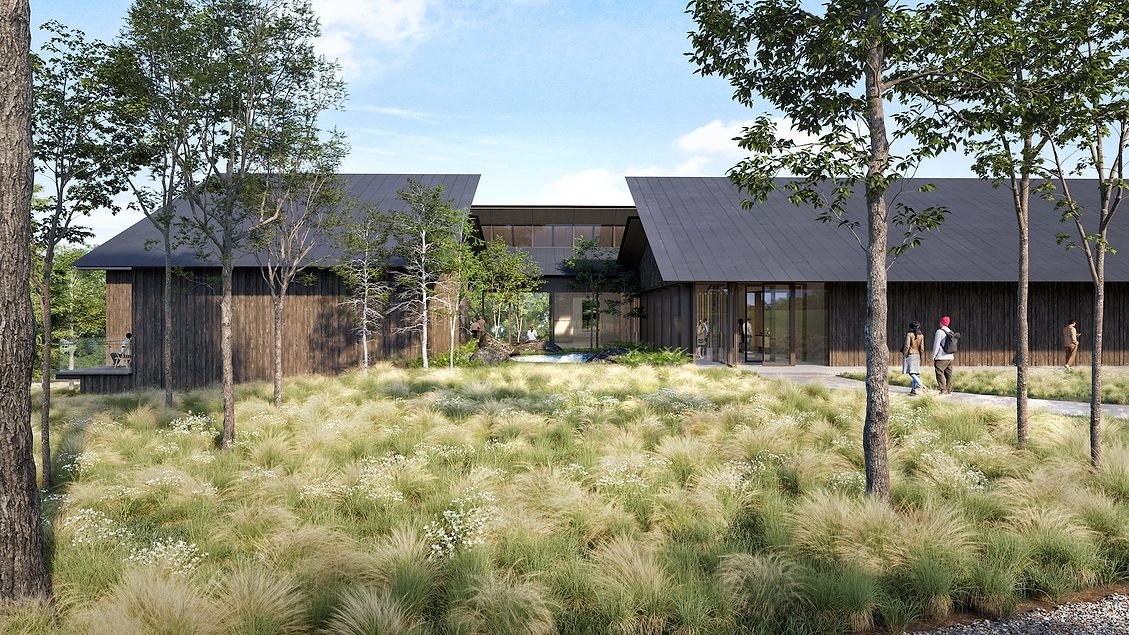
Rendering of north court. Image courtesy of Kengo Kuma & Associates and Field Operations

Rendering of main entrance hall. Image courtesy of Kengo Kuma & Associates and Field Operations
The $100 million project entails the construction of a 40,000-square-foot museum building that will add 14,000 square feet of additional gallery space—an 80-percent bump in the Brandywine Art Museum’s current exhibition capacity. Designed in association with Boston-based Schwartz/Silver Architects, the building takes form as a quartet of low-slung and wood-clad pavilions oriented around a central axis. It will house a total of five new dedicated exhibition spaces: two 4,000-square-foot galleries on either side of the main axis, a smaller gallery near the lobby for displaying the work of Andrew Wyeth, and two lower-level galleries adjacent to a coffee shop and terrace with expansive views of the museum’s surrounding nature preserve. The building will also accommodate offices and back-of-house operations.
The museum will also carry out an extensive refresh of its original gallery building, a converted 1864 grist mill along the Brandywine Creek. The historic structure has recently undergone significant repairs and upgrades, with most of the work focused on safeguarding against future flooding (it was severely damaged by flooding, wrought by Hurricane Ida, in 2021) and enhancing accessibility. In conjunction with the construction of KKAA’s new building, the erstwhile mill will be renovated to include a new studio art classroom, improved spaces for education and special events, and an interactive exhibit promoting the conservancy’s notable land-protection efforts that span more than 70,000 acres through Pennsylvania and Delaware. The Mill Building’s three existing galleries, totaling 5,500 square feet, along with its research and study centers, and creek-side café will be retained as part of the revamp.

Rendering of cypress grove landscape. Image courtesy of Kengo Kuma & Associates and Field Operations

West elevation view. Image courtesy of Kengo Kuma & Associates and Field Operations
“Our design seeks to honor the dynamic and evolving relationship between art and nature by creating a building that emerges from the landscape rather than imposing upon it,” says KKAA founding partner Kengo Kuma.
Previous large renovation and expansion projects on the campus have been helmed by Baltimore-based GWWO Architects.
While the new building alone will significantly transform the museum, perhaps the most striking element of the new scheme is how much it will grow. With the addition of a new public nature preserve and garden, the 15-acre campus will balloon to 325 acres. Field Operations’ design for the expanded landscape will include 10 miles of trails—including elevated boardwalk sections through protected wetlands—that connect the new and old museum buildings to nature. The trail system will also provide visitor access to what the nonprofit calls its “most important assets:” the original, National Historic Landmark–designated studios of N.C. and Andrew Wyeth.

Campus expansion site plan. Image courtesy of Kengo Kuma & Associates and Field Operations
The significant enlargement of the campus, which will also entail numerous landscape enhancements directly around the Mill Building, will “allow visitors to experience more fully the land and the critical work of the Conservancy in new ways,” a press statement reads.
Construction is slated to kick off in spring 2027, with the new structure set to open in fall 2029.
[ad_2]
Source link