
[ad_1]
There is a beautiful moment in Sriwhana Spong’s 32-minute video The Painter-Tailor (2019) about her grandfather, the Balinese painter I Gusti Made Rundu. She discusses his work with her father, the dialogue playing over the top of footage shot at the family home in Bali.
She asks, “Do you know why your father painted animals a lot?” He answers that it’s probably because her grandfather liked animals. We see Spong’s father and brother holding a white sheet up against a wall, a reference to the Dutch colonial method of photographing specimens. A golden retriever stands in front of the sheet. “He likes dogs,” Spong’s father continues, as two more dogs come into view. “He has three dogs.”
Spong points out that her father also has three dogs, but he doesn’t pay much attention to this symmetry. “He likes dogs and cats,” he says, as a ginger cat enters. He then punctuates the moment with accidental comedic gold: “He liked beers too.”
The dogs feature heavily in The Painter-Tailor: several scenes are filmed by the family’s golden retriever, Alaska. Equipped with a camera attached to his collar, he creates a home movie, albeit at knee height, complete with audible panting and drooling. The Painter-Tailor, now on display at Monash University Museum of Art (MUMA) in Spong’s solo exhibition Ha Ha Ha, is elegantly presented in its own gallery on a large projection screen, where plastic Monobloc chairs replace the standard Eames-adjacent gallery seating.
Spong, born to a New Zealand mother and Balinese father – whom she didn’t meet until her late teenage years – and now living in London, studying in the Netherlands in between, could crudely be defined as “cosmopolitan”. If this framing gives you the ick, it’s safe to say it would give Spong the ick too.
Trauma porn and the centring of self in opposition to settler colonialism are the cornerstones of rote identity art – cornerstones that Spong refuses. As Vera Mey says in a catalogue essay: “Her practice does not easily conform to ideas of origin or rootedness in land or specific communities.” Spong says herself that even though she is ethnically Balinese, coming to the culture later in life means she also navigates it as an outsider.
Abstraction is a central key to this navigation. Take the silk curtains suspended in three of the galleries. Each has been dyed with a consumable product produced by a multinational company. Purple Raincoat (for Vasiliki) (2016), for example, is dyed with grape-flavoured Fanta and Coca-Cola, but it looks as if it might have been lovingly dyed with natural pigments. There is a slippery relationship between the destructive logic of Western capitalism and the integration of this system into daily Balinese life.
Elsewhere, a set of chimes is cast from French fries, referring to how often Western junk food is used as ritual offerings across Bali. The chimes sit among a group of instruments inspired by the Balinese gamelan that were played by collaborators at the vernissage, a nod to Spong’s background as a dancer.
For the bulk of the exhibition, the instruments will not be played. As static objects, some are more successful than others. Viewing them against a set of 1926 gamelan from the university’s ever-surprising collection is valuable. Made by political activist Bapak Pontjopangrawit and fellow inmates at a prison camp in the former Dutch East Indies, where they were imprisoned for activism against occupation, the instruments are remarkable reminders of how recent Dutch colonialism was. In Spong’s neither/nor approach, she represents abstraction as a double-edged sword. It is a means by which she creates opacity that defies the colonial desire to categorise based upon race or nationhood, but it’s also a methodology used by colonisers. The Painter-Tailor includes shots of Spong’s father and brother holding a white sheet against plants in the family garden, in the style of Dutch colonisers photographing specimens.
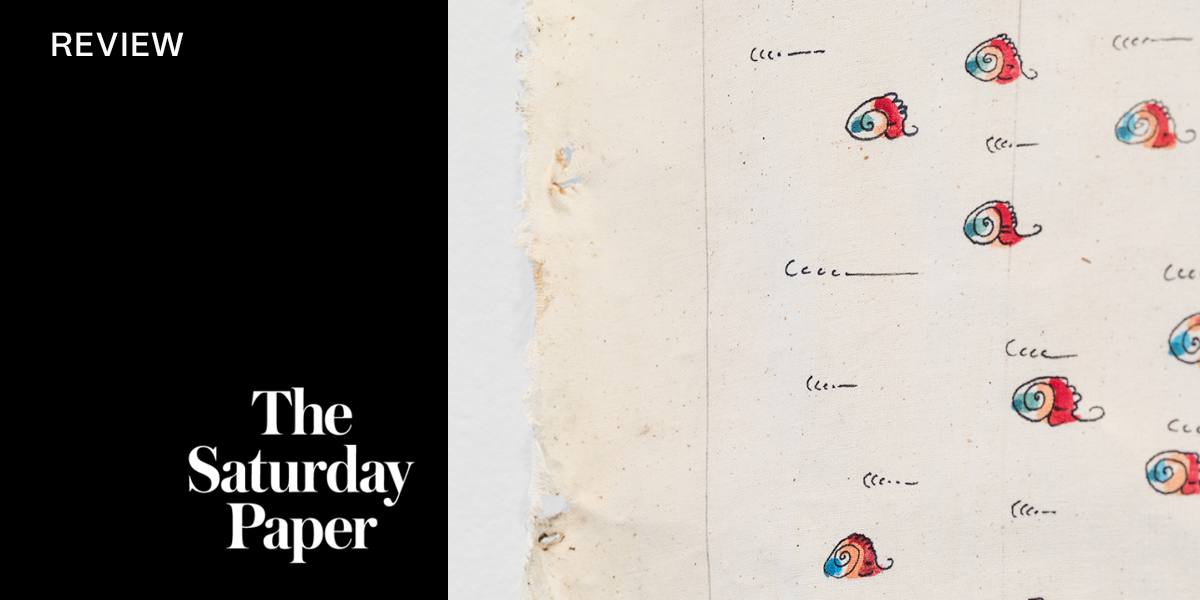
The abstract motif of the aun-aun, used in traditional Balinese painting, is the starting point for Ha Ha Ha. This motif is used as a space-filler between figures and, according to a Balinese friend, is traditionally painted by women. At the start of the exhibition, one encounters Untitled (aun-aun) (2025). This work, a study of a motif taught to her by Murki, shows the image repeated over and over, perhaps 50 times. The mood is of a frenzied need to get the thing right, as if it would unlock the secret to Spong’s heritage.
Ha Ha Ha goes off in many tangents. The most significant is Spong’s shift from the aun-aun to the video AD (2026), which is set around the Hound Tor rocks in Devon. Featuring a mystical heroine, the video reimagines Lord Byron’s “Don Juan” using an AI-generated script. There is a lot going on here: the references to England, romanticism and artificial intelligence will almost certainly confuse viewers at first.
Mist, which abounds in the rugged Devon landscape, ties the video back to the aun-aun. Spong tells me that to draw the aun-aun, one starts at the centre and works outwards, and it was through this process that she started thinking of the motif as mist-like. Spong’s grandfather put his own flourish on the aun-aun, turning them into fireflies.
The tangents continue in the form of horses. Horses in AD give way to a gallery of charcoal drawings of horse parts, Horse Bit 1-11 (2026), likely catalysed by one of her grandfather’s paintings held by the Museum Puri Lukisan in Ubud, Fighting Horses.
Spong’s refusal to be boxed in means that parts of Ha Ha Ha call for patient deciphering. But then I return to The Painter-Tailor, the video billed as the first work in the show. To me it is the ideal conclusion, containing all the abstract touchstones that Spong presents through the exhibition: the horses, the aun-aun, the colonial abstraction of nature. Even in the first scene, a purple and white curtain hangs in the window, not dissimilar to the silk ones displayed in Ha Ha Ha.
One of the show’s most captivating works, Something-somethings (Scrying mirror) 1–18 (2026), contains pull tab lids from tin cans. Like Spong’s grandfather’s aun-aun, they represent fireflies. Spong says she laboured for months polishing the lids to get the right effect. After all that work, she realised they were perfect untouched, and here they are displayed straight off the can. We come full circle.
Sriwhana Spong: Ha Ha Ha is showing at MUMA, Melbourne, until June 27.
This article was first published in the print edition of The Saturday Paper on
May 9, 2026 as “Animal practice”.
For almost a decade, The Saturday Paper has published Australia’s leading writers and thinkers.
We have pursued stories that are ignored elsewhere, covering them with sensitivity and depth.
We have done this on refugee policy, on government integrity, on robo-debt, on aged care,
on climate change, on the pandemic.
All our journalism is fiercely independent. It relies on the support of readers.
By subscribing to The Saturday Paper, you are ensuring that we can continue to produce essential,
issue-defining coverage, to dig out stories that take time, to doggedly hold to account
politicians and the political class.
There are very few titles that have the freedom and the space to produce journalism like this.
In a country with a concentration of media ownership unlike anything else in the world,
it is vitally important. Your subscription helps make it possible.
Send this article to a friend for free.
Share this subscriber exclusive article with a friend or family member using share credits.

[ad_2]
Source link